 Kevin
Check out the full comic version of this story on my patreon
Carla was telling a joke.
That was the first thing Sara noticed as she stopped on the pavement outside Carla’s Cuts, one hand pressed flat against the cold glass of the window. Inside, warm light fell across the polished shelving, the neat rows of Revolution products, the gleaming mirrors that doubled everything beautiful twice. Carla stood at her station in a fitted black apron, long auburn hair catching the light like something out of a shampoo commercial, scissors flashing in her hand as she laughed at her own punchline. Her client — wrapped in a black cape and grinning — was laughing too. The whole room was laughing.
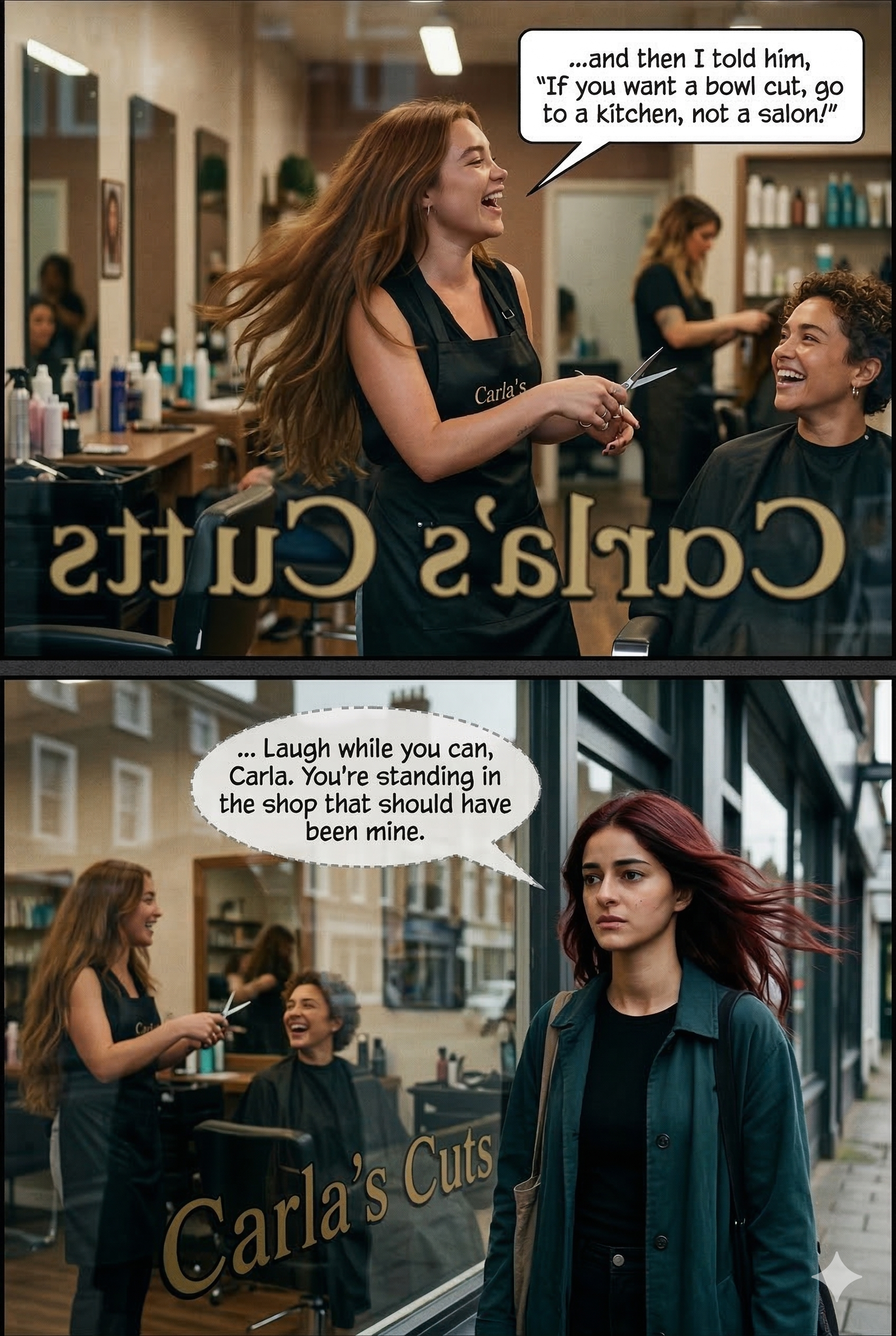
Laugh while you can, Carla, Sara thought, her breath fogging the glass. You’re standing in the shop that should have been mine.
Sara turned away from the window and walked. She didn’t need to look any longer. She had the address memorized. She had the phone number memorized. She had spent the last six months memorizing every detail of Carla’s operation — every five-star review, every feature in a local lifestyle blog, every Instagram reel of a perfect blowout. She had watched it all from the street, from her phone screen, from the front door of her own shuttered salon, Sara’s Snippets, where a foreclosure notice had been taped over her name like a label slapped on something nobody wanted.
One bad health inspection. That was all it had taken. The citation had been minor — a sink drainage issue, a label on a disinfectant bottle, nothing that couldn’t be fixed in forty-eight hours — but the timing had been catastrophic. The local paper had picked it up. Carla’s regulars, who had once split their appointments loyally between the two salons, had quietly drifted. And once they drifted, they didn’t come back. Not when Carla was right there, always right there, with her perfect hair and her waiting list and her ability to make every woman who sat in her chair feel like the most important person on the street.
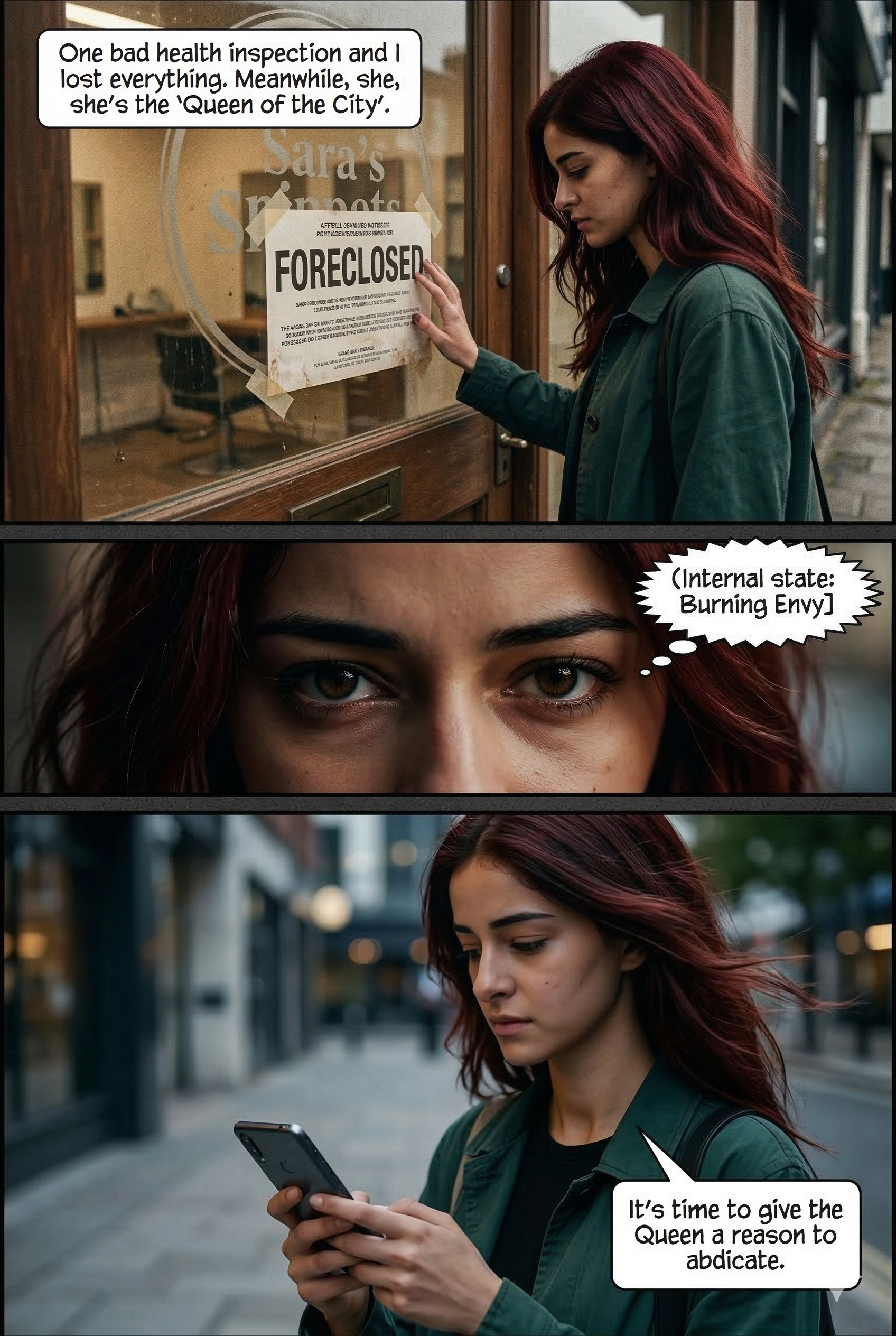
Sara had lost the lease three months later.
She pulled out her phone and dialled. The ring tone trilled twice before someone on reception answered, bright and efficient.
“Carla’s Cuts! Oh, hello! A colour refresh? I have a two o’clock tomorrow. I’d love to work on that red hair of yours!”
Sara looked at her reflection in a darkened shop window. Her hair — deep red, nearly burgundy, long and thick past her shoulders — fell forward as she tilted her head. She smiled at herself. It was not a warm smile.
“I’m sure you would,” she said quietly. “You’ll find it unforgettable. See you at two.”
That night, in her flat, Sara sat at her vanity and brushed.
This was the only moment of her day when she felt fully herself — not the disgraced salon owner, not the woman who checked her bank balance and looked away, not the person who had once had twelve regular clients and now had none. Just herself, and her hair, and the slow ritual of it: thirty-one, thirty-two, thirty-three strokes of the paddle brush, working from root to tip, listening to the whisper of it. Her hair was immaculate. She kept it immaculate. Smooth, healthy, controlled — a private proof of competence that no health inspector could take away.
She set the brush down and looked at herself for a long moment.
It’s just hair, she thought. And it’s time to give the Queen a reason to abdicate.
The next day, Carla met her at the door.
She was, objectively, magnetic — the kind of woman whose presence reorganises a room. She smiled at Sara’s hair the way a surgeon smiles at an interesting case: with professional hunger, with the pleasant certainty that she already knew exactly what she would do with it.
“Come on back,” Carla said, leading her to the station nearest the window. “I’ve been thinking about you since you called. That red — it’s gorgeous, but I think we could do something really special with a colour refresh. Brighten it up. Maybe take it somewhere warmer.”

Sara sat in the chair and looked at herself in the mirror. Behind her, the salon hummed. Carla’s hands moved efficiently, sectioning Sara’s hair with practiced ease, running her fingers through it from root to tip, assessing weight and texture and condition the way a craftsperson handles good material. The hair was heavy and dense, the sort that took time to work through properly. Carla reached for a spray bottle and misted it lightly, smoothing each section flat against her palm.
“You have exceptional hair,” Carla said, and she meant it. There was real admiration in her voice. “Whoever your last stylist was knew what they were doing.”
“She did,” Sara agreed pleasantly.
She had been her own last stylist.
Carla mixed a colour formula at the station — a warm reddish-copper, designed to enhance rather than overwrite, layered with a shine treatment that would have the hair glowing under the salon lighting. She sectioned it into quadrants with clips, then began painting from the underneath layers first, the way you always should, letting the timing stagger so that every section would process evenly.
Sara sat very still, watching.
Carla worked with genuine skill. There was no denying that. Her brush strokes were clean, her saturation even, her timing instinctive. She hummed softly as she painted, the kind of unconscious sound that meant she was in her element. Around them, the other stations carried on — the blow-dryer noise, the small talk, the laughter. A world operating smoothly under Carla’s ownership.
The colour was left to develop. A timer was set. Sara sat beneath the processing cap and smiled at her own reflection.
She had switched the developer.
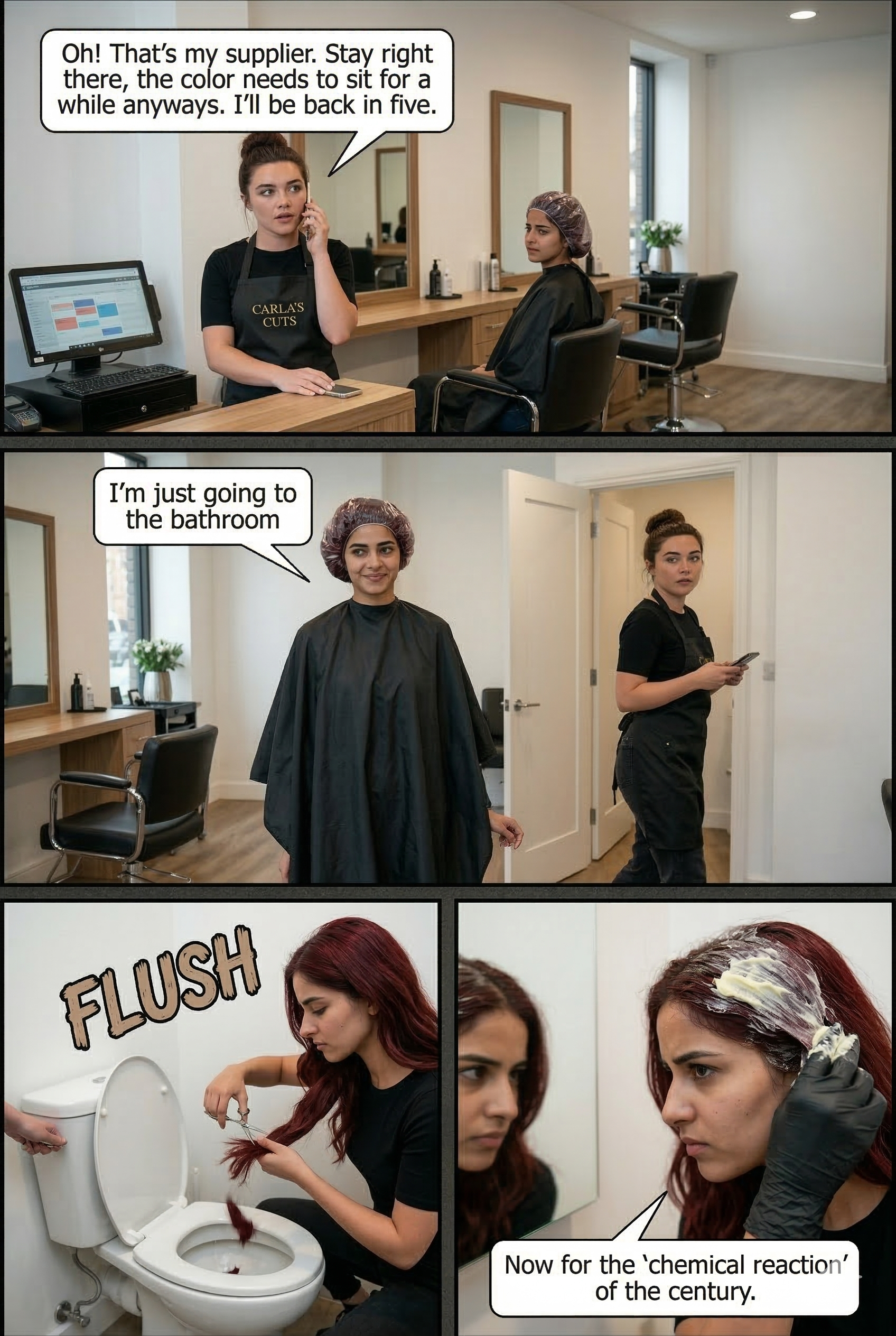
Not the formula. The developer — the oxidising agent that activates colour, that determines how deep the chemistry goes. The standard for a refresh would be 20-volume, gentle, reliable, the kind Carla used on every client, the kind she kept in clearly labelled bottles on the trolley. Sara had arrived twenty minutes early, told the receptionist she wanted to wait at the station, and in ninety seconds had swapped the 20-volume bottle for the 40-volume bottle she had carried in the inner pocket of her bag. Super strength. The kind reserved for severe lightening jobs on coarse hair. The kind that, applied to already-processed hair with no protective treatment, would strip the cuticle, swell the shaft, and when rinsed — would cause chaos.
Carla didn’t know.
When the timer went off and Carla walked Sara to the backwash basin, she was still humming.
The water was warm. Sara closed her eyes as it ran over her hair, feeling the familiar weight of it wet, the way it spread and darkened and clung. Carla’s hands worked through it efficiently, rinsing the colour from the underlayers first.
Then she stopped.
“Wait… what? No. No, no, no! Sara, something is happening!”
Sara opened one eye. In the mirror on the wall beside the basin, she could see a section of her own hair — or what had been her hair. The red had lifted chaotically, the 40-volume developer having stripped through the pigment and kept going, pulling everything into a violent orange-brass, the shaft visibly swollen where the cuticle had been blown open. The hair didn’t look like hair anymore. It looked like something had burned through it from the inside.
“I don’t understand,” Carla said, pulling Sara upright and staring at the wet sections laid across her palm. “My formulas are perfect. What went wrong?”
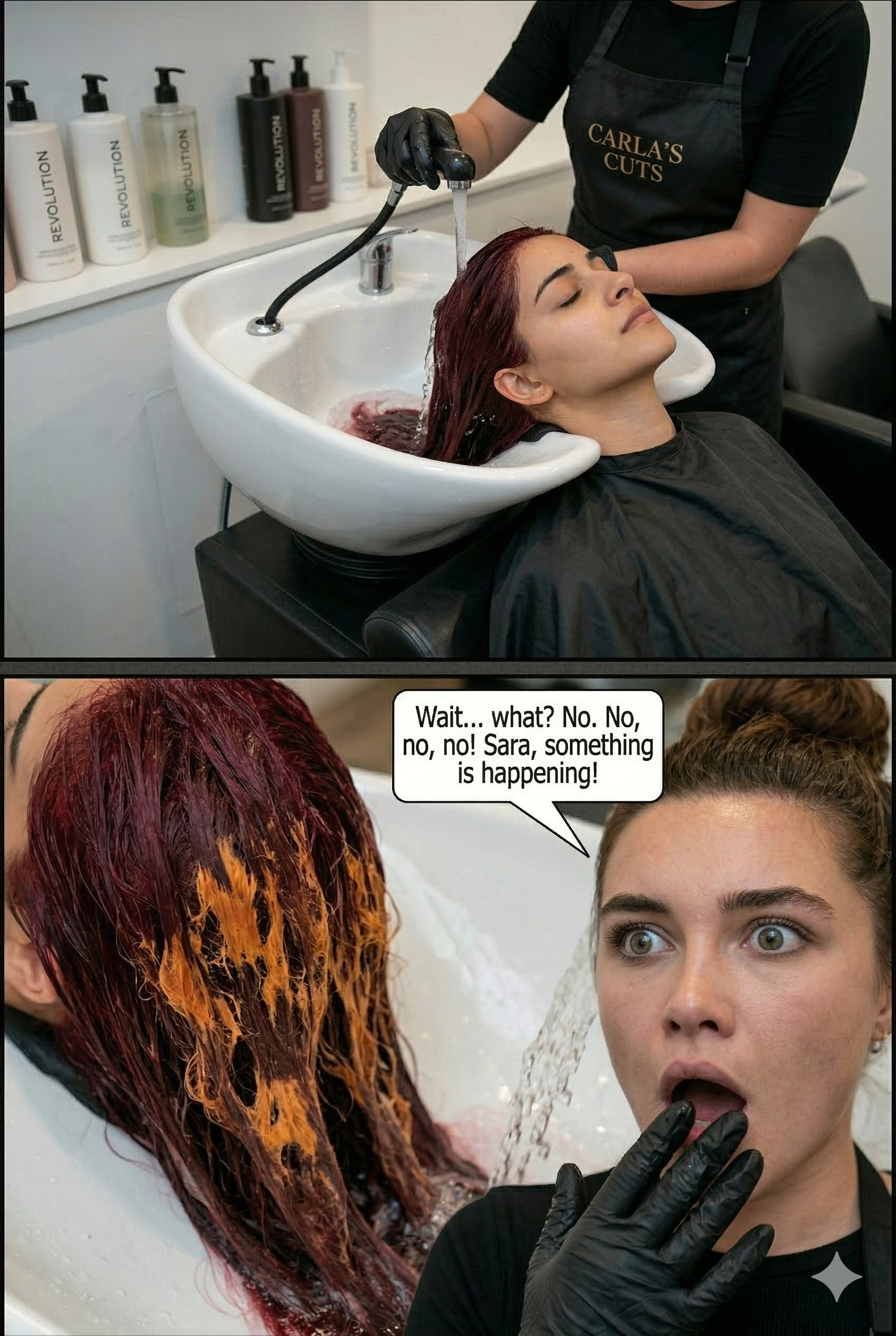
Her hands were shaking slightly. She separated section after section, and in one place the hair had already begun to snap — not long breaks, not split ends, but short, clean fractures, the kind that happen when the structural bonds inside the shaft have been fully compromised. A whole section on the left side was noticeably shorter than the rest, where breakage had taken nearly two inches without warning.

Carla’s voice was barely above a whisper. “Oh god. Sara. A whole section just fell out. It’s gone. It’s much shorter than the rest.”
She stared at it. At Sara. At it again.
“I’m going to fix this,” she said, and her jaw was set with the particular determination of someone who has never, in a career of perfect results, had to say those words. “I’m going to give you a textured, high-fashion pixie. It’s a very popular look in Paris right now. We can make this work, Sara.”

She reached for the scissors.
The cut was, even in distress, technically accomplished. Carla’s hands didn’t fumble — they were steadier now that there was a task, a solution, a shape to work toward. She sectioned what remained of Sara’s hair and began to cut from the nape upward, taking the damaged length off in clean passes, each snip releasing a few inches of compromised hair onto the black cape. Snip. Snip. The sound was very quiet against the ambient noise of the salon. When she blow-dried it, the remaining hair — bright blonde now, stripped of everything warm — stood in short, feathery tufts around Sara’s face. The profile in the mirror was angular. Striking, even.
“It actually looks cute on you,” Carla said, with something desperate around the edges of her smile. “High fashion. Maybe even better than before.”
Sara looked at herself in the mirror for a long time.
Then she stood up, unclipped the cape, and let it fall.
She reached into her bag, removed an envelope, and slid a document across the counter.
“Don’t bother with the compliments, Carla. My career is over. And now, yours is too. We’re done here.”
She walked out.
The lawsuit was filed under Sara v. Carla’s Cuts, LLC: gross negligence, intentional infliction of emotional distress, fraud.
What Sara had not anticipated was that it would work.
Carla, panicked and without a lawyer in the first hearing, had signed what Sara’s attorney had framed as a standard incident acknowledgement form. It was not. It was an admission of professional negligence. The judge — a grey-haired woman with the patience of someone who had heard every version of every story — looked at the document and then at Carla and said, very calmly, “Ms. Carla, you signed this admission of professional negligence. The evidence is irrefutable.”
The award was $100,000. Pay it, or the business assets would be seized immediately.
Carla sat in the courtroom afterward with her head in her hand. “That’s every penny I have,” she said to no one. “My salon. It’s over.”
Sara leaned across the aisle.
“I don’t want to see you in the poorhouse, Carla. I’m a forgiving person.”
Carla looked up.
“Let’s call it a compromise,” Sara said. “Give me half the cash, and sign a contract to be my hair model for my new vlog. I get total creative control.”
Outside the courthouse, standing at the low stone wall with the contract spread flat between them, Carla stared at the line waiting for her signature. She thought about a bob. Clean, chin-length, manageable. She thought about bangs — she had always secretly wanted bangs. She thought about her long, beautiful hair — still perfect, still immaculate, still the thing she touched every morning to remind herself that she was composed and controlled and in command of something.
It’s just hair, she told herself. It grows back. I have to save the business.
She signed.
Sara brought cameras.
Three of them. Ring lights on tripods. A crew of two who adjusted lenses and checked levels while Sara moved through Carla’s salon like she owned it — because, contractually, for the afternoon, she did.
Carla sat in the chair in the centre of the room, her long hair loose down her back, her hands folded in her lap. She had never been on the other side of this chair before. It felt entirely wrong.
“Sara, let’s just keep it professional,” she said. “A nice layered cut, maybe?”
Sara turned to face her, scissors raised, grinning into the nearest camera lens. “Professional? Oh honey, we passed professional back at the courthouse.”
She went live.
“Hey everyone! We’re live at Carla’s Cuts with the owner herself! She’s agreed to let me do whatever I want to her hair. Are you guys ready for a transformation?!”
She lifted the full mass of Carla’s hair in both hands, holding it up to the camera. It was extraordinary hair — thick, warm brown, waist-length, the product of years of obsessive maintenance, the nightly ritual with the paddle brush, the careful trims, the conditioning masks. The chat exploded.
“Look at all this hair,” Sara said into the lens. “It’s almost a shame. Almost.”
She made the first cut without sectioning.
“Sara, wait — we didn’t even section it! You’re just going in?”
CRUNCH. CRUNCH.
The sound of large scissors through undivided, unguided, unsectioned hair is not the delicate snip of a stylist’s shears. It is something more industrial — a tearing pressure, a resistance, a sound that makes the scalp prickle in sympathetic horror. Carla felt the weight shift immediately: the pull at her roots vanished, the familiar heaviness at her back disappeared, and what landed on the cape was a thick, dense rope of brown hair, twelve inches long at minimum, pooling in the black fabric like something shed.
A bob. She had a bob. Chin-length, blunt, slightly uneven at the back where Sara hadn’t bothered to guide the cut. Carla’s eyes were very wide.
“Say goodbye to the ‘Queen’s Crown,’ everyone! You’re officially a Bob-Girl now, Carla!”
The chat cheered. Four hundred viewers. Then eight hundred. Climbing.
Sara was already reaching for the bottle.
“Now that we’ve lost the dead weight,” she said brightly, holding a large silver container up to the camera with theatrical relish, “let’s brighten up that boring brown! I’m using my special mix today — extra strength.”
40-volume developer. Carla recognised it immediately.
“That smell — it’s overpowering. Is that 40-volume? Sara, you’re going to burn my scalp!”
“Beauty is pain, honey. Don’t be a baby.”
Sara worked the bleach through the bob with a brush, section by section, the pungent ammonia smell spreading through the salon. Carla sat rigid, the cape growing damp at the neckline, feeling the tingle shift to a sting and then to something that pulsed. The 40-volume ate through in record time. Too fast. That was the problem with too-strong developer on pre-processed hair — it moved before you were ready for it, before you could manage it, and it didn’t stop at blonde. It went further. It went past golden, past honey, past the pale platinum that was the goal, and landed somewhere harsh and orange and uneven.
At the backwash, Sara rinsed cheerfully. The camera watched. The chat watched.
Carla sat up and saw herself in the mirror.
Bleached orange-brass, chin-length, slightly asymmetric. Her hands moved to her head involuntarily.
“It… it feels like plastic,” she whispered. “It’s breaking off in my hands just by touching it.”
“Well, if it’s breaking, we might as well help it along!” Sara picked up the scissors again. “Snip, snip, Carla! It’s raining pink straw!”
She cut without measurement, without guide, trimming away the breaking sections wherever they snapped or fractured, which was everywhere. The blonde bob became shorter, became ragged, became something desperate and uneven at every angle. Then Sara reached for a bowl of neon pink semi-permanent dye — the kind used for fashion colours, bright and unsubtle — and began painting it through what was left.
“Let’s add some colour! Pink for the lady who’s tickled pink to lose her business!”
Carla didn’t say anything.
The pink went on cold and thick, the way hair dye always does on a raw scalp, and her scalp was very raw. She made a sound. She asked Sara to stop. Sara rinsed it out.
In the mirror, Carla had pink hair. Short, straw-textured, patchy pink hair. Her face was very still.
“Stop,” she said, quietly. “Please. Everyone has seen it. Just let me go.”
Sara looked at the chat. The number had crossed four thousand.
“It’s breaking anyway,” she said, almost to herself. “So let’s just help it along.”
She reached for the clippers.
The sound they made — BZZZZZZZZZZ — cut through everything.
Carla’s hands pressed together on her lap. “Please, Sara. Not the clippers. Anything but the clippers.”
Sara positioned the clippers at Carla’s hairline without a guard, and began to move them.
There is a particular intimacy to the clippers at the scalp — the vibration that travels down through the skull, the strange coolness of air on newly-exposed skin, the way the world becomes very simple and very large all at once. Strip after strip of pink-bleached hair fell away onto the cape. The camera was very close. Four thousand people watched it happen. The pink hair came off in sections, each pass of the clippers leaving behind a pale strip of scalp, and Carla sat entirely still, her jaw set, her hands now gripping the armrests.
“Oh, look! You have a lovely skull, Carla! Very shapely!”
Sara moved methodically — temples, sides, back, crown — until the last of the pink was gone and what remained were the faintest traces of stubble, barely a ghost of hair, enough to show the scalp was smooth and the shape was clean.
She set the clippers down. She reached for the shaving foam.
“You still have about an eighth of an inch of hair left,” she said pleasantly, “and the contract said any style.”
PSSSSSH. The foam came out in a long white curl and she spread it across Carla’s skull with a gloved hand, working it into every contour, pressing it gently across the crown and down the nape. Then she picked up the straight razor. The silver blade caught the ring light.
“Don’t move, Carla. I’d hate for my hand to slip — like yours did at the salon.”
SHRRRRRP. The razor moved in a single long stroke from front to crown, and the foam came away clean and white and absolute. Again. Again. Each pass slow and deliberate. The camera watched every stroke. Sara was whistling something cheerful under her breath, the way you do when the work is satisfying and you are almost done. She finished the top, then the sides, then tipped Carla’s head forward and worked down the back of the neck, shaving everything to nothing, leaving the skin pale and smooth and entirely bare.
She placed the razor on the trolley.
She looked at Carla in the mirror.
Then she leaned down, put her cheek next to Carla’s, and held the camera close. Carla was crying, silently, tears tracking down her jaw. Sara was beaming.
“You’re my favourite project, Carla. That’s who.”
The next morning, Carla stood in her own salon — she still had a key, would have one until the judgment was paid — and looked at herself in the mirror for a very long time.
The ring lights had been packed away. The cameras were gone. The chat had moved on to the next thing. Sara’s vlog had crossed fifty thousand views overnight, and the comments were still coming in, but none of that was here.
Here there was just Carla, and a mirror, and a reflection she did not fully recognise.
She raised both hands slowly and pressed them to her scalp. Smooth. Completely smooth. The skin was cool and soft and a little tender, the way any skin feels when it has just been stripped of something it had always had. She turned her head slowly to the left. To the right. She could feel the air differently. She could feel the light differently.
Still so raw, she thought. But so smooth. Is this really me now?
She stayed there for a long time, hands at her temples, looking.
She did not have an answer. But standing there in her empty salon, in the silence before the world started up again, she noticed something strange and small and undeniable: the woman in the mirror looked back at her with absolutely nothing left to hide behind.
And she was still there.
