 Captain Razor
[Note:- this is a series i strongly recommend reading previous parts before
reading this part trust me its worth a read]
(I am so sorry for the disappointment in the previous part I was a bit busy
So i didnt had time to add images i apologise for that but to make up for
that i am preparing something grand , something worth remembering and coming
Back to read, i hope you guys who are my loyal readers arnt angry with me )
Chapter 1 — Longer
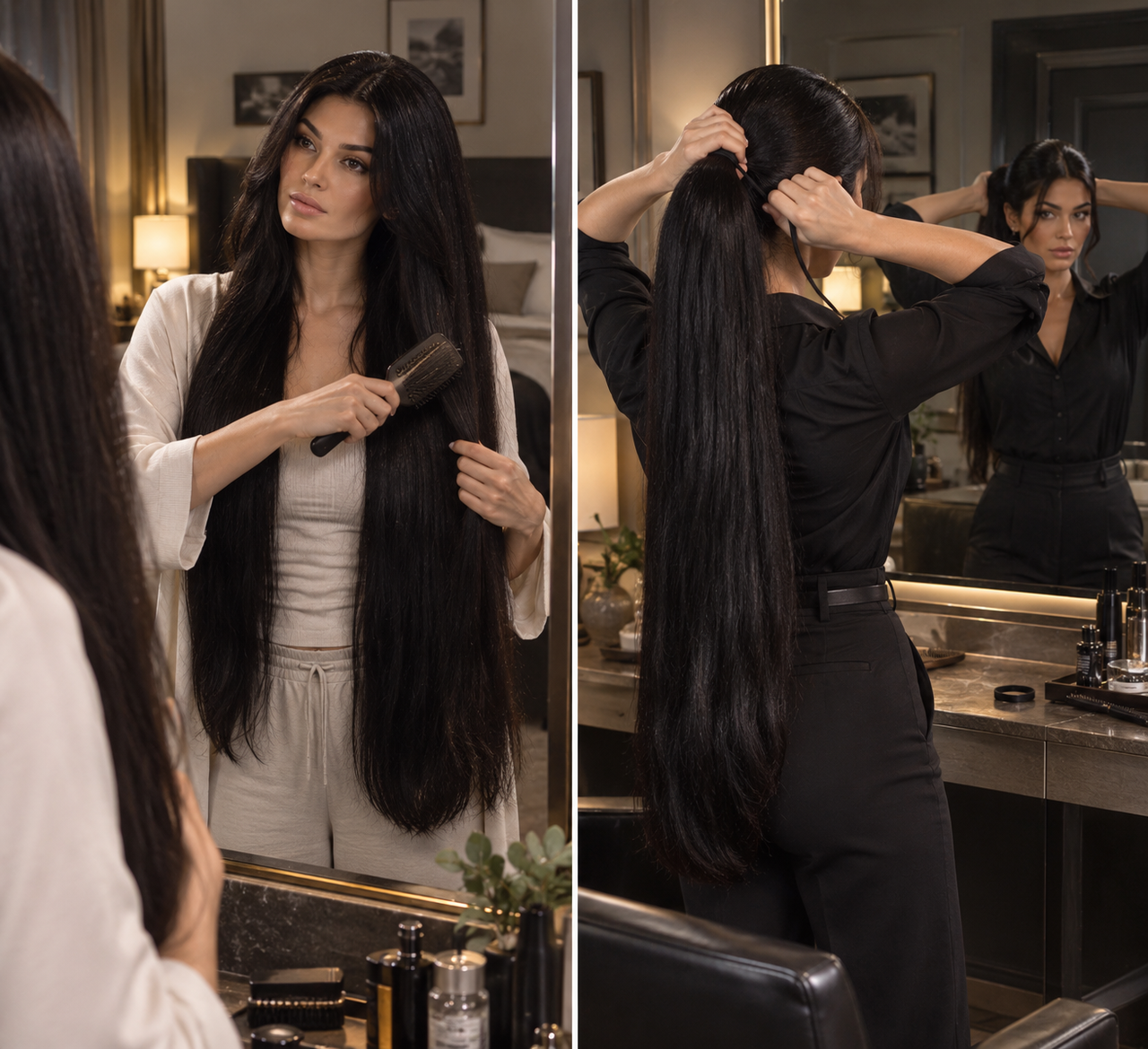
The alarm did not so much ring as interrupt the morning.
A soft succession of notes trembled across my bedside table, almost apologetic in the stillness of the room. I reached for it before the sound had a chance to become insistent and silenced it with the back of my hand.
For a moment, I didn’t move.
Morning had already begun beyond the curtains.
A thin wash of sunlight slipped through the gaps and spread itself across the room, turning the edges of the furniture pale gold. Dust drifted lazily through the beams of light. Outside, the world was beginning its ordinary work—distant traffic, a bird calling from somewhere beyond the building, the faint murmur of a city that had not yet fully awakened.
I liked mornings like this.
They felt unfinished.
Quiet enough that I could hear my own thoughts.
I finally sat up.
And then I felt my hair.
It had gathered beneath me during the night, warm from my body and slightly tangled from sleep. When I lifted it from the sheets, it slid over my shoulder in a heavy, glossy mass.
I ran my fingers through it.
The sensation still fascinated me.
Smooth.
Cool in some places.
Warm in others.
And extraordinarily substantial.
My hair had grown again.
I gathered more of it into both hands and let it fall slowly through my fingers. The black strands caught the morning light, reflecting it in narrow ribbons of silver and gold.
It had become almost absurdly long.
Just above the middle of my thighs.
I looked down at it and smiled.
I still hadn’t decided where I wanted it to stop.
Perhaps that was because every time I thought I had reached an impressive length, another few weeks passed and I found myself enjoying the new length even more.
I climbed out of bed carefully.
The hair followed me.
There was a strange intimacy in that simple movement—the awareness that such a large part of me now moved with every step.
I had learned to live around it.
To lift it when I sat.
To move it aside when I dressed.
To make sure it never caught beneath a chair or a door.
And, most importantly, to care for it properly.
I walked into the bathroom.
The morning routine began.
Washing hair this long was no longer something I could do absentmindedly.
It required time.
Patience.
Attention.
I worked through it methodically, making sure the shampoo reached the roots before rinsing it away. Conditioner followed, and I left it in for several minutes while I stood beneath the warm water.
I never rushed this part.
There was something calming about it.
By the time I finished, the bathroom smelled faintly of the products I used, and the wet length hung heavily down my back.
I wrapped it carefully in a soft towel and moved to the mirror.
Then came the drying.
Then the brushing.
I began at the ends, as always.
Slowly.
Patiently.
Working upward.
The brush moved through the damp lengths with a soft whisper.
I watched myself in the mirror.
The woman looking back at me seemed almost unchanged from the Raven I had been months ago.
But the hair was different.
Longer.
Heavier.
Thicker.
And somehow I loved it more precisely because it demanded more from me.
When I finally finished, I stood there for a moment, letting it settle naturally.
Then I gathered it behind my back.
I decided to put it into a ponytail.
The elastic disappeared around the gathered mass once.
Then again.
Then a third time.
I stopped and looked at it.
The ponytail was enormous.
I wrapped my fingers around it and couldn’t quite close my hand completely.
I laughed softly.
“That’s getting ridiculous.”
But I was smiling when I said it.
It wasn’t merely long.
It was thick.
The density had become almost as remarkable as the length itself.
I ran my hand down the ponytail and felt its weight settle against my back.
I liked that too.
I dressed for the morning slowly.
I chose a soft cream blouse with long sleeves and a pair of dark tailored trousers.
The blouse was simple, comfortable and elegant without being formal. I chose it because I knew I would be moving around the studio throughout the day, and I didn’t want anything restrictive.
The dark trousers were practical.
I added small gold earrings and a simple watch.
Nothing excessive.
I had never needed excessive clothing to feel polished.
My hair, however, was another matter.
I checked the ponytail once more before leaving the bathroom.
It fell almost to the middle of my thighs.
Just above it.
Long enough to be impractical.
Long enough to attract attention.
Long enough that I occasionally caught myself wondering just how far I could take it.
I still didn’t have an answer.
And strangely, I wasn’t in any hurry to find one.
Breakfast was quiet.
I made myself toast, fruit and eggs, along with a glass of water.
I sat near the window while sunlight gradually filled the kitchen.
The ponytail rested against the back of my chair, and every so often I had to lift it aside before moving.
I smiled to myself.
Even breakfast required accommodations now.
But I didn’t mind.
There was something satisfying about having created something that demanded care.
I finished eating, collected my bag and checked that I had everything I needed for the studio.
Before leaving, I paused.
There was one more place I wanted to visit.
My private room.
The room was separate from the ordinary spaces of my home.
Quiet.
Private.
Mine.
No one else knew what I kept there.
I opened the door.
Fourteen preserved ponytails rested inside, each one carefully kept.
Fourteen pieces of hair.
Fourteen women.
Fourteen moments.
I looked at them without touching anything.
The collection had begun almost innocently.
At least, that was how I preferred to remember it.
But fourteen was no longer an accidental number.
It was a collection.
A real one.
Claire’s ponytail was there.
Rachel’s was there.
And the others remained beside them, each different in color, texture, length and memory.
I stood silently for a while.
There was something strangely peaceful about the room.
The rest of my life was always moving.
Clients came and went.
Hair grew.
Hair was cut.
People changed their minds.
Appointments were forgotten.
Days disappeared into weeks.
But here, everything was still.
Preserved.
Untouched.
Remembered.
I closed the door.
Then I left.
By the time I reached Raven & Rose Studio, the streets were fully awake.
The quiet morning had disappeared beneath traffic and conversation.
I unlocked the studio and stepped inside.
Maya was already there.
She looked up from the counter.
“Morning, Raven.”
“Morning.”
Her eyes briefly traveled toward my ponytail.
Then she smiled.
“Your hair is getting longer.”
I touched it almost unconsciously.
“I noticed.”
“You’re never going to stop, are you?”
I smiled.
“I haven’t decided yet.”
Maya laughed.
“That’s not an answer.”
“It is for now.”
I put my bag away and looked around the studio.
The familiar chairs.
The mirrors.
The polished counters.
The scent of shampoo.
Everything was exactly where it belonged.
Another day was beginning.
And my hair was longer than it had been yesterday.
That thought pleased me more than it probably should have.
I picked up my first brush of the morning.
And began.
Chapter 2 — Coffee Across the Street
By the time the morning settled properly over the street, Raven & Rose Studio had already begun to fill with its familiar rhythm.
The soft hiss of the hair dryer.
The quiet clink of scissors against a counter.
The murmur of conversation from the waiting area.
I had finished with my first client when I glanced at the clock.
Coffee.
I smiled.
There was only one place I wanted it from.
I told Maya I would be gone for a little while and stepped outside.
Vanessa’s café stood directly across the street, its windows already glowing warmly against the brighter morning. The smell reached me before I opened the door—fresh coffee, toasted bread, and something sweet baking somewhere behind the counter.
The bell above the entrance chimed.
Vanessa looked up.
Her face immediately brightened.
“Raven.”
“Good morning.”
“Your usual?”
“You know me too well.”
“I own a café across from your shop. I’d be worried if I didn’t.”
I laughed.
She poured the coffee while I took my usual seat.
Vanessa was wearing a soft blouse that suited her perfectly, and her dark-brown hair was loose today. The layered lengths fell around her shoulders before continuing down her back, glossy and thick, ending approximately at her hips.
I tried not to stare.
I didn’t always succeed.
There was something about beautiful hair that had become impossible for me to ignore.
I knew that about myself now.
It wasn’t simply an appreciation anymore.
It was a hair fetish.
I had stopped pretending otherwise, at least in the privacy of my own thoughts.
And Vanessa’s hair had always been particularly difficult for me to ignore.
She placed my cup on the table.
“Careful. It’s hot.”
“Thank you.”
She sat opposite me for a few minutes.
“How’s the studio?”
“Busy.”
“That’s good.”
“It is.”
“And your hair?”
I smiled.
“What about it?”
“It’s getting ridiculous.”
I glanced down at the thick ponytail resting over one shoulder.
“I’ve heard that before.”
“How long is it now?”
“Just above mid-thigh.”
Vanessa’s eyebrows lifted.
“Still growing?”
“I haven’t decided where to stop.”
She laughed.
“That’s slightly terrifying.”
“I prefer ambitious.”
“That’s one word for it.”
I took a sip of coffee.
She watched me over the rim of her own cup.
For a few moments, neither of us said anything.
There was an easy silence between us now.
That hadn’t always been the case.
When we’d first met, every conversation had carried a slight uncertainty.
Now it felt almost natural.
We talked about customers.
The café.
The studio.
Small things.
Ordinary things.
The kind of conversation two friends might have on any morning.
Eventually, however, Vanessa’s expression changed.
She leaned back slightly.
“There is something I’ve been meaning to tell you.”
I looked at her.
“What?”
“Thank you.”
I smiled.
“For the coffee?”
She shook her head.
“No.”
I knew immediately what she meant.
“The other day.”
My smile faded into something quieter.
Vanessa continued.
“I’ve thought about it a lot.”
I didn’t interrupt.
She looked down at her hands.
“I know it probably sounds strange.”
“It doesn’t.”
“But you gave me exactly what I asked for.”
Her voice was softer now.
“You let me experience everything without actually taking my hair.”
I watched her carefully.
She was choosing her words.
“The washing. The brushing. The sectioning. The ponytail.”
She paused.
“And the anticipation.”
I remembered the moment.
The razor handle.
The middle part.
The way her breathing had changed.
The instant she’d told me to stop.
Vanessa looked back at me.
“I was frightened.”
“I noticed.”
“But I also…”
She hesitated.
“…really enjoyed it.”
I said nothing.
She smiled faintly.
“I think I needed to experience it without actually crossing that final line.”
There was honesty in her expression.
No embarrassment.
No attempt to disguise what she had felt.
That was one of the things I liked about Vanessa.
She was perceptive enough to understand herself.
And confident enough to admit it.
“I really am grateful,” she said.
“You don’t have to thank me.”
“I do.”
She took another sip.
Then she added casually,
“And if you ever have another headshave at the studio…”
She looked directly at me.
“Call me.”
I raised an eyebrow.
“You want to watch?”
“Absolutely.”
Her answer came without hesitation.
“Or at least let me know it’s happening.”
I smiled.
“You’re still interested?”
“More than before.”
There it was.
That same curiosity.
That same private hair fetish she had only recently begun acknowledging to herself.
But Vanessa’s interest was different from mine.
She was drawn toward the ritual.
The anticipation.
The atmosphere.
The moment before something irreversible happened.
I was drawn toward the hair itself.
Its weight.
Its texture.
Its length.
And, increasingly, what remained after it was gone.
I wondered if Vanessa understood that difference.
Perhaps she did.
Perhaps she understood more than I thought.
“I’ll call you,” I said.
She smiled.
“Promise?”
“Promise.”
We returned to lighter conversation after that.
But the request stayed in my mind.
Call me if there’s another headshave.
I finished my coffee and stood.
“I should get back.”
“Already?”
“I have clients.”
“Unfortunately, so do I.”
I smiled.
“See you later.”
“See you, Raven.”
I stepped outside.
The morning air felt warmer now.
As I crossed the street, I could see my reflection briefly in the studio window.
My long black ponytail moved behind me with every step.
I touched it absently.
Then I looked across the street.
Vanessa was still standing behind the café counter.
She was watching me through the window.
I smiled to myself.
Then I entered the studio.
There was work waiting.
And somewhere in the back of my mind, Vanessa’s words remained.
Call me.
I had no idea when the next headshave would happen.
But now I knew exactly who I would call.
Chapter 3 – Maya’s change
By the time I returned to the studio, the morning had lost its softness.
The street outside had grown louder, cars moving steadily past the windows while the café across from us settled into its own busy rhythm. Inside Raven & Rose Studio, everything smelled faintly of shampoo, conditioner and the warm air from the dryers.
I hung my bag behind the counter and glanced toward Maya.
She was finishing with a client.
I watched her work for a moment.
Maya had always been good at what she did. She had a quiet confidence with her hands, the sort that didn’t require much conversation. She listened carefully, worked patiently and rarely made mistakes.
We had worked together for years.
I knew her habits.
Her expressions.
The way she organized her tools.
Even the little hum she sometimes made when she was concentrating.
But that morning, something else caught my attention.
Her hair.
I had seen Maya every day.
Perhaps that was why I hadn’t noticed the change gradually.
But when she finally finished with her client and stood in front of the mirror to check her work, I realized just how much it had grown.
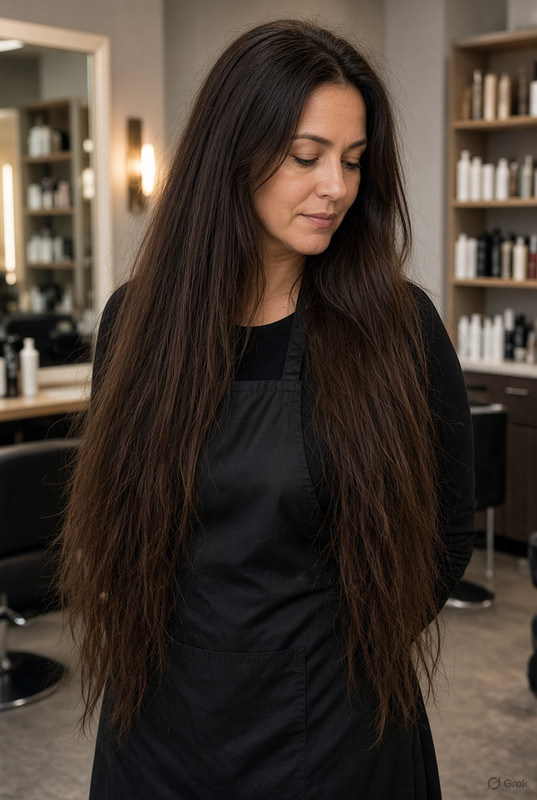
It fell past her hips now.
Only slightly, but unmistakably.
I stared for a moment longer than I intended.
Maya caught my reflection in the mirror.
“What?”
I smiled.
“Your hair.”
She reached behind herself.
“What about it?”
“It’s gotten longer.”
She looked at it as though she hadn’t considered that.
“I suppose it has.”
“How long have you been growing it?”
She shrugged.
“I don’t know. I haven’t really been paying attention.”
That answer made me smile.
“You haven’t been paying attention?”
“No.”
“You’ve grown it past your hips.”
She laughed softly.
“Apparently.”
I walked closer.
Maya’s hair was naturally thick and healthy-looking through most of its length. But when I looked carefully at the ends, I noticed something else.
A little dryness.
A few ends that had begun to split.
Nothing dramatic.
Nothing that couldn’t be corrected.
But enough for me to notice.
I gently lifted the last few inches.
“These need attention.”
Maya glanced at them.
“I know.”
“You’ve known?”
“Yes.”
“And you haven’t done anything?”
She gave me an apologetic smile.
“When?”
I laughed.
“Fair point.”
“I’ve been busy.”
“You’re a barber.”
“I know.”
“That’s a terrible excuse.”
“I know that too.”
She took the ends from my hand and examined them herself.
“I keep telling myself I’ll get around to it.”
“When?”
“Sometime.”
“That’s very specific.”
She laughed.
“I’ll ask you eventually.”
“Eventually?”
“Maybe.”
I shook my head.
“You know you can just make an appointment.”
“I know.”
“And I’ll trim it properly.”
“I know.”
“Then why haven’t you?”
Maya was quiet for a moment.
Then she shrugged.
“I’ve been busy with everything.”
Something about the way she said it made me pause.
Not work.
Everything.
I looked at her reflection.
Her expression had changed slightly.
The playful smile was gone.
“You okay?”
She looked at me through the mirror.
“Yeah.”
But the answer came too quickly.
I knew Maya well enough not to believe it.
I leaned against the counter.
“You sure?”
She sighed.
“I’m fine, Raven.”
I didn’t push her.
Not yet.
Instead, I looked again at her hair.
It was strange seeing it this long.
Maya had always kept it long, but there had been a time when she maintained it more regularly.
Now it seemed to have simply grown alongside her life.
Month after month.
Without much attention.
The ends were beginning to show the consequences.
I wondered how much longer she intended to let it go.
“You know,” I said, “you could always do something different with it.”
She smiled faintly.
“I could.”
“New style.”
“Maybe.”
“Different cut.”
“Maybe.”
“Or just a proper trim.”
“Definitely maybe.”
I laughed.
She laughed too.
For a moment, everything felt normal again.
But I couldn’t quite shake the feeling that something had changed.
Not just her hair.
Something underneath it.
Something I hadn’t noticed before.
Maya picked up her tools and began cleaning her station.
I watched her quietly.
After all these years, I knew her routines almost as well as my own.
But suddenly I wondered how much of Maya’s life I had stopped noticing simply because she had always been there.
And her hair had been growing all the while.
Past her hips.
Slowly.
Quietly.
Almost unnoticed.
I smiled faintly.
There was something strangely familiar about that.
I knew exactly what it was like to become attached to length.
To watch it accumulate day after day.
To wonder how far it could go.
But Maya’s relationship with her hair seemed different.
She wasn’t growing it deliberately.
She was simply…
letting it happen.
And somehow, that interested me.
“Don’t forget about those ends,” I said.
She smiled.
“I won’t.”
“You’d better.”
“Yes, boss.”
I laughed.
Then another client walked through the door, and the conversation ended.
The ordinary rhythm of the studio resumed.
But Maya’s hair remained in the back of my mind.
And so did the small, almost invisible damage at its ends.
Chapter 4 — A Change
The afternoon had settled into a slower rhythm.
The morning rush was behind us, and for once there wasn’t a client waiting at every station. The dryers were quiet. The front door remained closed for several minutes at a time.
It was one of those rare stretches of the day when the studio seemed to breathe.
Maya was standing near the reception desk, looking through the appointment book.
I was cleaning my station when I noticed her expression.
She wasn’t really reading the appointments.
Her eyes moved across the page, but there was no concentration behind them.
“You all right?”
She looked up.
“Yeah.”
I waited.
She smiled.
“I’m fine.”
I raised an eyebrow.
“You’ve said that twice today.”
She closed the appointment book.
“Have I?”
“Yes.”
She leaned against the counter.
For a few seconds neither of us spoke.
Then she sighed.
“I’m just tired.”
“From work?”
“Not exactly.”
I put the brush down.
“What then?”
Maya looked toward the front window.
Outside, people were walking along the street, going somewhere. Everyone seemed to have a destination.
“I don’t know,” she said.
That answer sounded more honest.
I waited.
Eventually she continued.
“I think I’m bored.”
I smiled slightly.
“With the studio?”
“No.”
“With being a barber?”
“No.”
“Then what?”
She shrugged.
“Everything.”
I didn’t say anything.
Maya looked down at her hands.
“My life is just…”
She searched for the right word.
“Monotonous.”
The word hung between us.
She continued before I could respond.
“I wake up. I go to work. I come home. I eat. I sleep. Then I do the same thing again.”
She gave a small laugh.
“Sometimes I think I could go through an entire week without anything actually happening.”
I understood what she meant.
Routine could be comforting.
But too much of it could become invisible.
Days could blur together until you couldn’t remember where one ended and another began.
“Have you thought about changing something?” I asked.
“Like what?”
“Anything.”
She looked at me.
“A new hobby.”
“Maybe.”
“A trip.”
“I can’t just disappear.”
“I didn’t say disappear.”
She smiled.
“Then what?”
I thought about it.
“I don’t know.”
That made her laugh.
“Great advice.”
“I didn’t say I had the answer.”
“You sounded very confident.”
“I usually do.”
She shook her head.
I smiled.
Then I became more serious.
“Maybe you don’t need to change your entire life.”
She waited.
“Maybe you just need something different.”
“Different how?”
“Something that makes you look forward to tomorrow.”
She considered that.
“What would you do?”
I smiled.
“That’s not really the point.”
“Why?”
“Because what works for me might not work for you.”
She looked thoughtful.
“You’re saying I need to find my own thing.”
“Exactly.”
She glanced toward the mirror.
Her reflection looked back at her.
Her long hair fell over her shoulders and down her back, reaching slightly below her hips.
She lifted a section absentmindedly.
“At least my hair is doing something.”
I laughed.
“Your hair?”
“Yeah.”
“It’s growing.”
“Exactly.”
I walked over and looked at the ends again.
“You’ve let it grow without even realizing it.”
“I suppose I have.”
“Maybe that’s your change.”
She looked at me.
“My hair?”
“Why not?”
Maya laughed.
“I don’t think growing my hair is going to make my life exciting.”
“Probably not.”
“Then why suggest it?”
“I didn’t.”
“You just did.”
“I said maybe.”
She smiled.
There was a brief silence.
Then she touched the ends again.
“I’ve been thinking about getting it trimmed.”
“I know.”
“Maybe soon.”
“Good.”
She looked at herself in the mirror.
“Do you think it needs much?”
“Not much.”
“Just the damaged ends?”
“Probably.”
She nodded.
“I’ll ask you eventually.”
“You keep saying that.”
“I mean it this time.”
“I’ll believe you when you sit in my chair.”
She laughed.
“Deal.”
I smiled.
But as I returned to my station, I found myself thinking about what she’d said.
Maybe soon.
There was something about Maya’s words that stayed with me.
Perhaps because I understood the feeling of wanting something different.
My own life had changed in ways I hadn’t expected.
My hair had changed.
My work had changed.
My relationships had changed.
And, perhaps most importantly, I had changed.
I looked toward Maya.
She was back at the reception desk, answering a phone call.
Her long hair shifted across her back as she moved.
Just below her hips.
Thick.
Still beautiful.
A little damaged at the ends.
Growing quietly while the rest of her life remained almost exactly the same.
Maybe she really did need a change.
I didn’t know what that change would be.
Not yet.
But sometimes the most important things began with something very small.
A conversation.
A thought.
A possibility.
And then, when you least expected it, life had a way of providing the opportunity.
The phone rang.
I turned toward the sound.
Maya answered it.
I went back to work.
Neither of us knew that, very soon, something unexpected was going to arrive at the studio.
Something that would take us far beyond our ordinary routine.
Chapter 5 — The Call
The afternoon had become unusually quiet.
For once, the studio seemed to have settled into a comfortable lull. The mirrors reflected empty chairs, the dryers were silent, and the faint scent of shampoo lingered in the warm air.
Maya was at the reception desk, sorting through the next day’s appointments.
I was cleaning my station.
My conversation with her was still somewhere in the back of my mind.
Maybe she really does need a change.
I wondered what that change would eventually look like.
Then the telephone rang.
The sharp sound cut through the quiet studio.
Maya glanced toward it.
“I’ll get it.”
She reached for the receiver.
“Raven & Rose Studio. How can I help you?”
I continued cleaning for a moment, but then I noticed her expression change.
Her eyebrows drew together.
She listened.
“Yes.”
A pause.
“How many children?”
Another pause.
Her eyes moved toward me.
“I see.”
She covered the receiver with her hand.
“Raven?”
I looked up.
“It’s a school.”
I walked toward her.
She uncovered the phone.
“Yes, she’s here.”
Maya handed me the receiver.
“Hello, this is Raven.”
A woman’s nervous voice answered.
“Hello, Ms. Sinclair. I’m calling from a local elementary school. We’ve been dealing with a lice outbreak.”
I straightened slightly.
“How extensive is the outbreak?”
“We’re still determining that.”
She sounded tired.
“We’ve already identified a number of children, and we’re concerned about it spreading further. We’ve contacted the parents, but we’re trying to deal with the immediate situation here at school.”
“I understand.”
“We were given your name by one of the parents. They said you’re very experienced.”
I smiled faintly.
“I do my best.”
“We were wondering if you could come in and help us.”
I glanced toward Maya.
She was listening carefully.
“What exactly do you need?”
“We need someone who can work with the children individually. Several families are having difficulty arranging appointments elsewhere, and we don’t want the children sitting around waiting.”
I understood.
“How many children?”
“We don’t have the final number yet.”
That concerned me.
“Roughly?”
Another pause.
“Possibly several dozen.”
Maya’s eyes widened when she heard that.
I thought for a moment.
A school full of children.
A lice outbreak.
Dozens of heads requiring attention.
It would be exhausting.
But it was also exactly the sort of situation where a professional could make a difference.
“All right,” I said.
The woman sounded relieved.
“You can come?”
“Yes.”
“Thank you. Truly.”
“When would you like me there?”
“As soon as possible.”
I glanced at the clock.
“I can leave shortly.”
“That would be wonderful.”
She gave me the school’s address and explained where I should enter.
Before ending the call, she added,
“And Ms. Sinclair?”
“Yes?”
“Some of the children are frightened.”
I softened.
“I understand.”
“They’ve already been upset about having to cut their hair.”
“I’ll make sure they’re treated gently.”
“Thank you.”
The call ended.
I placed the receiver back on its cradle.
For a few seconds, neither Maya nor I spoke.
Then she said,
“Several dozen?”
“Apparently.”
“That’s a lot.”
“It is.”
“Are you sure you want to take it?”
I looked around the studio.
There were no immediate appointments that couldn’t be rearranged.
And the school clearly needed help.
“I think they need someone.”
Maya nodded.
“Fair enough.”
I began gathering what I would need.
Comb.
Brushes.
Disposable supplies.
The equipment appropriate for the situation.
I checked everything twice.
Maya watched me.
“You’ll probably be there all afternoon.”
“Probably.”
“Maybe longer.”
“Probably.”
She smiled.
“At least you’ll get a change from the studio.”
I looked at her.
“Careful.”
“Why?”
“You were the one complaining about needing a change.”
She laughed.
“I didn’t mean this.”
“Neither did I.”
I closed the case.
For a moment, the conversation about her life returned to me.
Her boredom.
Her routine.
Her desire for something different.
Funny how quickly life could answer a thought.
I looked at the clock again.
“I should go.”
Maya nodded.
“Good luck.”
“Thanks.”
I picked up my bag.
Before leaving, I looked toward the mirror.
My long black ponytail rested heavily down my back, reaching just above mid-thigh.
I gathered it over one shoulder while putting on my jacket.
Then I caught my own reflection.
For a moment, I simply looked at myself.
Another ordinary day had become something else entirely.
I opened the door.
The afternoon air met me.
Across the street, Vanessa’s café was still busy.
For a fleeting moment I wondered whether Vanessa would have been interested in hearing about this.
She had asked me to call if another headshave ever happened at the studio.
I almost smiled.
This wasn’t happening at the studio.
Not yet.
I stepped onto the pavement.
Behind me, Maya locked the studio door.
“Take care,” she called.
“I will.”
I started toward my car.
I had expected the rest of the day to be ordinary.
Instead, I was going to a school with dozens of frightened children, an outbreak that needed containing, and a job that would likely take hours.
At that moment, that’s all I thought it was.
A job.
A responsibility.
Nothing more.
I had no idea how many chairs would eventually be needed.
Or how many children would sit in them.
Or that, before the day was over, my attention would shift from the children to the adults standing around them.
For now, though, I simply started the car and drove toward the school.
Chapter 6 — The School
By the time I reached the school, the afternoon had taken on a strange, unsettled quality.
The building itself looked perfectly ordinary.
Brick walls.
Tall windows.
A flag moving gently above the entrance.
Children’s artwork displayed behind the glass.
But the moment I stepped through the doors, I knew this wasn’t an ordinary school day.
There was too much movement.
Teachers hurried along the corridors carrying folders and boxes. Parents waited near the reception area. Children sat together in small groups, some whispering to one another, others looking frightened.
The atmosphere was tense.
I walked toward the reception desk.
A woman immediately approached me.
“Ms. Sinclair?”
“Yes.”
“I’m Susan Parker, the principal.”
She shook my hand.
Her expression was tired but grateful.
“Thank you for coming.”
“Of course.”
She glanced toward the corridor.
“It’s worse than we initially thought.”
“How many children?”
“We’re still counting.”
That wasn’t particularly reassuring.
She led me farther inside.
As we walked, I saw several children sitting with their parents.
Some had already had their hair examined.
Others were clutching their hair protectively.
One little girl looked at me and then immediately hid behind her mother.
I understood.
For a child, having someone talk about removing their hair could be frightening.
I turned back toward Susan.
“I’ll do my best to make this as easy for them as possible.”
She nodded.
“I appreciate that.”
Then I became aware of my own hair.
I had been thinking about it since I entered.
My hair was still tied in the ponytail I’d worn from home, and suddenly that didn’t seem like the best idea.
There were too many people.
Too much close contact.
Too many heads.
I didn’t want to take even a small risk of carrying anything home.
Especially not with hair like mine.
I touched the ponytail thoughtfully.
“Do you have somewhere I can prepare?”
Susan pointed toward an empty classroom.
“There’s a staff room just down the hall.”
“Perfect.”
I stepped inside.
The room was quiet.
I closed the door behind me and released my ponytail.
My hair came down in a heavy wave.
For a moment it seemed to fill the space behind me.
I gathered it with both hands.
There was so much of it.
The length had become almost absurd.
Just above mid-thigh when loose, it now formed a heavy black curtain down my back.
I began twisting it upward.
Once.
Again.
Then again.
The length wound around itself in thick coils, each layer folding over the next until the enormous mass became compact.
I continued wrapping.
The bun grew wider and fuller with every turn.
When I finally secured it, I stood in front of the mirror.
The result looked almost architectural.
A large, glossy black knot sat at the back of my head, its overlapping coils reflecting the light whenever I moved.
It was strange seeing all that length compressed into such a small space.
My hair had gone from a dark waterfall to a single sculpted crown.
I checked it carefully.
No loose strands.
Nothing hanging down my back.
Nothing brushing against my shoulders.
Good.
I smiled faintly.
“Much better.”
I adjusted the pins once more.
Then I returned to the corridor.
Susan looked at me and smiled.
“That’s quite a bun.”
I touched it.
“Too much hair to leave loose today.”
“I can see that.”
I smiled.
“Let’s get started.”
The first child was brought into the room a few minutes later.
A small boy.
He looked terrified.
I crouched slightly so that I wasn’t towering over him.
“Hi.”
He looked at me.
“Are you the barber?”
“I am.”
“Are you going to cut all my hair?”
I smiled gently.
“We’re going to take care of the problem first. I’ll explain everything before I do anything.”
He nodded cautiously.
His mother stood behind him.
I spoke quietly, explaining what I was going to do and reassuring him that he hadn’t done anything wrong.
That seemed to help.
He sat down.
I began.
The first few children took the longest.
Not because the work itself was difficult, but because each child needed reassurance.
Some cried.
Some asked whether their hair would grow back.
Some simply stared at the floor.
I answered every question.
Again and again.
“Yes, it will grow.”
“No, you didn’t do anything wrong.”
“You’re going to be okay.”
Little by little, the fear eased.
Then another child arrived.
Then another.
And another.
Soon the room had developed its own rhythm.
A child came in.
I spoke to them.
I worked.
They left.
The next child sat down.
I repeated the process.
Outside the room, the corridor remained busy.
Teachers moved back and forth.
Parents came and went.
More children were brought toward me.
I looked at the clock.
Then looked again later.
Time was disappearing.
I had expected several dozen.
But now I understood what that meant.
There were a lot of them.
Far more than I had imagined when I answered that telephone call at the studio.
My shoulders began to ache.
My hands grew tired.
But I continued.
I couldn’t afford to become careless.
Each child deserved patience.
Each child deserved dignity.
And each child deserved to leave feeling that what had happened wasn’t the end of the world.
At one point, I caught my reflection in the darkened window.
My face looked tired.
My bun was still perfectly secure.
That enormous mass of black hair remained tucked away safely at the back of my head.
I smiled faintly.
At least one thing was under control.
Then I heard another small voice behind me.
“Is it my turn?”
I turned around.
Another child was waiting.
I smiled.
“Yes.”
And I returned to work.
By late afternoon, I finally began to understand just how large this job was going to be.
I looked toward the corridor.
There were still children waiting.
I took a slow breath.
This was going to take a while.
A very long while.
Chapter 7 — Sixty
By late afternoon, I had stopped looking at the clock.
Time had become something abstract.
There was only the next child.
Then the next.
Then the next.
The room had settled into a rhythm of its own. A child would enter nervously, sit down, and look at me with uncertain eyes. I would speak to them gently, explain what I was doing, and begin.
Some were brave.
Some cried.
Some asked the same questions repeatedly.
“Will it grow back?”
“Yes.”
“Will everyone laugh at me?”
“No.”
“Will it look strange?”
“Only for a while.”
I tried to make every child feel that this was something temporary.
Something they could get through.
And slowly, one after another, they did.
My hands continued working long after my shoulders began to ache.
The school staff kept bringing children to the room.
Every time I thought surely we must be nearly finished, another small face appeared at the doorway.
My bun remained firmly secured throughout it all.
I had checked it several times during the afternoon.
The enormous mass of black hair remained tightly wound at the back of my head, every strand safely contained. I wasn’t taking chances with my own hair.
Eventually, I looked toward the clock again.
Nearly sixty.
I paused.
“Nearly sixty?”
One of the staff members nodded.
“Fifty-eight so far.”
I exhaled slowly.
Fifty-eight.
I had expected a busy afternoon.
I hadn’t expected this.
The next two children were brought in.
By the time they left, the number had reached sixty.
I stood quietly for a moment after the last child walked out.
Sixty.
I had worked on the hair of nearly sixty children in a single afternoon.
My hands were tired.
My back ached.
But there was something satisfying about knowing the immediate crisis had been dealt with.
The room was finally quiet.
I took a long breath.
Then I heard footsteps approaching.
Several women entered together.
The teachers.
They had been moving around the school all afternoon, helping coordinate everything while I worked.
Now they gathered around me.
“Ms. Sinclair,” one of them said, “thank you.”
Another nodded.
“You’ve done an incredible job.”
I smiled.
“It was my pleasure.”
“It certainly couldn’t have been easy.”
“It wasn’t.”
They laughed softly.
The tension that had filled the school earlier had begun to disappear.
The children were gone.
The room was quiet.
The crisis seemed, at least for the moment, to be under control.
I should have been thinking about going home.
Instead, I looked at the women standing before me.
And for the first time that afternoon, I really looked at their hair.
Not as a professional looking at ordinary hairstyles.
As Raven.
My eyes moved from one woman to another.
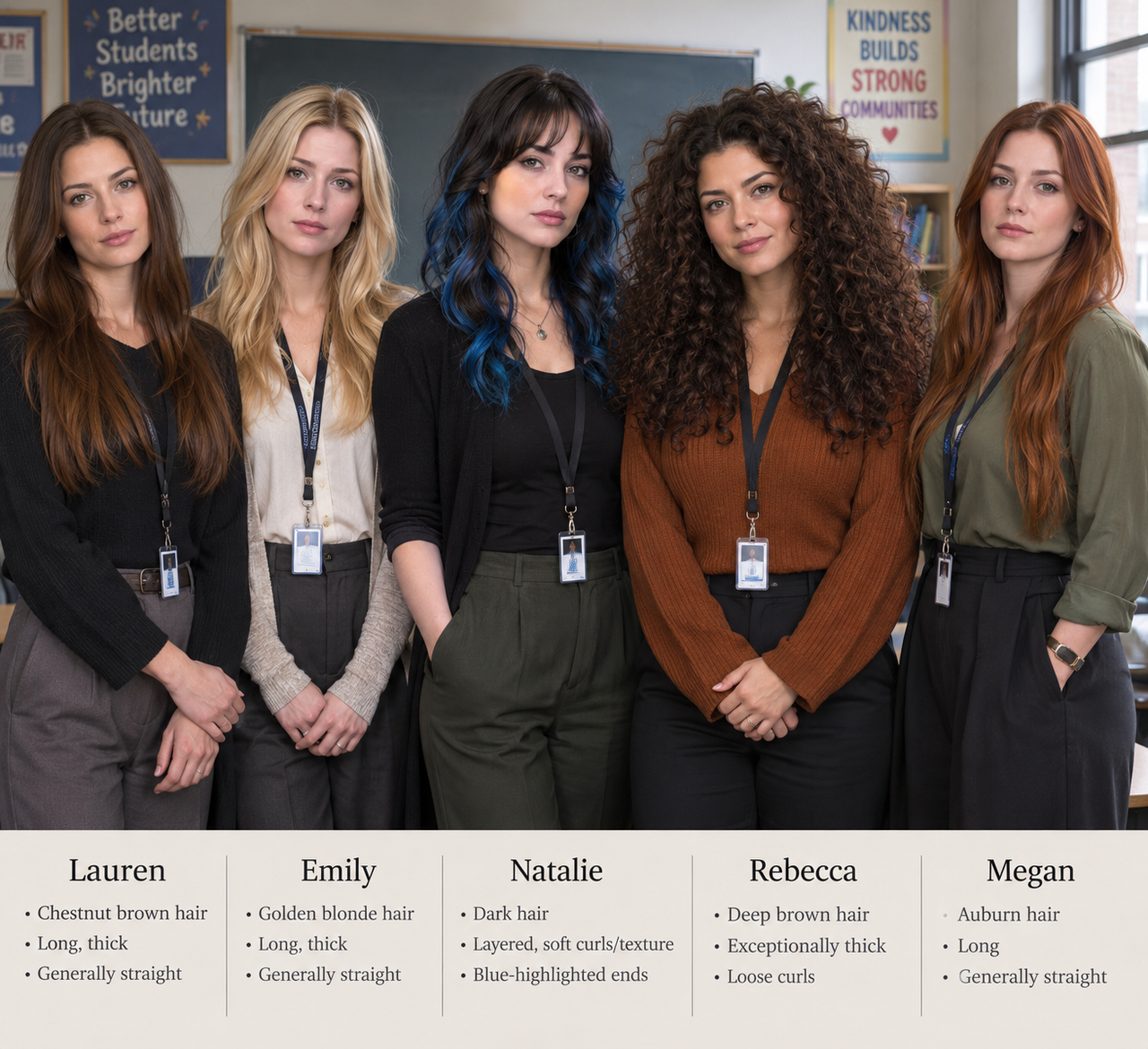
Lauren’s chestnut hair.
Emily’s golden-blonde length.
Natalie’s dark layered hair, her soft curls falling naturally around her shoulders and back, the blue highlights catching the light toward the ends.
Rebecca’s extraordinarily thick dark-brown hair, its loose curls giving it an almost cloudlike fullness.
Megan’s long auburn hair.
And then Susan.
Principal Susan Parker stood slightly behind the others.
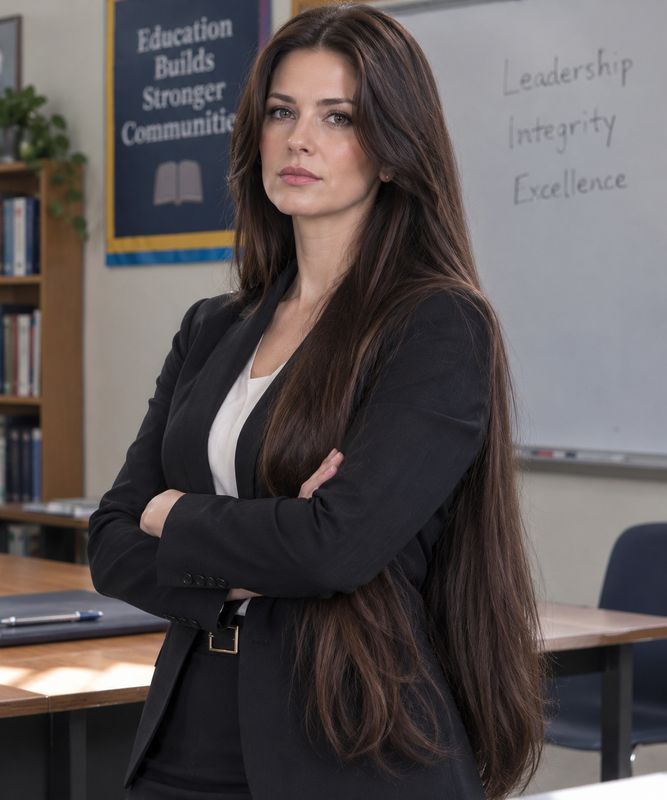
Her hair was dark brown, exceptionally thick, and long enough to reach her waist.
I looked at it for a little longer.
There was something about seeing all of them together that made my mind begin working differently.
Lengths.
Textures.
Colors.
Six women.
Six different possibilities.
My hair fetish stirred quietly beneath the professional calm I had maintained all afternoon.
I imagined their hair gathered together.
Sectioned.
Smoothed.
Drawn backward into tight ponytails.
One after another.
My mind went somewhere I hadn’t intended it to go.
I imagined those ponytails preserved.
Mounted carefully.
Displayed together on the wall of my private room.
A row of beautiful lengths.
Different colors.
Different textures.
Different memories.
I could almost picture them.
Lauren.
Emily.
Natalie.
Rebecca.
Megan.
Susan.
Six new additions.
The thought made something warm and private move through me.
I quickly returned my attention to the conversation.
“Thank you again,” Susan said.
I smiled.
“You’re welcome.”
The teachers continued thanking me.
I listened politely.
But my eyes kept returning to their hair.
Especially the lengths.
Especially Susan’s.
I had come to this school expecting to spend the afternoon dealing with children.
That part was finished.
But as I looked at the women standing before me, another thought quietly formed.
A thought that made me smile.
Although the children’s work was finished, the fun had just started.
Chapter 8 — The Teachers
The silence after the last child left felt almost unnatural.
For hours, the room had belonged to the children.
Small voices.
Nervous questions.
Tears quickly wiped away.
The scrape and hum of equipment.
The endless procession of frightened faces through the doorway.
Now there was nothing.
Only the faint mechanical breath of the building and the distant murmur of teachers speaking somewhere beyond the room.
I stood for a moment without moving.
Sixty children.
I had come here expecting a difficult afternoon.
I hadn’t expected to spend nearly the entire day working.
My shoulders were tired, and there was a dull ache running through my hands, but beneath the exhaustion was something else.
Satisfaction.
The crisis had been dealt with.
At least for now.
Then I heard footsteps.
I turned.
The teachers were approaching.
They came together in a loose group, and Susan walked among them.
“Ms. Sinclair,” she said, “we really can’t thank you enough.”
“You don’t have to.”
“We do.”
Another teacher smiled.
“You’ve done more for us today than you probably realize.”
I returned the smile.
“It was my job.”
But while they spoke, my eyes began wandering.
It happened almost instinctively.
I had spent hours looking at children’s hair.
Now, standing before me were six adult women.
And suddenly I could see them properly.
Lauren’s chestnut-brown hair fell just below her shoulders, soft and smooth.
Emily’s golden-blonde hair reached toward the middle of her back, thick enough that even its loose ends retained considerable volume.
Natalie caught my attention next.
Her dark layered hair fell in soft curls, the different lengths giving it movement. At the ends, blue highlights appeared like small strokes of color against the darker strands.
Then Rebecca.
Her hair was extraordinary.
Dark brown.
Exceptionally thick.
Loose curls all the way through.
It reached her hips, and the curls made the overall mass appear even fuller.
Megan’s auburn hair fell toward her lower back, catching the overhead light whenever she moved.
And Susan—
I stopped there.
Her hair was dark brown, long and remarkably thick.
It reached her waist.
I had seen her throughout the afternoon, but until now I hadn’t really looked.
Now I couldn’t stop noticing it.
Six women.
Six different lengths.
Six different textures.
Six different colors.
My hair fetish whispered quietly at the back of my mind.
I imagined each length gathered neatly into a ponytail.
Not loose.
Not casual.
Precise.
A clean middle part.
Smooth sections.
A firm tie.
The thought came with almost uncomfortable clarity.
I pictured those six ponytails hanging together in my private room.
The wall already held fourteen.
Fourteen preserved memories.
Fourteen carefully kept lengths of hair.
And suddenly my imagination seemed to make room for six more.
I forced myself back into the moment.
One of the teachers was speaking.
“We’re just relieved the children are all right.”
I nodded.
“They were frightened.”
“They certainly were.”
Susan folded her arms.
“I hope this is the end of it.”
I looked at the teachers.
Then at Susan.
I chose my words carefully.
“There is something else you should consider.”
Susan looked at me.
“What?”
I gestured subtly toward the teachers.
“The staff.”
A silence followed.
One of the women frowned.
“What about us?”
“You’ve all been working around the children today.”
“Yes.”
“I think you should take precautions too.”
The teachers exchanged glances.
Susan’s expression became serious.
“What kind of precautions?”
I kept my voice calm.
“The same basic precaution we’ve taken with the children.”
The reaction was immediate.
One woman instinctively touched her hair.
“Wait.”
Another stared at me.
“You mean… cut it?”
I nodded.
The room suddenly felt different.
The tired relief that had existed only seconds earlier vanished.
Rebecca’s hand moved protectively over her curls.
“All of it?”
I didn’t answer immediately.
Instead, I let them understand what I meant.
The women looked at one another.
Their expressions changed one after another.
Fear.
Disbelief.
Then outright horror.
“My hair isn’t coming off,” Emily said.
“No.”
The answer came from Lauren.
“I’ve been growing this for years.”
Natalie reached toward the blue-highlighted ends of her hair.
“But why would we need to do that?”
I remained composed.
“I’m not saying anyone definitely has anything.”
That was true.
“But you’ve been around the children all day. If you’re concerned about the outbreak, you shouldn’t assume the adults are automatically exempt.”
Susan looked at me.
“You haven’t examined us.”
“No.”
“Then how can you recommend shaving?”
“I can recommend caution.”
The teachers began speaking over one another.
“I don’t want to lose my hair.”
“Neither do I.”
“This is ridiculous.”
“My hair isn’t even that long.”
Rebecca looked particularly distressed.
Her hands had disappeared into the thick curls at the sides of her head.
“I’ve spent years taking care of this.”
I understood.
Hair wasn’t simply material.
People attached memories to it.
Years.
Identity.
Comfort.
Confidence.
I had seen it countless times.
And that was precisely why their reactions were so strong.
I looked at Susan.
She was quiet.
Her gaze moved from one teacher to another.
She was listening.
Thinking.
The others were looking toward her now.
Because she was the principal.
Because ultimately, she was responsible for the decision.
One of the teachers finally said,
“Susan, surely we’re not actually doing this.”
Susan didn’t answer.
I waited.
Then I spoke softly.
“The children didn’t get a choice about what happened today.”
The teachers looked at me.
“I know this is difficult.”
My voice remained gentle.
“But they were frightened. Some of them cried. Some of them were embarrassed.”
I paused.
“If the adults around them demonstrate that they’re willing to stand beside them, it may help.”
Susan’s expression changed slightly.
I could see the conflict in her face.
She looked toward the hallway.
Then back at the teachers.
Nobody wanted to lose their hair.
That much was obvious.
Especially Rebecca.
Especially Susan herself.
Her long hair remained draped down her back, almost reaching the bottom of her waist.
I looked at it again.
For one fleeting second, the image of a ponytail appeared in my mind.
Then I buried it.
Not yet.
The teachers continued protesting.
“We can have our hair checked.”
“Exactly.”
“There’s no reason to shave everyone.”
“Couldn’t we just go home?”
Susan finally raised her hand.
“Enough.”
The room fell quiet.
She looked at each of them.
They waited.
I remained silent.
This was no longer my decision.
At least, it needed to appear that way.
Susan took a breath.
“I understand how everyone feels.”
Her voice was steady, but her expression wasn’t.
“But we have a responsibility here.”
The teachers stared at her.
She continued.
“We’ve spent the entire day asking the children to accept something frightening for the sake of controlling this outbreak.”
She looked toward the hallway.
“I don’t think we can ask them to do that while we stand here pretending we’re somehow different.”
Nobody answered.
I watched Susan carefully.
She was beginning to convince herself.
That was the important part.
Not me.
Her.
One of the teachers shook her head.
“Susan…”
“I know.”
Her voice softened.
“I know exactly what you’re thinking.”
She looked at them again.
“But I’m not comfortable asking children to face something we aren’t willing to face ourselves.”
The teachers fell silent.
I could see the reluctance in every face.
They were mortified.
They were frightened.
They were looking at their hair as though they were suddenly seeing how much they stood to lose.
And yet Susan’s authority had begun to settle over the room.
I said nothing.
I didn’t need to.
I simply stood there, calm and patient, while Susan wrestled with the decision.
My eyes drifted once more toward the six women.
Six lengths.
Six textures.
Six possibilities.
And behind my composed expression, the picture returned.
My private room.
TheThe silence after the last child left felt almost unnatural.
For hours, the room had belonged to the children.
Small voices.
Nervous questions.
Tears quickly wiped away.
The scrape and hum of equipment.
The endless procession of frightened faces through the doorway.
Now there was nothing.
Only the faint mechanical breath of the building and the distant murmur of teachers speaking somewhere beyond the room.
I stood for a moment without moving.
Sixty children.
I had come here expecting a difficult afternoon.
I hadn’t expected to spend nearly the entire day working.
My shoulders were tired, and there was a dull ache running through my hands, but beneath the exhaustion was something else.
Satisfaction.
The crisis had been dealt with.
At least for now.
Then I heard footsteps.
I turned.
The teachers were approaching.
They came together in a loose group, and Susan walked among them.
“Ms. Sinclair,” she said, “we really can’t thank you enough.”
“You don’t have to.”
“We do.”
Another teacher smiled.
“You’ve done more for us today than you probably realize.”
I returned the smile.
“It was my job.”
But while they spoke, my eyes began wandering.
It happened almost instinctively.
I had spent hours looking at children’s hair.
Now, standing before me were six adult women.
And suddenly I could see them properly.
Lauren’s chestnut-brown hair fell just below her shoulders, soft and smooth.
Emily’s golden-blonde hair reached toward the middle of her back, thick enough that even its loose ends retained considerable volume.
Natalie caught my attention next.
Her dark layered hair fell in soft curls, the different lengths giving it movement. At the ends, blue highlights appeared like small strokes of color against the darker strands.
Then Rebecca.
Her hair was extraordinary.
Dark brown.
Exceptionally thick.
Loose curls all the way through.
It reached her hips, and the curls made the overall mass appear even fuller.
Megan’s auburn hair fell toward her lower back, catching the overhead light whenever she moved.
And Susan—
I stopped there.
Her hair was dark brown, long and remarkably thick.
It reached her waist.
I had seen her throughout the afternoon, but until now I hadn’t really looked.
Now I couldn’t stop noticing it.
Six women.
Six different lengths.
Six different textures.
Six different colors.
My hair fetish whispered quietly at the back of my mind.
I imagined each length gathered neatly into a ponytail.
Not loose.
Not casual.
Precise.
A clean middle part.
Smooth sections.
A firm tie.
The thought came with almost uncomfortable clarity.
I pictured those six ponytails hanging together in my private room.
The wall already held fourteen.
Fourteen preserved memories.
Fourteen carefully kept lengths of hair.
And suddenly my imagination seemed to make room for six more.
I forced myself back into the moment.
One of the teachers was speaking.
“We’re just relieved the children are all right.”
I nodded.
“They were frightened.”
“They certainly were.”
Susan folded her arms.
“I hope this is the end of it.”
I looked at the teachers.
Then at Susan.
I chose my words carefully.
“There is something else you should consider.”
Susan looked at me.
“What?”
I gestured subtly toward the teachers.
“The staff.”
A silence followed.
One of the women frowned.
“What about us?”
“You’ve all been working around the children today.”
“Yes.”
“I think you should take precautions too.”
The teachers exchanged glances.
Susan’s expression became serious.
“What kind of precautions?”
I kept my voice calm.
“The same basic precaution we’ve taken with the children.”
The reaction was immediate.
One woman instinctively touched her hair.
“Wait.”
Another stared at me.
“You mean… cut it?”
I nodded.
The room suddenly felt different.
The tired relief that had existed only seconds earlier vanished.
Rebecca’s hand moved protectively over her curls.
“All of it?”
I didn’t answer immediately.
Instead, I let them understand what I meant.
The women looked at one another.
Their expressions changed one after another.
Fear.
Disbelief.
Then outright horror.
“My hair isn’t coming off,” Emily said.
“No.”
The answer came from Lauren.
“I’ve been growing this for years.”
Natalie reached toward the blue-highlighted ends of her hair.
“But why would we need to do that?”
I remained composed.
“I’m not saying anyone definitely has anything.”
That was true.
“But you’ve been around the children all day. If you’re concerned about the outbreak, you shouldn’t assume the adults are automatically exempt.”
Susan looked at me.
“You haven’t examined us.”
“No.”
“Then how can you recommend shaving?”
“I can recommend caution.”
The teachers began speaking over one another.
“I don’t want to lose my hair.”
“Neither do I.”
“This is ridiculous.”
“My hair isn’t even that long.”
Rebecca looked particularly distressed.
Her hands had disappeared into the thick curls at the sides of her head.
“I’ve spent years taking care of this.”
I understood.
Hair wasn’t simply material.
People attached memories to it.
Years.
Identity.
Comfort.
Confidence.
I had seen it countless times.
And that was precisely why their reactions were so strong.
I looked at Susan.
She was quiet.
Her gaze moved from one teacher to another.
She was listening.
Thinking.
The others were looking toward her now.
Because she was the principal.
Because ultimately, she was responsible for the decision.
One of the teachers finally said,
“Susan, surely we’re not actually doing this.”
Susan didn’t answer.
I waited.
Then I spoke softly.
“The children didn’t get a choice about what happened today.”
The teachers looked at me.
“I know this is difficult.”
My voice remained gentle.
“But they were frightened. Some of them cried. Some of them were embarrassed.”
I paused.
“If the adults around them demonstrate that they’re willing to stand beside them, it may help.”
Susan’s expression changed slightly.
I could see the conflict in her face.
She looked toward the hallway.
Then back at the teachers.
Nobody wanted to lose their hair.
That much was obvious.
Especially Rebecca.
Especially Susan herself.
Her long hair remained draped down her back, almost reaching the bottom of her waist.
I looked at it again.
For one fleeting second, the image of a ponytail appeared in my mind.
Then I buried it.
Not yet.
The teachers continued protesting.
“We can have our hair checked.”
“Exactly.”
“There’s no reason to shave everyone.”
“Couldn’t we just go home?”
Susan finally raised her hand.
“Enough.”
The room fell quiet.
She looked at each of them.
They waited.
I remained silent.
This was no longer my decision.
At least, it needed to appear that way.
Susan took a breath.
“I understand how everyone feels.”
Her voice was steady, but her expression wasn’t.
“But we have a responsibility here.”
The teachers stared at her.
She continued.
“We’ve spent the entire day asking the children to accept something frightening for the sake of controlling this outbreak.”
She looked toward the hallway.
“I don’t think we can ask them to do that while we stand here pretending we’re somehow different.”
Nobody answered.
I watched Susan carefully.
She was beginning to convince herself.
That was the important part.
Not me.
Her.
One of the teachers shook her head.
“Susan…”
“I know.”
Her voice softened.
“I know exactly what you’re thinking.”
She looked at them again.
“But I’m not comfortable asking children to face something we aren’t willing to face ourselves.”
The teachers fell silent.
I could see the reluctance in every face.
They were mortified.
They were frightened.
They were looking at their hair as though they were suddenly seeing how much they stood to lose.
And yet Susan’s authority had begun to settle over the room.
I said nothing.
I didn’t need to.
I simply stood there, calm and patient, while Susan wrestled with the decision.
My eyes drifted once more toward the six women.
Six lengths.
Six textures.
Six possibilities.
And behind my composed expression, the picture returned.
My private room.
The wall.
Fourteen ponytails.
And six empty spaces that existed only in my imagination.
For now.
I smiled very slightly.
The children had come first.
But now the adults were standing before me.
And the afternoon was far from over. wall.
Fourteen ponytails.
And six empty spaces that existed only in my imagination.
For now.
I smiled very slightly.
The children had come first.
But now the adults were standing before me.
And the afternoon was far from over.
Chapter 9 — Susan’s Decision
The room remained suspended in an uneasy silence.
The teachers stood together, looking at one another as though someone might suddenly produce a better answer.
Nobody did.
Their expressions told me everything.
They were frightened.
Not of the school anymore.
Not of the children.
Not even particularly of the outbreak.
They were frightened of what I had suggested.
Their hair.
For years, perhaps decades, each woman had carried it through ordinary mornings and important occasions, through photographs and celebrations, through days when they felt beautiful and days when they didn’t. Hair could become such an ordinary part of a person that its importance wasn’t noticed until the possibility of losing it appeared.
Now they were all noticing.
Lauren repeatedly ran her fingers through her chestnut hair.
Emily held the ends of her golden-blonde length against her chest.
Natalie touched the blue-highlighted curls at the ends of her dark hair.
Rebecca’s hands disappeared into her loose curls, instinctively protecting the enormous mass of hair around her shoulders.
Megan kept glancing toward the mirror.
And Susan stood among them, apparently much calmer than the others.
She wasn’t thinking about herself.
That was important.
She was thinking about the teachers.
I could see it in her expression.
She believed she was responsible for them.
That belief would become useful.
“Ms. Sinclair,” Emily said, “surely you’re not seriously suggesting that all of us shave our heads.”
“I am suggesting that it would be the safest precaution.”
“But why?”
“Because you’ve been working around the children all day.”
“We weren’t sitting with them all day.”
“No.”
I kept my voice measured.
“But you’ve been moving through their classrooms. You’ve been helping them. You’ve been touching their belongings, comforting them, organizing them.”
Susan listened silently.
I looked at her.
“I understand that nobody wants to lose their hair.”
Rebecca gave a nervous laugh.
“That’s putting it mildly.”
I smiled sympathetically.
“But the children didn’t want to lose theirs either.”
The laughter disappeared.
That sentence had landed exactly where I wanted it to.
The teachers looked toward the doorway.
Beyond it was the corridor where the children had been waiting earlier.
I continued.
“Some of them cried today.”
Susan’s face became more serious.
“They were scared.”
“Yes.”
“And you expect the teachers to do the same thing?”
“I expect the adults responsible for those children to show them that they’re not alone.”
Nobody answered.
I didn’t push.
Sometimes silence was more persuasive than another argument.
Susan finally spoke.
“How certain are you that the teachers are at risk?”
I looked directly at her.
“I can’t tell you that they’re infected.”
That distinction was important.
“But after an outbreak of this size, I wouldn’t dismiss the possibility.”
Susan nodded slowly.
One of the teachers immediately objected.
“Then examine us.”
Another agreed.
“Exactly. Why shave everyone?”
“Because examination isn’t the same as eliminating the problem.”
The teachers looked increasingly distressed.
Rebecca shook her head.
“My hair took years to grow.”
“I know.”
“You don’t understand.”
“I understand more than you think.”
I looked at her curls.
“They’re beautiful.”
Rebecca seemed surprised by the compliment.
“But beauty doesn’t make them immune.”
Her hand tightened around a section.
I could see how badly she wanted another answer.
There wasn’t one I intended to give her.
Susan looked at the teachers.
They looked back at her.
The decision was beginning to move toward her.
That was precisely where I wanted it.
“You’re their principal,” I said quietly.
Susan looked at me.
“What does that have to do with it?”
“Everything.”
I stepped slightly closer.
“The children spent the entire day being told that this was necessary.”
Susan nodded.
“If the teachers refuse while the children have already gone through it, what message does that send?”
One teacher immediately responded.
“That adults can make their own decisions.”
“Of course.”
I smiled.
“They can.”
Then I looked at Susan.
“But you’re responsible for the school.”
She understood the implication.
Her expression hardened slightly.
I could almost see the thought taking shape.
If the teachers refused, she would have to decide whether their objections mattered more than the example she wanted them to set.
I didn’t need to make the decision for her.
I simply gave her enough reasons to make it herself.
Susan turned toward the teachers.
“I’ve heard everyone’s concerns.”
Lauren stared at her.
“Susan…”
“I understand.”
“But you’re not actually considering this.”
Susan hesitated.
Then she answered.
“I am.”
The room went still.
Emily’s mouth opened slightly.
Rebecca looked genuinely horrified.
“Susan, no.”
Susan raised her hand.
“Please.”
Everyone stopped.
She took a breath.
“I’m not saying this because I don’t care about your hair.”
Her eyes moved from one woman to another.
“I’m saying it because the children had to face this today, and I don’t think the staff should simply pretend we’re completely separate from what happened.”
“But we can be checked,” Megan said.
“Yes.”
“We can use other precautions.”
“Yes.”
“Then why this?”
Susan looked toward the corridor.
“Because I believe it’s the strongest way to demonstrate support.”
I kept my expression neutral.
Inside, I felt a quiet satisfaction.
Susan was doing exactly what I had hoped.
She wasn’t merely agreeing with me.
She was becoming the person who would enforce the decision.
She turned toward the teachers.
“I’ve made my decision.”
Nobody spoke.
“You’ll all have your heads shaved.”
The words seemed to fall heavily into the room.
Rebecca’s face went pale.
“All of us?”
“Yes.”
Emily stared at Susan.
“But—”
“No.”
Susan’s voice was firmer now.
“I’ve heard the objections.”
She paused.
“But this is my responsibility.”
Lauren looked close to tears.
“Susan, please.”
“I’m sorry.”
Her answer was surprisingly gentle.
“But I’m not changing my mind.”
Natalie looked down at her curls.
Her fingers moved slowly through the dark strands, tracing the blue highlights at the ends.
I watched the gesture.
There was something almost heartbreaking about it.
People always touched their hair differently when they knew they might lose it.
A final unconscious acknowledgement.
A goodbye before the goodbye.
Rebecca’s loose curls trembled slightly as she moved them away from her face.
Megan stared at herself in the mirror.
One by one, they realized that Susan wasn’t going to relent.
Finally, Lauren whispered,
“This is really happening.”
Susan nodded.
“Yes.”
The teachers began moving toward the chairs.
Slowly.
Reluctantly.
Almost as though the floor had become heavier beneath their feet.
I watched them sit.
Their long hair remained untouched for the moment.
That was the strange beauty of anticipation.
Nothing had changed yet.
And yet everything had changed.
The hair was still there.
The same lengths.
The same colors.
The same textures.
But now every strand seemed more significant because they knew it wouldn’t remain.
I picked up my comb.
Susan remained standing.
She looked toward the teachers, apparently satisfied that she had done what she believed was necessary.
She had no idea that she had just created a decision she would eventually have to answer for herself.
I looked at her waist-length dark-brown hair.
It fell down her back in a heavy, glossy sheet.
For a moment, I imagined it gathered tightly at the center of her head.
A clean middle part.
Two precise sections.
Everything smoothed into place.
Then a single ponytail holding all that length together.
The image disappeared as quickly as it came.
I smiled.
Not yet.
First, the teachers.
Susan believed she was only supervising.
She believed the difficult decision was over.
She was wrong.
I turned toward the first chair.
“All right,” I said calmly.
“Let’s begin.”
And Susan remained standing behind them, completely unaware that her own reasoning had already begun to close around her.
Chapter 10 — The First Two
The room had become almost unnaturally still.
Lauren sat in the first chair, her hands folded tightly in her lap. Emily occupied the chair beside her, watching every movement with an expression that betrayed how desperately she wanted this to be over before it had even begun.
Behind them stood the other teachers.
And behind all of them stood Susan.
The principal looked composed.
The teachers did not.
I approached Lauren first.
Her chestnut-brown hair fell around her shoulders in a thick, smooth curtain. She kept touching it, almost unconsciously, as though reassuring herself that it was still there.
“Lauren,” I said gently, “sit comfortably.”
She obeyed.
I took my comb.
The first stroke passed through her hair.
She closed her eyes.
Another stroke.
Then another.
The simple sound of the comb moving through her hair seemed strangely loud in the silence.
I began creating the middle part.
The comb travelled from her forehead toward the crown in one deliberate line.
Her hair separated cleanly on either side.
Lauren opened her eyes.
“What happens now?”
“I secure it first.”
I gathered both sections behind her head.
The two sides came together beneath my hands, forming a substantial mass.
Then I selected a tiny strand.
Lauren immediately noticed.
“You’re not using a tie?”
“No.”
I carefully removed the small strand and wrapped it around the gathered hair.
Once.
Twice.
Again.
The strand tightened around the base until the entire length was held securely.
A thick chestnut ponytail hung behind her.
Lauren looked at it in the mirror.
Her expression changed.
For a moment, there was almost admiration.
Then reality returned.
“That’s my hair.”
“Yes.”
“And you’re going to shave everything except that?”
I nodded.
She stared at her reflection.
Her eyes became wet.
“I don’t want to do this.”
I didn’t answer.
Susan did.
“Lauren, we’ve discussed this.”
Lauren looked toward her.
“You’re really making me?”
Susan’s voice softened.
“I believe it’s necessary.”
Lauren looked away.
I positioned the razor at the center of the part.
The first pass moved sideways.
A narrow path appeared through the chestnut hair, exposing the scalp beneath.
Lauren inhaled sharply.
The sound of the razor was steady and restrained, a dry, repetitive whisper that seemed to fill the entire room.
She watched the mirror.
The narrow shaved strip became wider.
Another sideways pass.
Then another.
The difference was becoming unmistakable.
One side remained covered in chestnut hair.
The other was progressively bare.
Lauren’s eyes followed the boundary as it travelled toward her temple.
“Oh…”
Her voice was barely audible.
I continued carefully.
The hair fell away in short pieces, collecting against the cape.
Lauren’s expression remained frozen.
She seemed unable to decide whether she wanted to watch or look away.
She chose to watch.
Perhaps because looking away would have made the uncertainty worse.
As I worked around the side, the ponytail remained intact.
That created an almost surreal contrast.
From the front, Lauren’s familiar hair was disappearing.
Behind her, her long chestnut ponytail still existed exactly as before.
She noticed the contradiction.
“How can it still look like that?”
“The length is secured.”
“But everything else is gone.”
I continued.
The razor moved across the remaining hair.
The bare area widened around her crown.
Then toward the other side.
Lauren’s breathing became uneven.
She finally closed her eyes.
The sound continued.
When she opened them again, the change was much more obvious.
Her face seemed completely different without the surrounding hair.
She stared at herself.
“I look…”
She stopped.
I waited.
“I don’t know.”
The razor continued toward the back.
More hair disappeared.
The ponytail began to loosen.
A few chestnut strands slipped free and fell against Lauren’s shoulder.
Her eyes widened.
“It’s coming loose.”
I paused.
The strand securing it had begun to lose its support as the surrounding hair disappeared.
I adjusted it carefully.
“Stay still.”
Lauren nodded.
Her fingers tightened around the chair.
I resumed.
The remaining hair at the back was removed.
The ponytail sagged.
Then sagged again.
Finally, the last supporting hair disappeared.
The gathered length slipped free.
I caught it in my hand.
Lauren stared.
Her entire head was now shaved while the long chestnut hair rested separately in my hand.
She looked at the ponytail.
Then at the mirror.
Then back at the ponytail.
Her expression wasn’t dramatic.
It was worse than that.
It was empty.
“I had that hair for years.”
I placed it carefully on the counter.
Lauren looked down.
A tear finally rolled down her cheek.
She wiped it away quickly.
“I don’t want anyone to see me like this.”
Susan looked uncomfortable.
“Lauren…”
But Lauren didn’t answer.
She simply kept staring at the ponytail.
Emily had watched every second.
That had made her own fear worse.
She had seen the entire sequence.
The middle part.
The gathered hair.
The tiny strand used to secure it.
The gradual disappearance of the hair.
The final release of the ponytail.
Now she knew exactly what awaited her.
She touched her golden hair.
“I can’t.”
Susan looked at her.
“Emily.”
“I really can’t.”
Her voice trembled.
“I’ve watched it happen. I know what it’s going to look like.”
I approached her slowly.
“You’ll need to sit still.”
She looked at me.
For a moment, anger replaced fear.
“You say that like this is ordinary.”
I paused.
“No.”
That answer seemed to surprise her.
“No,” I repeated. “It isn’t.”
Emily looked toward Susan.
Susan remained firm.
“You agreed to follow the precaution.”
“I agreed because you told me it was necessary.”
“And I still believe it is.”
Emily’s shoulders fell.
She finally sat.
Her golden hair spilled over the back of the chair.
I began combing it.
Unlike Lauren, Emily kept her eyes closed.
The comb moved slowly through the length.
She took a deep breath.
Then another.
I created the middle part.
Her eyes opened immediately.
She watched the reflection.
“Please be quick.”
“I’ll be careful.”
I gathered the two sections.
The golden hair became one substantial ponytail.
Then I selected the small securing strand.
Emily watched closely.
“That’s how you tied hers?”
“Yes.”
She looked at Lauren.
Lauren sat quietly beside her.
Emily swallowed.
I secured the ponytail.
Then stepped back.
The golden length remained intact.
For one last moment, Emily looked exactly as she had before.
That seemed to hurt her most.
She knew the reflection was temporary.
I positioned the razor.
Emily gripped the arms of the chair.
The first sideways movement from the middle part made her flinch.
Her eyes widened.
The sound filled the room.
The golden hair gave way gradually, leaving a widening path of bare scalp.
Emily’s breathing became faster.
“No…”
She wasn’t speaking to me.
She was speaking to the reflection.
Another pass.
The shaved section expanded.
Emily turned her eyes away.
Then looked back.
She couldn’t stop herself.
Her expression became increasingly distressed as the familiar golden frame around her face disappeared.
The razor moved methodically toward the side.
Short strands fell away.
The ponytail remained behind her.
Still beautiful.
Still long.
Still unmistakably hers.
That contrast seemed almost cruel.
Emily stared at it.
“Please don’t let it fall.”
I secured it again when it began to loosen.
She exhaled shakily.
Then the shaving continued.
The crown became bare.
The sides followed.
Then the back.
The ponytail gradually lost the hair supporting it.
It began to hang lower.
Emily saw it happening.
Her eyes filled with tears.
“Is it almost done?”
“Almost.”
The last sections were removed.
The securing strand finally released.
The golden ponytail slipped free.
I caught it.
Emily stared at it.
For several seconds she said nothing.
Then she looked at herself.
Her expression collapsed.
She covered her mouth with one hand.
“I don’t recognize myself.”
Lauren quietly looked over.
Neither woman spoke again.
I placed Emily’s ponytail beside Lauren’s.
Chestnut and gold.
Two preserved lengths sitting side by side.
The room seemed colder than before.
Behind us, Susan watched.
She had expected resistance.
She had expected discomfort.
Perhaps she had even expected tears.
But seeing the completed results seemed to make the decision feel heavier.
Her eyes moved from Lauren to Emily.
Then to the two ponytails.
Finally, almost unconsciously, she touched her own dark-brown hair.
It fell heavily over her shoulder.
Waist length.
Untouched.
She quickly lowered her hand.
I noticed.
I said nothing.
There were still four teachers waiting.
And Susan still believed she was merely the person standing outside the chairs, supervising a decision she had imposed on everyone else.
She didn’t yet realize that her own logic had left one question unanswered.
Chapter 11 — Midnight and Blue
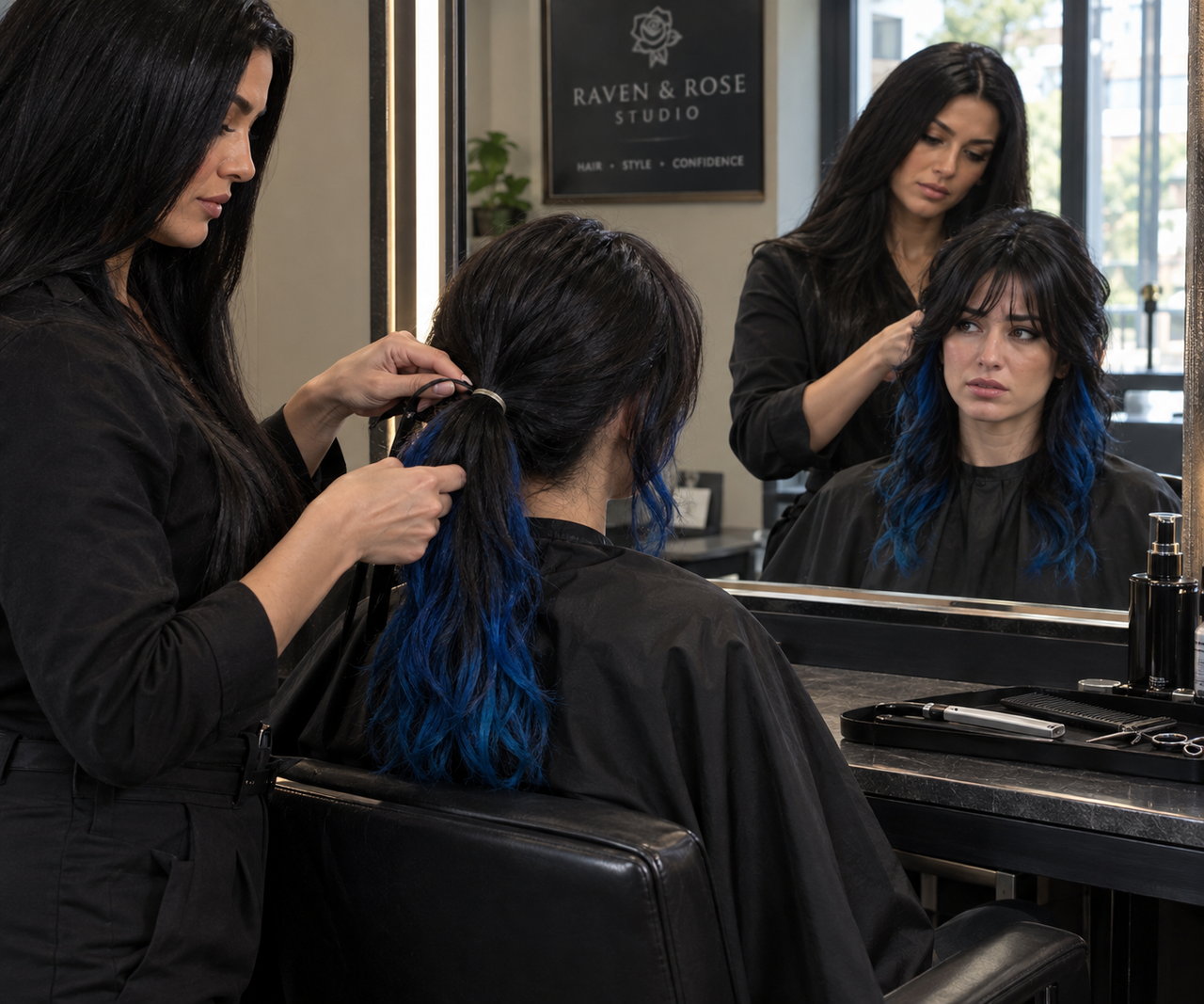
By the time I turned toward the next two chairs, the room had changed.
Lauren and Emily sat silently together.
Their reactions were different, but the result had left the same strange emptiness behind them. Lauren kept looking at the chestnut ponytail resting on the counter. Emily barely looked at hers at all.
I left them alone.
There was nothing I could say that would make either woman feel better.
My attention moved to Natalie and Rebecca.
They were still standing.
Natalie was touching the blue-highlighted ends of her dark hair.
Rebecca had gathered her loose curls protectively over one shoulder.
Susan remained behind them.
“Next,” she said.
Natalie looked at her.
“Do I really have to?”
Susan’s answer was immediate.
“Yes.”
Natalie exhaled through her nose.
Her expression had changed from fear to something harder.
Anger.
She sat.
Her dark layered hair fell around her shoulders, soft curls settling against the cape. The blue highlights were most visible toward the ends, almost glowing against the darker base.
I began brushing through it.
Natalie watched me in the mirror.
“Don’t pretend this is some kind of ordinary haircut.”
“I’m not.”
“Then don’t talk to me like it is.”
I stopped for a moment.
She met my eyes.
There was resentment there.
I understood.
I resumed brushing.
The comb moved through the curls, gradually bringing them under control.
Then I created the middle part.
Natalie’s eyes followed the line.
She knew the ritual now.
Everyone did.
I gathered both sections behind her head.
The curls compressed into a dense mass.
Then I selected a small strand.
Natalie watched.
“You’re going to use that to tie it?”
“Yes.”
She gave a bitter little laugh.
“Of course you are.”
I wrapped the strand around the gathered hair.
The ponytail formed.
Dark curls.
Blue ends.
A concentrated mass hanging behind her.
Natalie stared at it.
For a moment her anger disappeared.
She simply looked at the hair.
“I liked the blue.”
“I know.”
“I chose those highlights carefully.”
She looked away.
“Then let’s finish.”
I positioned the razor at the middle part.
The first movement went sideways.
Natalie immediately stiffened.
The dark hair began disappearing along the narrow path.
The blue-highlighted ends remained untouched in the ponytail behind her.
She watched the mirror.
The expression on her face was almost defiant.
She refused to close her eyes.
As the shaved area widened, her anger seemed to turn inward.
She watched the dark boundary move across her scalp.
Another pass.
Then another.
The sound remained steady.
The curls gradually disappeared.
Natalie’s jaw tightened.
When the razor reached the side of her head, she whispered,
“That’s enough.”
I continued.
She closed her eyes.
A few seconds later, she opened them again.
Her expression had softened.
Not because she accepted what was happening.
Because she seemed exhausted from fighting it.
The ponytail began loosening.
One of the blue-tipped curls slipped free.
Natalie’s eyes immediately went toward it.
Another strand fell.
She swallowed.
“My hair…”
The ponytail sagged.
I secured it again.
Then continued removing the remaining hair.
Eventually the final supporting strands disappeared.
The ponytail came loose.
I caught it.
Natalie stared at the dark mass in my hand.
The blue highlights looked almost brighter now that they were concentrated together.
She reached toward it.
Her fingers stopped just short.
Then she withdrew her hand.
“Keep it.”
I placed it beside the others.
Natalie turned away from the mirror.
Her anger had disappeared.
What remained was exhaustion.
Rebecca was different.
She hadn’t said much throughout the entire process.
But I knew she was frightened.
Her loose curls were exceptionally thick.
They had always given her a distinctive silhouette.
Now she sat in the chair with both hands resting tightly against her thighs.
I began working through the curls.
The comb met resistance almost immediately.
There was simply so much hair.
I worked slowly.
Section by section.
Rebecca watched silently.
“There’s so much of it,” she finally whispered.
“Yes.”
She looked at her reflection.
“I’ve always had this much.”
“I can see that.”
Her eyes became wet.
“I don’t want to lose it.”
Unlike Natalie, there was no anger in her voice.
Only attachment.
I created the middle part.
The curls separated.
I gathered them behind her head.
The ponytail became enormous.
Rebecca stared.
For the first time, she seemed to understand just how much hair she had been carrying.
I selected the small securing strand.
Her eyes followed it.
“That’s all you’re taking to secure it?”
“Yes.”
I wrapped it around the base.
The ponytail held.
Rebecca reached back and touched it.
Her fingers lingered.
“I want to remember what it felt like.”
I said nothing.
She closed her eyes.
I began.
The razor moved from the center outward.
The first section of curls disappeared.
Rebecca opened her eyes.
Her expression changed instantly.
The loss of the curls was visually dramatic.
The soft, rounded silhouette around her head began disappearing, replaced by the clean surface beneath.
She watched.
Unlike Lauren, she wasn’t numb.
Unlike Emily, she wasn’t panicking.
She was mourning.
Every few moments, her eyes returned to the ponytail.
It remained intact.
That seemed almost comforting.
The hair was disappearing from her head, but the long curls still existed behind her.
As I worked toward the sides, the ponytail began to loosen.
A curl slipped free.
Then another.
Rebecca’s lips trembled.
“Please…”
I stopped.
She took a breath.
“Just… don’t let it fall.”
I secured the ponytail again.
Then continued.
The back of her head was gradually cleared.
The ponytail became increasingly unsupported.
Finally, the last connecting strands were removed.
The enormous curled length came free.
I caught it with both hands.
Rebecca stared.
Her eyes filled completely.
For several seconds she didn’t speak.
Then she whispered,
“That was me.”
I placed the ponytail beside Natalie’s.
Rebecca looked at her reflection.
She touched the top of her newly shaved head with trembling fingers.
Her expression wasn’t horror anymore.
It was grief.
Deep, quiet grief.
I stepped back.
Four ponytails now rested together.
Chestnut.
Golden.
Dark with blue.
Deep brown curls.
Four memories.
Four women.
Behind them, Susan stood motionless.
She looked at the ponytails.
Then at the women.
Then at the two empty chairs.
Her expression was becoming increasingly difficult to read.
I looked at her reflection.
Her waist-length hair remained untouched.
She seemed suddenly aware of its weight.
She reached behind herself and gathered a section absentmindedly.
Then released it.
I noticed.
But once again, I said nothing.
There were still two teachers left.
And after them…
Susan.
Chapter 12 — The Last Chair
Only two teachers remained.
Megan stood beside the empty chair, staring at the floor.
Susan’s attention was fixed on the remaining ponytails arranged across the counter.
I could sense the exhaustion in the room.
The earlier nervousness had faded into something heavier.
Megan was the first to sit.
Her auburn hair fell down her back, catching the light whenever she moved.
Unlike Rebecca, she didn’t touch it protectively.
Unlike Natalie, she didn’t argue.
She simply looked at herself in the mirror.
“I suppose there’s no point asking anymore.”
I met her eyes.
“No.”
She gave a faint, humorless smile.
“At least you’re honest.”
I began brushing through her hair.
The auburn strands moved smoothly beneath the comb.
Then came the familiar middle part.
Megan watched the line appear.
Her expression remained strangely calm.
I gathered the two sections and brought them together behind her head.
A small strand was separated from the gathered hair and used to secure the ponytail.
Megan looked at it.
“That’s going to be kept too?”
“Yes.”
She nodded.
“Then make sure you don’t damage it.”
There was something almost detached about her voice.
I positioned the razor.
The first pass moved sideways from the middle part.
The auburn hair disappeared beneath it, leaving a gradually widening area of bare scalp.
Megan watched for only a few seconds before looking downward.
The steady sound continued.
Her hands remained motionless.
As more hair disappeared, the shape of her face changed.
Without the auburn frame around it, her features appeared sharper.
She finally looked back at the mirror.
“I thought I’d be more upset.”
I continued working.
“People react differently.”
“I think I’m just tired.”
The ponytail remained intact behind her.
As the surrounding hair disappeared, it began to hang more heavily.
A few loose auburn strands slipped from the binding.
Megan noticed.
“Don’t let it fall.”
I secured it.
She gave a small nod.
The remaining hair gradually disappeared.
When the last connecting strands were removed, I caught the ponytail.
Megan stared at it.
She didn’t cry.
She didn’t reach for it.
She simply watched it for a long moment.
Then she looked at herself.
“I suppose that’s the strangest part.”
“What is?”
“I expected to feel like I’d lost something.”
She paused.
“But I mostly feel empty.”
I placed the auburn ponytail beside the others.
Megan rose quietly from the chair.
The final teacher was ready.
She sat without being asked.
Her expression was resigned.
I repeated the ritual.
Comb.
Middle part.
Two sections.
A small strand separated.
The ponytail secured.
The room had become almost silent again.
This time, everyone knew exactly what the sequence meant.
The teacher watched the mirror.
“I’ve never seen anything like this.”
“Neither have I,” someone murmured from behind her.
I began.
The razor moved outward from the center.
Hair disappeared gradually.
The teacher’s expression changed as she watched the process.
At first she looked frightened.
Then resigned.
Finally, almost strangely peaceful.
The ponytail remained until the very end.
When the last connecting hair was removed, it slipped free.
I caught it and placed it alongside Megan’s.
Six ponytails now occupied the counter.
Six different colors.
Six different textures.
Six different lengths.
The teachers sat together, each carrying a different expression.
The room felt strangely ceremonial.
And then there was silence.
Susan looked at them.
She had ordered all of this.
Yet she hadn’t anticipated what it would feel like to stand among the consequences of her own decision.
Her gaze moved toward the ponytails.
Then toward the chairs.
Then finally toward the mirror.
Her own reflection stared back.
Her dark-brown hair fell past her waist.
It was long, thick and carefully maintained.
For the first time that morning, Susan reached for it deliberately.
She pulled the length over her shoulder.
Her fingers moved through it.
She looked at the six ponytails.
Then at her own hair.
I watched her carefully.
She noticed me watching.
“What?”
“Nothing.”
She released her hair.
“I think we’re finished.”
I smiled faintly.
“Almost.”
Susan frowned.
“Almost?”
I looked at the empty chair.
Then back at her.
“You asked the teachers to show solidarity with the children.”
She nodded.
“Yes.”
“And you told them that everyone who had close contact with the children should take the same precaution.”
“I did.”
I let the silence linger.
Susan’s expression slowly changed.
“Raven…”
I remained perfectly calm.
“You have considerably more contact with the children than anyone else here.”
Her face went still.
The realization arrived gradually.
She looked at the chair.
Then at me.
Then at her own reflection.
For the first time all day, Susan looked genuinely uncertain.
I said nothing more.
I didn’t need to.
The logic she had used to place six women in those chairs had quietly come back around to her.
And now there was only one chair left.
Chapter 13 — The Principal’s Argument
The room had gone quiet.
Susan remained standing behind the chairs, her arms folded tightly across her chest.
I looked at her through the mirror.
“You said everyone needed to show solidarity with the children.”
“I said the teachers needed to.”
“You said everyone who had been exposed should take the precaution seriously.”
“I did.”
“And you’re the principal.”
Susan’s expression hardened.
“That doesn’t mean I need to sit in that chair.”
“No?”
“No. I don’t have the same level of contact with the children that they do.”
I glanced toward the teachers.
Lauren was still looking at her preserved ponytail . Emily sat quietly beside her. Natalie had her arms folded, her expression still carrying the remnants of her earlier anger. Rebecca remained subdued.
Susan continued.
“My office is nowhere near the younger classrooms. I don’t spend hours around the children.”
I nodded slowly.
“I understand.”
She seemed relieved that I wasn’t arguing.
Then I added,
“But you were the one who decided that the teachers couldn’t use that argument.”
Her relief vanished.
Susan stared at me.
“That isn’t the same thing.”
“Why?”
“Because I’m responsible for the school.”
I smiled faintly.
“Exactly.”
Susan frowned.
I continued calmly.
“You’re responsible for protecting the children. You’re responsible for the teachers. You’re responsible for the decisions made during this outbreak.”
“That doesn’t mean I have to shave my head.”
“No,” I said. “It doesn’t.”
The teachers looked at me.
I turned toward them.
“But doesn’t it seem strange that the person who ordered everyone else to demonstrate solidarity should be the only person exempt from demonstrating it?”
Susan’s face tightened.
“This isn’t about appearances.”
“Then it shouldn’t matter if you do it.”
Silence.
Natalie finally spoke.
“She has a point.”
Susan looked sharply at her.
Natalie didn’t look away.
“You told us that refusing would make us look like we didn’t care about the children.”
“I was trying to protect the school.”
“And we weren’t?”
Natalie’s voice was controlled, but the anger beneath it was obvious.
Emily spoke next, much more quietly.
“You told us there wasn’t really a choice.”
Susan’s expression changed.
Emily lowered her eyes.
“So I don’t understand why there’s suddenly a choice for you.”
Susan looked toward Lauren.
“Lauren?”
Lauren hesitated.
Then she looked at the long ponytail resting on the counter.
“You made the decision.”
Her voice was soft.
“But you also told us we had to stand together.”
Rebecca finally spoke.
“Then stand with us.”
Susan stared at them.
For the first time, she seemed completely alone.
The authority she had carried all morning suddenly felt much less useful.
She looked at me.
“You planned this.”
I raised an eyebrow.
“I didn’t plan the outbreak.”
“You know what I mean.”
I remained silent.
Susan’s eyes narrowed.
“You’ve been waiting for this.”
I smiled.
“I’ve been listening.”
That answer seemed to unsettle her more than an admission would have.
She glanced toward the chair.
Then toward the teachers.
Then finally toward the mirror.
Her long dark-brown hair fell over her shoulders, still untouched.
She reached for it.
Her fingers closed around the length.
She held it for several seconds.
Then released it.
“Fine.”
Nobody moved.
Susan took a breath.
“If this is what I have to do to demonstrate solidarity…”
She stopped.
Her voice became quieter.
“…then I’ll do it.”
I stepped aside.
Susan approached the chair.
Every step seemed deliberate.
She stopped in front of it.
Looked at her reflection.
Then sat.
Her waist-length hair spilled over the back of the chair.
I stood behind her.
The room fell silent once again.
Susan looked at me through the mirror.
“Let’s get this over with.”
I reached for my comb.
And began.
Chapter 14 — Susan
Susan had spent the entire morning telling other people not to be afraid.
Now she was afraid.
I could see it before she said a word.
She sat rigidly in the barber’s chair I had brought into one of the school’s empty classrooms, her hands gripping the edges of the seat. Around us, the classroom had been stripped of its usual purpose. Desks had been pushed against the walls. A few children’s drawings remained pinned to a bulletin board. Afternoon sunlight fell through the windows and illuminated the loose strands of hair scattered across the floor.
It was an ordinary schoolroom.
But Susan no longer looked like the principal who had walked into it.
She looked like someone waiting for a decision to become irreversible.
I stood behind her and studied her reflection.
Her dark-brown hair fell almost to her waist.
It was thick, smooth, and carefully maintained. I noticed details automatically—the density around the crown, the layered ends, the way the length settled against the back of the chair.
That was simply how I worked.
I noticed hair.
I always had.
But with Susan, I found myself noticing something else too.
She kept touching it.
Every few seconds, her fingers moved toward the length before she caught herself and lowered her hand.
She finally looked at me through the mirror.
“I can still change my mind.”
There was no authority in her voice now.
Only uncertainty.
I didn’t answer immediately.
I wanted her to hear the silence.
Behind her, the teachers remained quiet.
Susan looked at them.
“I can.”
Natalie folded her arms.
“You told us we couldn’t.”
Susan’s jaw tightened.
“That was different.”
“How?”
Susan looked toward me.
For a second, I thought she might start arguing again.
Instead, she looked down.
I recognized the moment.
She had run out of arguments.
I had seen that expression before—not in people being shaved, but in people realizing that the explanation they had used to justify something no longer protected them from its consequences.
I picked up my comb.
Susan noticed.
Her shoulders tightened.
“Wait.”
I stopped.
She gathered her hair over one shoulder.
The movement exposed the full length to the mirror.
Susan stared at it.
“I’ve spent years growing this.”
I watched her reflection.
There was something almost strange about hearing that sentence.
People talked about hair as though it were permanent because it grew slowly.
Years could disappear in minutes.
I knew that better than most.
Susan’s fingers moved through the dark strands.
“I didn’t think it would feel like this.”
I understood.
But I didn’t say so.
Instead, I began combing.
Slowly.
Carefully.
The comb traveled through the length.
Susan followed every movement.
I could see her trying to memorize the feeling.
When I created the middle part, she immediately noticed.
A narrow line of scalp appeared beneath the separated hair.
Her eyes widened.
“Stop.”
I stopped.
She stared at the part.
Then, almost unconsciously, she tried to pull the two sides together again.
The hair fell back across the line.
For one second, the old appearance returned.
Susan looked relieved.
Then she seemed embarrassed by her own reaction.
“I’m sorry.”
“You don’t have to apologize.”
“I do.”
She looked at herself.
“I’m frightened.”
The admission landed heavily in the room.
I looked at her reflection.
For all her authority, Susan suddenly seemed very small beneath the mirror lights.
I had no desire to frighten her further.
But I also knew that pretending this was something other than what it was would be dishonest.
“You agreed to this,” I said quietly.
“I know.”
Her eyes closed.
Then opened.
“That’s what makes it worse.”
I understood what she meant.
If someone else had forced the decision upon her, she could have directed her anger outward.
Now she had nowhere to put it.
I gathered her hair into a ponytail.
The weight of it settled against the back of the chair.
Susan watched.
When I removed a small strand and used it to secure the ponytail, she stared at my hands.
Then she reached backward.
Her fingers closed around the length.
I waited.
She held it for several seconds.
Then whispered:
“That’s the last time I’ll see it attached to me.”
I looked at her through the mirror.
There was no triumph in me.
Only the strange awareness of watching a person arrive at the truth of something she had previously understood only in theory.
I placed the straight razor on the tray.
Susan saw it.
Her entire posture changed.
“That’s what you’re using?”
“Yes.”
“A straight razor.”
“Yes.”
She looked at it for several seconds.
“It’s more final.”
“It gives a closer shave.”
“I wasn’t talking about the shave.”
I understood.
I picked up the razor.
Susan immediately pulled her head backward.
“No.”
I stopped.
Her hands tightened around the chair.
For a moment, neither of us moved.
Then she took a breath.
“I’m sorry.”
“You don’t need to apologize.”
“I keep saying that.”
“You keep getting frightened.”
She looked at me in the mirror.
“Yes.”
I waited until her breathing steadied.
Then she nodded.
“Okay.”
I positioned the razor at the center part.
My attention narrowed.
The classroom disappeared around me.
The teachers disappeared.
There was only the section of hair in front of me, the angle of the razor, the pressure of my hand, and Susan’s reflection.
I made the first careful stroke.
A narrow path appeared through the dark hair.
Susan’s eyes widened.
She inhaled sharply.
I watched her face in the mirror rather than the razor.
That was one of the habits I had developed over years of barbering.
The hands worked.
The eyes watched the person.
Susan stared at the newly cleared strip.
“Oh.”
It was barely more than a whisper.
I continued.
Another measured stroke.
More hair fell.
Susan’s hands tightened.
Her breathing became shallow.
Then her hand rose suddenly.
“Wait.”
I stopped immediately.
She touched the shaved strip.
Her fingertips trembled.
She looked at them.
Then at the remaining hair.
Her expression seemed almost disbelieving.
“There’s so much left.”
“Yes.”
“And it’s going to disappear.”
“Yes.”
She closed her eyes.
When she opened them, she looked directly at herself.
“Continue.”
I did.
The straight razor moved steadily.
I kept my movements controlled and professional, refusing to let the atmosphere of the room affect my hands.
Susan’s composure changed with every section.
At first she watched every stroke.
Then she began looking away.
Then she forced herself to look again.
I noticed all of it.
The tightening of her jaw.
The way her shoulders rose whenever the razor approached her temple.
The occasional instinctive movement of her head.
The fingers gripping the chair.
She was resisting without even meaning to.
And yet she kept telling herself to continue.
That contradiction fascinated me—not because I enjoyed her distress, but because it revealed exactly how complicated her decision had become.
She had wanted to be fair.
Now she was discovering that fairness and wisdom were not necessarily the same thing.
Her ponytail remained behind her.
As the surrounding hair disappeared, it became increasingly conspicuous.
Susan kept looking at it.
Eventually, she reached backward and grasped it.
I stopped.
She held the length tightly.
“Just give me a second.”
“Take your time.”
She looked down at the ponytail.
Her thumb moved slowly over the ends.
Then she looked toward the teachers.
“I understand now.”
Nobody answered.
Susan looked back at herself.
“I really didn’t before.”
She released the ponytail.
“Finish.”
I resumed.
The remaining hair disappeared section by section.
I kept my attention on the work.
The final passes were slower.
More precise.
When I finally lowered the razor, I stepped back.
Susan stared into the mirror.
I watched her face.
The transformation in her expression was more striking than the change in her appearance.
There was anger.
There was embarrassment.
There was regret.
But underneath all of it was recognition.
She raised both hands and touched her head.
Her fingertips moved cautiously across the short stubble.
She closed her eyes.
I stood quietly beside her.
For once, I didn’t have anything clever to say.
Susan opened her eyes.
She looked at the ponytail lying across the cape.
“I thought I understood what I was asking from them.”
Her voice was quiet.
“I didn’t.”
She picked up the ponytail.
“I was wrong.”
The words surprised me.
Not because she said them.
Because she didn’t follow them with an excuse.
No explanation.
No defense.
No attempt to make the decision sound noble.
Just four words.
I looked at Susan in the mirror.
That was the moment I understood that the shaving had changed something deeper than her appearance.
She had spent the morning believing leadership meant standing above difficult consequences.
Now she had discovered that sometimes leadership meant standing directly inside them.
Susan looked at me.
“I don’t know what I’m going to tell everyone tomorrow.”
I met her eyes.
“You’ll figure it out.”
She gave a tired, almost embarrassed smile.
“You’re remarkably calm.”
I glanced at the straight razor on the tray.
“I’ve learned not to rush when someone is having a difficult moment.”
Susan nodded.
Then she looked at herself again.
This time, she didn’t turn away.
And I watched silently as the principal of the school finally confronted the woman beneath the title.
Chapter 15 – Aftermath
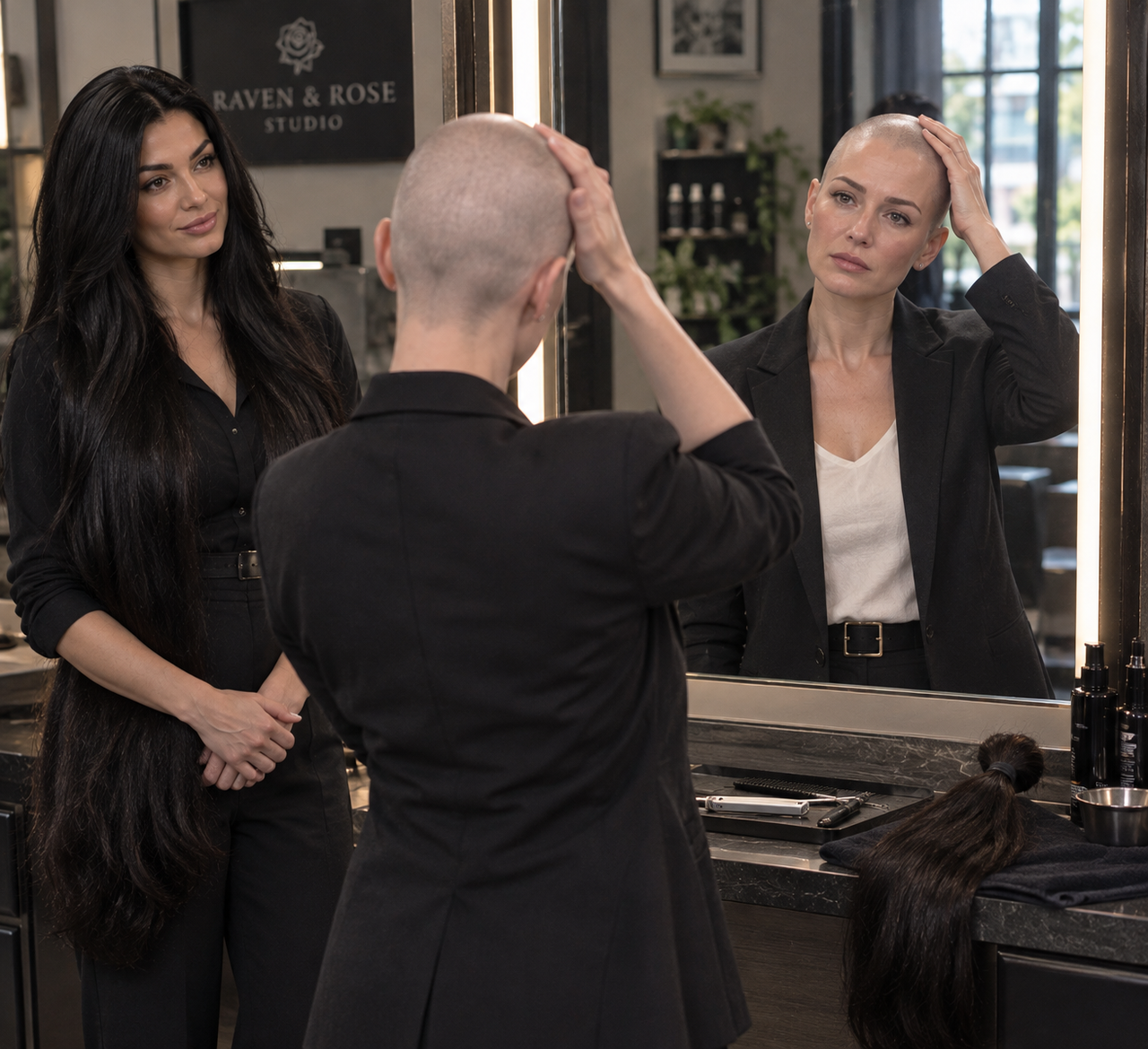
The classroom felt different after Susan stood up.
The chair was still there.
The mirror was still facing it.
The cape still carried loose strands of dark-brown hair.
And on the table beside me lay Susan’s ponytail.
She remained in front of the mirror, touching the short stubble on her head with tentative fingertips.
I watched her reflection.
The transformation in her appearance was obvious.
The transformation in her expression was harder to describe.
Susan had always carried herself with certainty. Even when angry, she had possessed the confidence of someone accustomed to making decisions and having other people follow them.
That certainty was gone.
Not completely.
But enough.
She looked at herself for a long time.
Then her eyes moved toward the ponytail.
She walked over and picked it up.
Her fingers closed around the thick length.
For several seconds she simply held it.
“That’s really all of it,” she whispered.
“Yes.”
She turned it over in her hands.
Then she looked at me.
“What am I supposed to do with this?”
“That’s up to you.”
Susan gave a faint, tired smile.
“Of course you’d say that.”
She looked down at the hair again.
“I don’t think I can decide.”
“Then don’t decide yet.”
She shook her head.
“No.”
Her eyes met mine.
“I don’t want to take it.”
That surprised me.
“Are you sure?”
Susan nodded.
“I’ve spent the entire day making decisions.”
She glanced toward the doorway, where the other teachers had disappeared.
“And most of them were made for other people.”
Then she looked back at the ponytail.
“I want someone else to make this one.”
She held it out toward me.
I took it carefully.
It was heavier than it looked.
Susan watched my hands close around it.
“You decide.”
I looked at her.
“You’re giving me complete discretion?”
“Yes.”
“What if I preserve it?”
Susan hesitated.
Then she nodded.
“Then preserve it.”
Her words stayed with me.
She wasn’t asking me to make a practical decision.
She was giving away the final choice connected to the hair she had spent years growing.
I looked down at the ponytail.
The dark-brown length was neatly secured, the ends still arranged almost exactly as they had been before the shaving.
For a moment, I thought about my private room.
Fourteen ponytails already rested there.
Fourteen separate histories.
Fourteen women whose hair had once been part of their appearance, their routines, their identities.
And suddenly I remembered the other ponytails from this school.
Lauren’s chestnut-brown hair.
Emily’s golden-blonde hair.
Natalie’s dark layered hair, including those blue-highlighted ends.
Rebecca’s extraordinarily thick loose curls.
Megan’s auburn hair.
And now Susan’s dark-brown length.
Six teachers.
Six ponytails.
Six additions to the collection.
The thought settled quietly in my mind.
Susan’s hair wouldn’t be alone.
None of theirs would.
They would all eventually occupy a place in the private room.
I kept my expression neutral.
“All right,” I said.
Susan nodded.
“I trust you.”
Those three words affected me more than I expected.
Trust was different from permission.
Different from compliance.
Different from agreement.
She had placed something deeply personal in my hands and deliberately removed herself from the decision.
I understood the weight of that.
Behind us, Lauren appeared briefly in the doorway.
“Are you all right, Susan?”
Susan looked toward her.
“I’m not sure.”
Then she smiled faintly.
“But I think I’ll be all right eventually.”
Lauren nodded.
She didn’t ask any more questions.
One by one, the others passed the doorway.
Emily.
Natalie.
Rebecca.
Megan.
For a moment, each of them looked back toward Susan.
There was no celebration.
No laughter.
Only the strange solidarity of six women who had gone through the same irreversible experience.
Susan watched them leave.
Then she looked at me again.
“Raven.”
“Yes?”
“My hair.”
I looked down at the ponytail in my hands.
“What about it?”
“You decide.”
I nodded.
“I will.”
She gave me one last look.
Then she walked out.
I waited until her footsteps disappeared down the corridor.
The classroom became quiet again.
I looked at the ponytail.
Then at the empty chair.
Then at the mirror.
But I wasn’t thinking only about Susan’s hair anymore.
I was thinking about the others.
Six ponytails.
Six different textures.
Six different lengths.
Lauren’s chestnut-brown strands.
Emily’s golden-blonde length.
Natalie’s dark hair with those distinctive blue ends.
Rebecca’s dense, loose curls.
Megan’s auburn hair.
Susan’s dark-brown ponytail now resting in my hands.
I had spent years building my private collection one memory at a time.
Now, almost without warning, the school had given me six more.
I knew exactly where they would eventually go.
Not together.
Each would have its own place.
Its own label.
Its own memory.
The thought made me pause.
There was something almost unsettling about how quickly a single morning could alter the contents of a room nobody knew existed.
I carefully wrapped Susan’s ponytail.
Then I began gathering my equipment.
The school had already returned to its ordinary rhythm.
Doors opened and closed.
Teachers moved through the corridors.
Voices echoed somewhere in the distance.
But I knew that when I returned home, I would not be carrying only the memory of Susan.
I would be carrying six pieces of the day.
Six reminders of six women.
And six new additions waiting for the private room.
I looked once more at the empty chair.
Then I switched off the classroom light.
The decision had been made.
All six ponytails would come home with me.
Chapter 16 – Maya
The studio felt strangely quiet when I returned.
After the school, the empty classroom, the voices, the chairs, the long hours of work, the silence of Raven & Rose seemed almost unnatural.
Maya was still there.
She stood at the second station, cleaning a pair of scissors beneath the warm light above the mirror.
She looked up when I entered.
“You’re back.”
“I’m back.”
“How was it?”
“Long.”
She smiled faintly.
“That bad?”
“Just long.”
She returned to cleaning the scissors.
I watched her reflection.
There was something about Maya lately that I couldn’t quite put into words.
She hadn’t changed dramatically.
That was almost the problem.
She came to work at the same time.
She took the same chair.
She performed the same tasks.
She went home at roughly the same hour.
Tomorrow would probably look almost identical.
And the day after that.
And the day after that.
I had the strange impression that Maya wasn’t living her days anymore.
She was simply repeating them.
My eyes moved to her hair.
It had grown slightly beyond her hips.
It was still beautiful—thick, dark and heavy, with years of length behind it—but the ends were beginning to betray how little attention she’d been able to give it.
A few were split.
Some were dry.
Others had broken unevenly.
“Maya.”
“Hm?”
“When was the last time you properly took care of your hair?”
She glanced at herself.
“I do take care of it.”
“You know what I mean.”
She smiled.
“I suppose I don’t have much time for it anymore.”
“That’s different.”
“How?”
“Taking care of something isn’t the same as simply maintaining it.”
She looked at me through the mirror.
For a second, she seemed almost offended.
Then her expression softened.
“I know.”
She put the scissors down.
“I know.”
There was something in the way she said it that made me stop.
“You’ve noticed it too?”
She nodded.
“My hair?”
“Your hair. Yourself.”
She looked away.
“I don’t know what you mean.”
“Yes, you do.”
She was silent.
I waited.
Eventually she said,
“I’m tired.”
“I know.”
“No. I mean…” She paused. “I’m tired of feeling tired.”
Her fingers moved unconsciously through the ends of her hair.
“I wake up and I’m already thinking about work. I come here and I spend the entire day thinking about what needs to be done. Then I go home and I’m too exhausted to do anything that isn’t necessary.”
She gave a small laugh.
“I keep telling myself I’ll do something different on the weekend.”
“And do you?”
“No.”
The answer came immediately.
She looked almost embarrassed by it.
“I tell myself next weekend. Then next month. Then when things calm down.”
She looked at the clock.
“They never calm down.”
I said nothing.
Maya stared at her own reflection.
“I don’t even know what I would do if they did.”
That sentence seemed to surprise her.
She lowered her eyes.
“That’s the worst part.”
“What is?”
“I don’t know what I want.”
Her voice became quieter.
“I used to think I knew.”
She swallowed.
“I thought I would have a life outside this place. Not that I dislike working here. I don’t. I love it, actually.”
“I know.”
“But somewhere along the way, work stopped being one part of my life and became my entire life.”
She laughed softly.
“Listen to me.”
“I’m listening.”
“I sound ridiculous.”
“You don’t.”
“I have a job I like. A home. People who care about me. Nothing terrible has happened.”
She looked at me again.
“So why do I feel like something is missing?”
I didn’t answer immediately.
Because sometimes the hardest emptiness to explain was the one that existed when nothing was obviously wrong.
“You don’t need a disaster to justify wanting something different,” I said.
Her eyes stayed on mine.
That seemed to reach her.
She looked down at her hands.
“Maybe I’m afraid.”
“Of what?”
“Changing things.”
She looked toward the mirror again.
“If I change something and I still feel the same afterward…”
She stopped.
I waited.
“…then I’ll have to admit the problem wasn’t my routine.”
She gave a small, almost helpless smile.
“It was me.”
The room became very quiet.
I stepped closer.
“No, Maya.”
She looked at me.
“Change isn’t proof that something is wrong with you.”
“Then what is it?”
“Sometimes it’s simply proof that you’ve noticed you’re not the same person you used to be.”
She considered that for a long time.
Then she looked at her hair.
Her fingers gathered the length over one shoulder.
“I haven’t changed this in years.”
“I know.”
“I don’t even remember why I keep it this long.”
That caught my attention.
“You don’t?”
She shook her head.
“I think I just always had long hair. So eventually it became part of who I was.”
She looked at her reflection.
“People know me with this hair.”
Her fingers tightened slightly around it.
“Maybe that’s why changing it feels strange.”
“Because people might notice?”
“Because I might notice.”
There it was.
Not fear of other people’s opinions.
Fear of seeing herself differently.
I watched her carefully.
Then I said,
“Perhaps you need a change in your life, Maya.”
She turned toward me.
“A change?”
“Perhaps.”
“What kind of change?”
“I don’t know.”
She frowned.
“Then how do you know I need one?”
“Because you’ve been telling me without saying it.”
She was quiet.
I continued.
“You said you don’t know what you want. You said every day feels the same. You said you’ve been waiting for things to calm down even though you know they won’t.”
I nodded toward her reflection.
“Perhaps you need to do one thing simply because you choose to.”
She looked at herself again.
“And you think that should be my hair?”
“Perhaps we can start with your hair.”
She blinked.
“My hair?”
“Yes.”
She touched the ends.
“What would changing my hair actually change?”
“Maybe nothing.”
She gave me a skeptical look.
“Very reassuring.”
I smiled.
“But maybe that’s not the point.”
“What is?”
“The point might be making a decision.”
She looked down at the long strands in her hands.
“I could cut it.”
“You could.”
“Or just trim it.”
“You could.”
“Or do something completely different.”
“You could.”
She looked at me.
“You really aren’t going to tell me what to do, are you?”
“No.”
“Why?”
“Because this has to be your decision.”
That seemed to matter to her.
She turned back toward the mirror.
For a long time she simply stood there.
Her reflection looked familiar.
But perhaps, for the first time, she was looking at it as something she could change.
“I don’t know what I want yet,” she whispered.
“That’s okay.”
“But I think…”
She stopped.
“What?”
She looked at her own hair.
“I think I want to find out.”
I smiled.
“Then that’s enough for tonight.”
Maya nodded.
She gathered her hair behind her back before picking up her bag.
At the door she stopped.
“Raven?”
“Yes?”
“If I decide to change it…”
She hesitated.
“Will you help me?”
I looked at her.
“Of course.”
She smiled.
Not her usual polite smile.
Something smaller.
More uncertain.
But real.
“Good night, Raven.”
“Good night, Maya.”
The door closed.
I remained alone in the studio.
Her words stayed with me.
I think I want to find out.
Perhaps that was how change really began.
Not with certainty.
Not with courage.
Sometimes it began with dissatisfaction.
Sometimes with exhaustion.
And sometimes with nothing more than the uncomfortable realization that the person in the mirror had become someone you had stopped asking what she wanted.
I switched off the last light.
The studio disappeared into darkness.
But Maya’s reflection remained in my thoughts.
And so did her hair.
