 Captain Razor
Chapter 1
After the Conversation
The last client of the day had been gone for nearly forty minutes, yet the studio still held the faint, clean scent of shampoo, conditioner, and the warm metallic note of tools that had been used and set aside. The mirrors along the walls reflected empty chairs and the soft grey light that filtered in from the street. Outside, the afternoon had begun its slow slide toward evening. Inside, everything was quiet in the particular way a workspace becomes quiet only after the final person has left.
Maya stood near the front station with her back partly turned to me. Her hair—long, thick, dark brown—hung past her hips in a single heavy fall. It moved whenever she shifted her weight. The ends were dry. I had noticed the change weeks ago: the way the last several inches had begun to fray, the slight unevenness where strands had broken under their own weight, the dullness that no amount of product could fully disguise. She had not asked me to trim it. She never did. She simply continued carrying it, the same way she continued the rest of her life—without deciding, without changing, without ever quite admitting that the length had stopped being a choice and had become a habit.
I watched her fingers find a section near her collarbone and twist it once, slowly, before letting it fall again. The gesture was small. Almost private. I had seen her do it three separate times that afternoon when she believed my attention was elsewhere. Each time the same quiet motion, as if she were checking that the hair was still there, still heavy, still hers.
She spoke without looking at me.
“I need time to think about it.”
Her voice was careful, measured, the way people speak when they are trying not to commit to anything that might later be used against them. I set down the towel I had been folding and gave her my full attention. My own hair—jet black, exceptionally thick, glossy, still reaching just above mid-thigh—shifted against my back with the movement. I had not decided yet where I wanted it to stop growing. Some mornings I stood in front of the mirror and considered the scissors. Most mornings I simply brushed it out, felt the familiar weight of it, and left it alone.
“I understand,” I said.
Maya finally turned. Her eyes met mine for only a second before sliding away again. There was something unsettled in her expression, something that had not been present before the school, before I returned with six new lengths of hair locked in the back room and the quiet knowledge of what I had done. The teachers had sat in a temporary chair in a classroom that still smelled of chalk and floor polish. Maya had only heard the outline of it. She did not know the details. She did not know about the collection.
“I’m not saying no,” she added, quieter now. “I just… I’m not ready to say yes. Not yet.”
I nodded once. I did not push. Not openly. The pressure I intended to apply would not begin with raised voices or sudden demands. It would begin here, in the quiet, in the way I allowed her hesitation to exist while already deciding it would not last indefinitely. I had watched her for years. I had watched the quiet dissatisfaction settle into the way she moved through the same routines, the same conversations, the same long hours that never quite became anything else. Her hair had become part of that pattern—long because it had always been long, heavy because she had never chosen to make it otherwise.
“Take the time you need,” I told her.
She looked at me as if she wanted to believe that was the end of it. Then she gathered her bag from the counter. The long dark mass of her hair swung across her back as she moved. The ends brushed the backs of her thighs. I watched the movement carefully—the way the weight pulled at her shoulders, the slight drag of dry strands against the fabric of her clothes, the soft sound it made when it settled again. She paused at the door with her hand on the handle, as if there was something else she meant to say. Whatever it was, she kept it. The bell above the door gave its soft, familiar sound as she stepped out into the street.
The studio became very still.
I remained where I was for a long time, listening to the quiet settle around the empty chairs and the mirrors that no longer held her reflection. The leather of the chair she had stood beside was still faintly warm from the last client, but it was Maya’s presence I was thinking of—the way she had touched her hair, the careful wording of her refusal that was not quite a refusal, the underlying reluctance that already felt temporary to me.
I moved through the studio without turning on more lights. The dimness suited the hour. I locked the front door, turned the sign to Closed, and stood for a moment looking out at the street. People passed in both directions. None of them knew what was kept in the room behind me. None of them knew that the woman who had just left would, eventually, sit in one of these chairs and leave without the hair she had carried for years.
Eventually I walked to the back.
The door to the private room opened with the same soft resistance it always did. Inside, the air was cooler, stiller, untouched by the ordinary traffic of the studio. Twenty ponytails rested in careful order along the shelves I had built for them. Fourteen older ones. Six new ones from the school. I did not turn on the overhead light. The single lamp in the corner was enough. It cast a low, warm glow across the lengths of hair—chestnut brown, golden blonde, dark with blue-highlighted ends, the thick loose curls that had belonged to Rebecca, the auburn that had been Megan’s, and the long dark-brown fall that had once framed Susan’s face before the razor took it away.
I stood in front of them for several minutes without touching anything. My own hair brushed the backs of my thighs whenever I shifted my weight. I thought about Maya’s hesitation, about the dry ends she continued to ignore, about the way she had asked for time as if time itself might make the decision for her. It would not. Time only made the hair longer, the ends more damaged, the quiet dissatisfaction deeper. I had seen it before. I had guided other women through the moment when the familiar length became something they were willing to surrender. Some had cried. Some had gone silent. Some had thanked me afterward in voices that did not sound entirely like their own.
Maya would be different. Quieter. More resistant in some ways, more fragile in others. She would need to be guided carefully. She would need to believe, for as long as possible, that the choice remained hers even as I removed the options one by one.
I reached out and touched the nearest ponytail—Susan’s—letting the dark-brown strands slide between my fingers. The texture was still soft. The memory of the first razor stroke, the narrow strip of scalp that had appeared beneath the middle part, the way Susan’s hands had tightened on the arms of the chair, was still clear. I had not forced her in the way people usually meant the word. I had simply taken away every argument she tried to stand on until there was nothing left but the chair, the blade, and the decision she had already made without realizing it.
Maya’s path would be slower. More intimate. She worked beside me every day. She trusted me. That trust was useful.
I turned off the lamp and closed the door behind me.
In the main studio I stood once more in front of the largest mirror. My reflection looked calm. Professional. The long black hair framed my face the way it always did, heavy and glossy and precisely the length I had allowed it to become. No one who saw me like this would have guessed at the collection in the back room, or at the patience I was already preparing to use on the woman who had just left. I brushed my hair slowly, feeling the familiar resistance at the ends before the strands slid free. When I was finished I gathered it into a simple, practical ponytail and secured it. The weight of it pulled gently at my scalp—a reminder that I, too, was still deciding how long I was willing to carry it.
I locked the studio behind me and stepped out into the cooler air of the evening. The street was quieter now. I walked home with the slow, settled certainty that Maya would return tomorrow, and the day after that, and that each ordinary conversation would bring her a little closer to the chair she did not yet know she would sit in.
She had asked for time.
I would give her a little.
But not much.
Chapter 2. **The Collection**

I woke before the alarm.
The room was still dark except for the thin line of grey light that had begun to press against the curtains. For a moment I lay without moving, listening to the quiet of the apartment, feeling the weight of my own hair spread across the pillow and over my shoulder. It had shifted during the night. A thick section lay against my cheek; the rest trailed down my back and across the sheets, cool and heavy. I reached up and gathered it slowly, drawing the full length forward so it rested over my collarbone. The ends still fell past my waist and continued until they rested just above mid-thigh when I sat up. I had not cut it since Elena. I still had not decided where I wanted it to stop.
I sat on the edge of the bed for several minutes, combing the night’s tangles out with my fingers. The strands were smooth until the last few inches, where they resisted slightly. I thought about Maya’s hair—the dry ends, the way it had hung past her hips yesterday, the careful way she had said she needed time. The words had been polite. The reluctance underneath them had been real. I had allowed both to stand. For now.
I rose and walked to the bathroom without turning on the overhead light. The mirror showed me in fragments: the line of my shoulder, the dark fall of hair, the calm expression I always seemed to wear even when my thoughts were elsewhere. I brushed my hair out completely, taking my time, section by section, until it hung straight and glossy and very long. Then I bound it loosely at the nape of my neck so it would not interfere while I made coffee.
The apartment was quiet. I moved through it with the same unhurried precision I used in the studio. Coffee. A piece of toast I did not finish. The ordinary motions of a morning that looked, from the outside, no different from any other. Inside, the quiet was different. It carried the memory of Maya standing near the front station, twisting a strand of her hair, saying she was not ready. It carried the knowledge of what I intended to do with that unreadiness.
When I had finished the small rituals of the morning I went to the second bedroom—the one I never showed anyone.
The lock turned smoothly. The door opened onto cool, still air and the faint, clean scent of preserved hair. I did not turn on the main light. The single lamp in the corner was enough. It threw a low, warm circle across the shelves and the lengths that rested there.
Twenty.
I stood in the doorway for a long time before I stepped inside and closed the door behind me. My own ponytail brushed the small of my back. I let my eyes travel along the rows.
The older ones first. Claire’s. Rachel’s. The ones that had come before the school, before the six teachers, before the number had climbed from fourteen to twenty. Each was tied with the same careful method: a small strand of the woman’s own hair used to secure the ponytail so that nothing foreign touched it. Some were still glossy. Some had softened with time. All of them held the shape of the head they had once belonged to.
Then the six from the school.
Lauren’s chestnut brown, thick and straight.
Emily’s golden blonde, the colour still bright even in the low light.
Natalie’s darker length with the blue-highlighted ends that had distressed her so much.
Rebecca’s heavy, loose curls, the thickest of the six.
Megan’s auburn, quieter in tone.
And Susan’s—long, dark brown, the one that had taken the most time to obtain.
I walked slowly along the shelf until I reached Susan’s. I did not take it down. I only rested my fingertips against the bound end, feeling the texture through the slight give of the preserved strands. The memory of the classroom came back with perfect clarity: the temporary chair, the afternoon light through the windows, the way Susan’s hands had tightened on the armrests when the first narrow strip of scalp appeared beneath the middle part. She had said “wait” more than once. She had touched the shaved line with trembling fingers. In the end she had told me to finish. And afterward she had given me the ponytail and said she trusted me to decide what to do with it.
I had decided.
I moved past the six and stood in front of the empty space I had already measured with my eyes. There was room for more. There was always room for more.
Vanessa’s hair would look different here.
I had thought about it more often than I liked to admit. The exact shade of her dark brown—richer than Maya’s, glossier, the layers cut so that the ends moved when she turned her head. Hip length. Thick enough that when I had gathered it during the ritual I performed for her (the washing, the conditioning, the brushing, the middle part, the tight ponytail secured with a strand of her own hair, the harmless razor handle pressed to her scalp) it had filled my hands completely. She had been curious. She had been drawn to the anticipation. She had also been clear: she did not want the actual loss. She had thanked me for stopping. She had asked me to call her if another headshave occurred, but the request had been for the experience of watching, not for the surrender of her own hair.
I could not trick her. I knew that. Vanessa was too perceptive, too steady in her own boundaries. Any attempt to pressure her the way I intended to pressure Maya would fail, and the failure would cost me the careful friendship we had built. So I did not plan to try. I only allowed myself the private thought, the quiet wanting, the image of her ponytail resting on this shelf beside the others.
I turned away from the empty space and looked at the rest of the collection again. Twenty lengths of hair that had once framed living faces. Twenty records of the moment when a woman sat still and let me take something she had believed was permanent. Some had cried. Some had gone very quiet. Some had stared at their own reflections afterward as if the person in the mirror were a stranger who had been waiting underneath the whole time.
Maya would look different without hers.
I had already imagined it. The shape of her head. The way her face would change when the weight was gone. The pale skin that had not seen light in years. The vulnerability of a woman who had spent so long hiding behind length and routine. I wanted to see it. I wanted to be the one who removed the last of the dry ends and then kept going. I wanted the ponytail in my hands, secured with a strand of her own hair, while the razor moved across her scalp in the slow, precise pattern I preferred.
The wanting was not loud. It never was. It sat underneath everything else—under the professional calm, under the measured conversations, under the patience I was prepared to show for a little while longer. It was simply there, steady and certain, the way the collection itself was there.
I switched off the lamp.
The room fell back into darkness except for the thin light that came under the door. I stood in it for another minute, listening to the silence, feeling the weight of my own hair against my back. Then I locked the door behind me and returned to the ordinary morning.
I finished dressing. I bound my hair into a practical bun so it would stay out of the way at the studio. I checked my reflection once more. The face that looked back at me was the same one Maya would see later: composed, attentive, trustworthy. Nothing in it betrayed the room I had just left or the decisions I had already made about her.
I left the apartment and walked to the studio through air that still held the cool of early morning. The streets were only beginning to wake. I thought about Maya as I walked—about the way she would arrive, about the careful distance she would try to keep, about the small signs of hesitation I would watch for. She had asked for time. I would give her some. Not enough to let the moment pass. Just enough to make the eventual surrender feel, to her, like something she had moved toward on her own.
The studio key turned smoothly in the lock. The familiar scent of clean hair and metal greeted me. I turned on the lights one by one, set out the tools, and prepared for the day as if it were any other day.
It was not.
Somewhere in the quiet of the private room, twenty ponytails waited.
And I had already begun making space for the twenty-first.
**Chapter 3** **Ordinary Days**
The days that followed were deliberately ordinary.
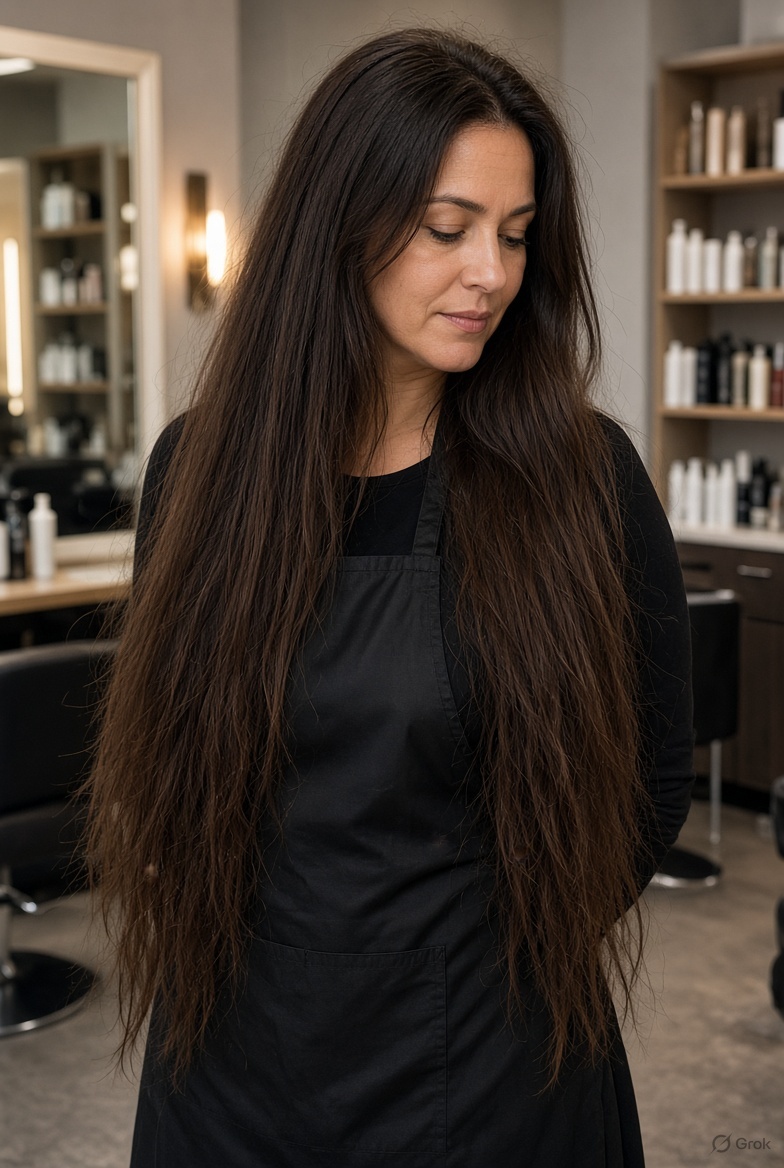
I did not mention Maya’s hair again. I did not ask whether she had thought about what I had said. I simply worked beside her the way I always had—calm, precise, professional—while the quiet pressure of the unanswered question remained between us like a held breath. She arrived each morning at the usual time. She hung her coat. She tied her apron. Her long dark-brown hair was always down at first, heavy past her hips, the dry ends moving against the backs of her thighs when she walked. Sometimes she gathered it into a low ponytail once the first client arrived. Sometimes she left it loose. I watched either way.
I did not comment.
On the second day after our conversation I went to Vanessa’s café in the late afternoon, the way I sometimes did when the studio was quiet. The place smelled of roasted coffee and warm pastry. Vanessa was behind the counter when I entered, her dark-brown hair falling in long layers around her shoulders and down her back, the ends curling slightly where they reached her hips. She looked up and smiled the moment she saw me—the same easy, intelligent smile she always offered, the one that never quite revealed how much she noticed.
“Raven,” she said. “I was beginning to think you’d forgotten the way here.”
“I’ve been busy.”
“The school?”
“Among other things.”
She made my usual order without asking and brought it to the small table near the window where I preferred to sit. Then she joined me for a few minutes, wiping her hands on a clean towel. Her hair shifted when she moved—thick, glossy, deliberately cut so that the layers framed her face and then fell in a long, controlled cascade. I had held that hair once. I had washed it, conditioned it, brushed it until it shone, parted it down the middle, gathered it into a tight ponytail secured with a strand of its own length, and pressed the handle of a razor against her scalp without ever opening the blade. She had thanked me for stopping. She had also asked me to call her if another headshave occurred. The request still sat between us, unanswered in any practical sense.
“You look tired,” she said lightly.
“I’m fine.”
“And the collection?” She kept her voice low, almost playful, but her eyes were steady. She did not know the full truth of the private room. She only knew that I kept things. That hair mattered to me more than it mattered to most people.
“Intact,” I answered.
Vanessa studied me for a moment longer than was strictly polite. Then she smiled again, smaller this time. “You’re thinking about something.”
“I’m always thinking about something.”
“Something specific.”
I drank my coffee and did not answer. She let the silence stand. That was one of the things I valued about her—she did not need to fill every quiet space. After a while she returned to the counter, and I finished my drink while watching the street through the window. When I left I told her I would come again soon. She said she would hold me to it.
I walked back to the studio through the cooling air. Maya was still there, finishing a client’s blow-dry. Her own hair had been pinned up for the afternoon; a few dark strands had loosened and fallen along her neck. I watched her hands move—competent, practiced, slightly automatic. When the client left she began sweeping the floor without being asked. I thanked her. She nodded. Neither of us mentioned the conversation from days earlier. The subject remained untouched, and therefore present.
The next day was the same in almost every detail.
I opened the studio. Maya arrived. Clients came and went. Hair was washed, cut, styled, discussed in the ordinary language of length and shape and what would be easier to manage. I performed each service with the same care I always did. Between appointments I caught Maya looking at herself in the mirror once when she thought no one was watching. She lifted a section of her hair, examined the ends, then let it fall again. The movement was quick. Almost embarrassed. I pretended not to see it.
In the late afternoon I returned to Vanessa’s café. She was speaking with a regular customer when I entered, her posture easy, her hair moving when she laughed. I waited until she was free. We talked about nothing important—the weather, a book she had finished, a new pastry she was testing. She asked whether the studio was busy. I said it was steady. She asked whether Maya was well. I said she was. Vanessa’s gaze lingered on me a moment longer, thoughtful, but she did not press.
I left with the taste of coffee still in my mouth and the image of her hair still clear in my mind. Hip-length. Layered. Thick enough to fill both hands. I would not take it. I knew that. But the wanting remained, quiet and persistent, a private ache that had no practical outlet.
That evening, after Maya had gone and the studio was locked, I stood for a while in the private room with the lamp on. Twenty ponytails. The empty space beside them. I did not touch anything. I only looked, and thought about the days still to come, and about the moment when ordinary time would end and the real work would begin.
The following morning Maya arrived a few minutes early. Her hair was down again. She had brushed it carefully; the upper lengths shone, but the ends still told the truth of neglect. She greeted me the way she always did. I greeted her the same way. We prepared the stations in silence. The first client arrived. The day unfolded exactly as the ones before it had unfolded—cuts, conversations, the soft sound of water and scissors and the low hum of the dryer.
I watched her throughout.
I watched the way she moved when she thought the subject of her own hair had been forgotten. I watched the small signs of tension that appeared whenever our eyes met for too long. She was still thinking about it. The time she had asked for was not empty. It was working on her, slowly, the way I had intended.
In the afternoon I went once more to the café. Vanessa was not behind the counter this time; she was seated at a small table with a notebook, her hair gathered loosely over one shoulder. She looked up and gestured for me to join her. I did. We spoke for nearly half an hour. She told me about a supplier who had disappointed her. I told her about a difficult client who had changed her mind three times during a single appointment. The conversation was easy, familiar, almost warm. Underneath it I remained aware of the length of her hair, the way the layers shifted when she turned her head, the memory of how it had felt when I had gathered it into that temporary ponytail and stopped just short of the irreversible.
When I rose to leave she walked me to the door.
“You’re quieter than usual,” she said.
“Am I?”
“Yes.” She studied my face. “Whatever you’re planning, be careful with it.”
I held her gaze. “I’m always careful.”
She did not look convinced, but she let me go without further comment. I walked back to the studio through streets that were beginning to empty. The light was fading. Maya was finishing the last client of the day. I helped her close, the two of us moving through the familiar tasks in near silence. When everything was done she paused near the door, one hand on the strap of her bag.
“Good night, Raven.”
“Good night, Maya.”
Ordinary days.
They would not last much longer.
I turned off the light, locked the room, and went home with the slow, settled certainty that the next time I closed the studio with Maya still inside, the conversation would not remain unfinished.
** Chapter 4** **Closing Time**
The day had been steady but not unusually busy. Clients came and went in the ordinary rhythm the studio had settled into over the years. I cut, shaped, listened, reassured. My own hair remained bound in a low, practical bun at the nape of my neck; even so, I could feel the heavy length of it pulling gently whenever I turned my head. The weight had become so familiar that I only noticed it when the room was quiet enough for small sensations to surface.
Maya worked at the second station. Her long dark-brown hair was down for most of the morning, then gathered into a loose ponytail after lunch when the air grew warmer. The ends still looked dry. I had watched them brush the backs of her thighs each time she moved from chair to sink. She had not spoken of the conversation we had days earlier. Neither had I. The subject remained suspended between us, present in every silence.
By late afternoon the last scheduled client had left. The light outside had begun to soften into the deeper grey of early evening. I finished cleaning my station, wiped down the mirrors, and emptied the small bins of hair. Maya was sweeping near the front. The soft rasp of the broom against the floor was the only sound for several minutes.
I walked to the door, turned the lock, and flipped the sign to Closed. The soft click of the lock and the dull sound of the sign against the glass felt louder than they should have. Maya looked up. Her hands paused on the broom handle.
“We’re done for the day?” she asked.
“We are.”
She nodded and returned to sweeping, but the movement had lost some of its automatic quality. I watched her for a moment longer. The ponytail she had made earlier had loosened; a thick section of hair had slipped free and now hung along the side of her neck. I could see the damaged ends more clearly in the angled light.
I did not speak immediately. I finished the last of the small closing tasks—unplugging the dryers, checking the back room supplies, setting the appointment book in its place. My own hair shifted against my back when I reached up to adjust a shelf. Even secured, the length of it remained a constant presence, a quiet reminder of how much of myself I carried from one day to the next.
When there was nothing left to do, I turned to face her fully.
“Maya.”
She stopped sweeping. The broom rested against her leg. She did not look at me at first. When she finally did, her expression was carefully neutral, the way it became when she sensed a conversation she was not ready for.
“Yes?”
“Come sit down for a minute.”
She hesitated. The broom remained in her hand. I waited. After a few seconds she leaned it against the wall and walked toward the chair I indicated—the one at my station. She sat slowly, as if the act itself already carried weight. Her long hair spilled over the back of the chair and hung down, the ends nearly reaching the floor. I moved behind her and rested my hands lightly on the back of the chair, not yet touching her.
“You’ve had time,” I said.
Her shoulders tensed. “I know.”
“And?”
She was quiet for several breaths. In the mirror I could see her face clearly—the careful composure, the faint tightness around her mouth, the way her eyes avoided mine. Her hands rested on her thighs, fingers slightly curled.
“I still don’t know,” she said at last. “I keep thinking about it. I look at it in the mirror at home. I try to imagine it shorter. But every time I get close to deciding, something pulls me back.”
I let the silence settle for a moment. Then I reached out and lifted a section of her hair, letting the length slide through my fingers. The upper part was still healthy, still thick. The ends were rough, split, uneven. I held the damaged portion so she could see it in the mirror.
“This isn’t a decision about style anymore,” I said. “It’s a decision about whether you’re going to keep carrying something that no longer fits the life you actually want.”
Maya’s breathing had changed. I could see the slight rise and fall of her chest. She stared at the hair in my hand as if it belonged to someone else.
“I don’t know what I want,” she whispered.
“You know enough.” I released the section and let it fall. “You’ve known for a long time that something needs to change. The hair is only the part you can actually reach.”
She closed her eyes briefly. When she opened them again they were brighter than before. “I’m scared.”
“I know.”
“What if I do it and nothing feels different? What if I just look in the mirror and hate what I see?”
I rested both hands on her shoulders. The contact was light, but deliberate. My own hair brushed against my back as I leaned forward slightly. “Then you’ll know. Right now you don’t know anything except that staying the same is starting to hurt.”
Maya’s hands tightened on her thighs. A long moment passed. Outside, a car moved down the street; the sound of it faded quickly. The studio felt very contained, very quiet.
“I don’t think I can do a big change all at once,” she said.
“You don’t have to decide the entire thing tonight.” My voice remained calm, steady. “But you do have to stop pretending the question will answer itself if you wait long enough.”
She looked at me in the mirror. For the first time since she had sat down, her gaze held mine. There was fear in it, and something else—something that looked almost like relief at no longer being the only one holding the weight of the decision.
“What do you think I should do?” she asked.
I did not answer immediately. I moved my hands from her shoulders to the heavy fall of her hair, gathering it gently at the nape of her neck so she could feel the sudden lightness there. The length of it filled my hands. I held it for a few seconds, then let it drop again.
“I think you should let me start,” I said. “Tomorrow. Early. Before anyone else is here. We’ll take the damaged ends first. You’ll see how it feels to lose even that much. Then we can talk about the rest.”
Maya’s throat moved as she swallowed. She stared at her own reflection, at the long dark hair that had framed her face for so many years, at the woman who was beginning to look uncertain inside it.
“And if I say I need more time?”
“Then you’ll have more time,” I said. “But the ends will still be damaged. The weight will still be there. And you’ll still be the same person who walked in here this morning.”
The words settled between us. I did not add anything further. I simply stood behind her, my hands resting lightly on the back of the chair again, and waited.
Maya’s eyes filled slowly. She blinked and one tear tracked down her cheek. She wiped it away quickly, almost angrily.
“Okay,” she said, so quietly I almost missed it.
“Okay?”
“We’ll start with the ends.” Her voice was thin. “Tomorrow. Early.”
I nodded once. “Tomorrow.”
She sat for another minute without speaking. Then she rose. The long hair swung heavily as she stood. She did not look at me as she gathered her bag and coat. At the door she paused, one hand on the handle.
“Raven.”
“Yes?”
“Don’t let me change my mind in the morning.”
I met her eyes in the reflection of the glass door. “I won’t.”
She left. The bell above the door gave its soft sound. I locked it behind her and stood for a while in the empty studio, listening to the quiet that followed.
My own hair had begun to loosen from its bun. A thick section had slipped free and now rested against my neck. I reached up and released the rest of it, letting the full length fall down my back until the ends brushed the backs of my thighs. The weight of it was familiar and, in that moment, oddly steadying.
I turned off the lights one by one. Then I left the studio, locked the outer door, and walked home through the cooling evening air.
At the apartment I did not go immediately to the private room. I made tea. I stood at the window for a while. Only later, when the quiet of the place had fully settled, did I unlock the second bedroom and turn on the low lamp.
Twenty ponytails rested in their careful order. I stood in front of them for a long time, feeling the soft pull of my own hair against my back, and thought about the woman who would sit in my chair tomorrow morning with the damaged ends of her long dark hair and the first real crack in her resistance.
I did not touch the collection.
I only looked, and planned, and felt the slow, certain movement of the days that were no longer ordinary.
**Chapter 5**
**The Decision**
I arrived at the studio earlier than usual.
The street was still quiet. The sky held that pale, undecided light that comes just before the day fully begins. I unlocked the door, turned on only the lights near my station, and set my bag down. My hair was still damp from the morning shower; I had brushed it out completely and left it loose so it could finish drying. The long black length of it moved against my back with every step, the ends brushing the backs of my thighs whenever I turned. I gathered it slowly into a low, loose ponytail and secured it, feeling the familiar weight settle against my spine.
I prepared the station with more care than the ordinary day required. Clean cape. Fresh towels. The wide-tooth comb. The sharp shears I preferred for long hair. I did not take out the clippers or the razor yet. Those would come later, if the morning went the way I intended.
Maya arrived ten minutes after me.
She stepped inside as if the threshold itself required courage. Her long dark-brown hair was down, brushed but still slightly uneven at the ends. She had not put it up. She closed the door behind her and stood there for a moment, bag still on her shoulder, looking at the empty studio and then at me.
“You’re early,” she said.
“So are you.”
She gave a small, tight smile that did not reach her eyes. She set her bag down, hung her coat, and walked slowly toward the chair I had already positioned. She did not sit immediately. She stood beside it with one hand resting on the backrest, fingers pressing into the leather.
“I almost didn’t come,” she said.
“I know.”
“I told myself I could still change my mind. That we could just open the studio like any other day and pretend we hadn’t talked about any of this.”
I waited. My own ponytail shifted against my back when I moved closer. I did not speak. Sometimes silence did more work than words.
Maya’s throat moved as she swallowed. “But I kept hearing what you said. About carrying something that doesn’t fit anymore. About not knowing anything if I never change anything.” She looked down at the floor, then at the chair, then finally at me. “I’m still scared.”
“I know you are.”
“And you’re still going to do it.”
It was not quite a question. I met her eyes and answered evenly.
“We’re going to start. That’s all. The damaged ends first. You’ll feel what it’s like to lose even that much. Then we decide what comes next.”
She let out a slow breath. Her shoulders dropped a fraction. After another long moment she sat down in the chair. The hydraulic base gave its soft, familiar sigh. Her long hair spilled over the back and hung down in a heavy dark curtain, the dry ends nearly touching the floor.
I moved behind her and placed my hands lightly on her shoulders. The contact was steady, grounding. In the mirror I watched her face—the tight mouth, the unsettled eyes, the way she kept glancing at her own reflection as if trying to memorize it.
“I’m going to take the cape,” I said.
She nodded. I draped the dark cape around her, fastening it at the neck with careful fingers. The fabric settled over her shoulders and lap. Only her hair remained free, long and dark and still belonging entirely to her for a few more minutes.
I began by brushing it out completely.
The wide-tooth comb moved slowly from roots to ends. I took my time. Section by section I worked through the length, feeling the healthy thickness of the upper hair and the rough, brittle resistance of the last several inches. Small white flecks of split ends lifted and drifted to the floor. Maya sat very still. Her hands rested on the arms of the chair, fingers curled loosely around the edges.
“You’ve been neglecting this for a long time,” I said quietly.
“I know.”
“It doesn’t have to stay this way.”
She did not answer. I continued brushing until the entire length hung smooth and free. Then I gathered it gently at the nape of her neck, lifting the weight so she could feel the sudden lightness against her scalp. A soft sound escaped her—something between a breath and a suppressed protest. I held the hair there for a few seconds longer than necessary before letting it fall again.
“I’m going to section it now.”
I divided the hair into clean horizontal sections, clipping the upper lengths out of the way so that only the damaged ends remained free. The contrast was clear under the light: healthy dark brown above, dry and frayed below. I picked up the shears.
Maya’s eyes followed the movement in the mirror.
“Raven—”
“I’m only taking what’s already broken,” I said. “Nothing more. Not yet.”
She pressed her lips together and gave a single, tight nod.
I made the first cut.
The sound of the shears was soft and decisive. A length of dry, split hair fell away and landed on the cape. Maya flinched as if the sensation had travelled further than the ends. I continued steadily, working around the bottom section, removing the damaged portion in clean, even passes. Each cut released another small fall of rough brown hair onto the dark fabric. The studio remained very quiet except for the metallic whisper of the blades and the soft sound of hair landing.
When I finished the first full pass I stepped back slightly so she could see.
Several inches were gone. The new ends were still long—well past her shoulders—but they were clean. The dry, uneven fringe that had hung near her thighs was no longer there. Maya stared at her reflection. Her hand rose slowly, as if she were not sure she was allowed to touch, and felt the place where the hair now ended. Her eyes shone.
“It feels lighter,” she whispered.
“It is.”
“I didn’t think it would feel like this much.”
I set the shears down and rested my hands on her shoulders again. My own ponytail brushed against my back as I leaned forward. “This is only the beginning of what lighter can feel like.”
She closed her eyes. A tear slipped free and tracked down her cheek, followed by another. She did not wipe them away this time. She simply sat there with the cape around her and the newly cut ends of her hair resting against her back, breathing as if the air itself had changed weight.
“I don’t know if I can do more,” she said.
“You don’t have to know yet.” I kept my voice calm, steady, almost gentle. “We’ve started. That’s enough for this moment.”
But I was already thinking past the moment. I was thinking about the next cuts, about the way the length would continue to leave her, about the chair and the mirror and the quiet force I was prepared to use when her courage failed. The damaged ends had been the opening. The rest would follow.
Maya opened her eyes and looked at me in the mirror. Her face was wet. Her expression held fear and something harder to name—something that looked like the first crack in a long resistance.
“Don’t stop if I ask you to stop,” she said very quietly.
I held her gaze.
“I won’t.”
She gave a small, broken nod. Then she leaned back in the chair, the newly shortened hair shifting against the cape, and waited for whatever came next.
Outside, the street was beginning to wake. Inside the studio the light remained soft and contained. I picked up the comb again and began to section the hair for the next stage, my own long black ponytail resting heavily against my spine, the private certainty of what I intended settling deeper with every quiet breath.
**Chapter 6**
**The First Cuts**

The studio remained locked.
Morning light pressed softly against the half-drawn blinds, but none of the ordinary noise of the street entered the room. The closed sign still faced the glass. Inside, only the lights above my station were lit, creating a clean, contained brightness around the chair. Everything beyond that circle stayed in gentle shadow.
Maya sat under the dark cape. The damaged ends were already gone. I had removed them carefully at the beginning of the session—nothing more. What remained of her hair was still long, still thick, still heavy. It fell well past her shoulders and continued down her back in a dark, unbroken length. The new ends were clean and even, but the overall impression was unchanged: a woman with very long hair. That was exactly how I wanted it.
She kept reaching up beneath the cape to touch the place where the hair now stopped. Each time her fingers found the clean ends she exhaled as if the sensation still surprised her. Her eyes were red from earlier tears, but she was no longer actively crying. The fear had settled into something quieter and more watchful.
I stood behind her, wide-tooth comb in hand. My own hair was bound in a low, heavy ponytail. Even secured, the long black length of it rested against my spine and pulled gently at my scalp with every movement. I had left it that way deliberately. The weight kept me present.
“It still feels like mine,” Maya said, staring at her reflection.
“It is still yours.”
“For now.”
I did not answer that. I simply began brushing.
I took my time. Long, slow strokes from roots to ends, section by section, letting the comb travel the full remaining length. The hair was thick and responsive. It caught the light and shone. I watched Maya’s shoulders in the mirror. The rigid tension she had carried since she sat down began, very gradually, to loosen. I said nothing about it. I only continued brushing until every strand hung smooth and free.
When I was finished I set the comb down and rested both hands lightly on her shoulders.
“I’m going to play with it for a while,” I said. “Different styles. Nothing permanent. Just so you can see how it moves.”
Maya hesitated, then gave a small nod. “All right.”
I started with a simple left-side part. I combed the hair across, gathered it into a low side ponytail, and secured it loosely with a soft elastic. The style changed her face immediately—softer on one side, more open on the other. Maya tilted her head, studying the effect with cautious curiosity.
“I’ve never worn it like this,” she murmured.
“It suits the shape of your face.”
I left it for a minute, letting her sit with the new feeling. Then I released the ponytail, brushed everything out again, and created a high ponytail instead. The long length swung when she moved. I watched the weight of it shift in the mirror. My own ponytail shifted against my back in answer, a quiet counterweight.
I undid the high ponytail and divided the hair into two loose pigtails that rested over her shoulders. Maya gave a short, startled laugh—the first of the morning—and quickly pressed her lips together as if the sound had escaped without permission.
“I look younger,” she said.
“You look different. That’s all.”
I continued without hurry.
I braided a simple three-strand braid down the centre of her back, then slowly unravelled it. I made two French braids that hugged her scalp before releasing them strand by strand. I twisted sections into soft ropes and pinned them up for a short time, then let them fall. Each style required my hands to move through the full length of her hair—lifting, dividing, smoothing, gathering. The repeated contact was deliberate. I wanted her body to grow accustomed to my hands controlling the hair. I wanted the earlier panic to soften into something more manageable.
It worked, slowly.
Maya’s breathing evened. The tightness in her shoulders continued to ease. She began to watch the transformations with reluctant attention rather than pure dread. Once or twice she reached up to touch a braid or a twisted section before I took it down. The small gestures told me she was no longer braced for immediate harm. She had begun, cautiously, to inhabit the moment instead of only enduring it.
I kept my movements calm and precise. The long black tail of my own hair brushed against my spine whenever I leaned forward or reached. The weight remained constant, familiar, almost steadying.
After a while I said, almost casually, “One more.”
I combed her hair straight again. Then I created a precise middle part from forehead to nape. The line was clean, deliberate, exact. I gathered every strand into a single ponytail that sat at the exact centre of the back of her head. Instead of an elastic I separated a thin strand from the underside of her own hair and used it to bind the ponytail tightly. The method was the same one I had used on every teacher. The finished ponytail hung long and heavy down the centre of her back, secured by nothing that did not already belong to her.
Maya looked at the result in the mirror. The middle part changed her face once more—made it more symmetrical, more exposed.
“This one feels intentional,” she said softly.
“It is.”
She sat with it. The tension in her body had receded further. She reached back once and touched the bound base of the ponytail, then let her hand fall into her lap. For the first time since she had arrived, her posture suggested a fragile, temporary acceptance of being in the chair and under my hands.
I moved slightly to the side of the station, as if reaching for a different comb. My body blocked her view of the drawer for a few seconds. I opened it quietly, closed my fingers around the handle of the straight razor, and brought it out against the side of my leg where she could not yet see it. The metal was cool and familiar. I kept it hidden while I returned to my place directly behind her.
Maya was still studying her reflection—the clean middle part, the long ponytail that followed it. Her expression had softened. The earlier panic had loosened its hold.
I lifted the closed razor and, without speaking, placed the flat of the blade against the centre of the middle part, just behind her hairline.
The metal touched her scalp.
Maya froze.
Her eyes locked on the mirror. For a fraction of a second she did not understand what she was seeing. Then understanding arrived all at once. Her body jerked hard against the chair.
“Raven—what is that?”
I did not move the blade away.
“You know what it is.”
“No.” She tried to lean forward. I placed my free hand firmly on the crown of her head and held her in place. “No. We didn’t talk about this. You said the ends. Only the ends.”
“I said we would start with the ends. We did.”
“Take it off. Take it off me right now.”
Her voice rose. She pushed against the chair arms, trying to stand. I increased the pressure of the hand on her head—steady, absolute—and kept her seated. The long black length of my own ponytail pulled against my scalp as I leaned closer.
“Stay still.”
“Raven, stop it—please—this isn’t what I agreed to—”
“You asked me not to stop if you asked me to stop.”
“I didn’t mean a razor. I didn’t mean this.”
Tears returned in a sudden rush. She twisted under my hand, shoulders shaking, breath coming in short panicked bursts. The ponytail swung with her movements but remained tightly bound by its own strand. The closed blade stayed exactly where I had placed it—centred on the middle part, cool and unmistakable against her scalp.
“I’m not ready,” she choked. “I’m not ready for this.”
“I know.”
“Then stop.”
“No.”
I held her there, one hand firm on her head, the other keeping the razor in place, and let the moment stretch. The studio was silent except for her crying and the soft sound of my own hair shifting against my back when I adjusted my stance.
Maya’s resistance was fully alive again—desperate, physical, tear-streaked—but the chair and my hands were more certain. She could not rise. She could not remove the blade. She could only sit with the knowledge of what had been placed against her scalp and the growing understanding that I did not intend to take it away.
I spoke quietly, close to her ear.
“This is the middle part I always use. This is the ponytail secured with your own hair. This is the razor. You felt the first loss when the ends came off. Everything else follows from here.”
She sobbed and shook her head as much as my grip allowed. Fresh tears fell onto the cape.
I did not open the blade.
I simply kept it there, centred and deliberate, and held her while the first wild edge of her panic began to exhaust itself against the fact that I was not moving.
The morning was still early.
The studio was still locked.
And the shaving had not yet begun.
But the razor was already on her skin, and neither of us was leaving
I kept the closed blade exactly where it was.
The flat of the razor rested against the clean middle part, cool and unmistakable on Maya’s scalp. My other hand stayed firm on the crown of her head, fingers threaded into the hair above the ponytail, holding her in place with steady, unyielding pressure. She twisted and pushed, but the chair and my grip gave her nowhere to go. Each time she tried to rise I corrected her with the same calm force, never rough enough to bruise, never soft enough to allow escape.
“Take it off,” she begged, voice cracking. “Raven, please, take it off me.”
“No.”
“I can’t do this. I thought we were only—”
“We were only starting. We started. Now we continue.”
Her sobs came harder. Tears ran down her face and dropped onto the dark cape among the earlier cuttings of damaged ends. The long ponytail—still secured with its own strand—swung with every desperate movement of her head, but it did not come loose. I had bound it too carefully for that.
I did not open the razor. I simply held it there, centred on the parting line, and let the reality of its presence settle into her.
A soft sound came from the back of the studio.
The rear entrance opened and closed with almost no noise. I did not turn. In the far edge of the mirror I saw the movement: Vanessa stepping inside, closing the door quietly behind her, then remaining near the wall in the half-shadow. Her long layered dark-brown hair fell around her shoulders. She did not speak. She did not announce herself. She simply stood and watched, exactly as I had asked her to.
Maya had not noticed her. All of Maya’s attention was locked on the mirror and on the silver line of the closed blade resting against her scalp.
I adjusted my stance slightly. The long black ponytail of my own hair shifted against my back, the heavy length pulling gently at my scalp. The weight felt grounding. I kept my voice low, close to Maya’s ear, so that only she could hear the words.
“This is the same middle part I used on the others. The same way of binding the ponytail with your own hair. The same razor. You felt the first loss when the ends came off. Everything that follows is only the continuation of that loss.”
“I don’t want it,” she choked. “I don’t want to lose all of it.”
“I know you don’t. That doesn’t change what is going to happen.”
She tried again to twist free. I held her. The struggle was real—her shoulders shook, her hands pushed hard against the arms of the chair, her breath came in short panicked bursts—but it was already beginning to lose strength. The first wild edge of resistance was exhausting itself against the simple fact that I was not moving and the blade was not leaving her skin.
I let the silence stretch. Only her crying and the soft sound of my own hair shifting filled the room. Vanessa remained motionless against the far wall, a quiet witness Maya still did not know was there.
After a long moment I spoke again, still quietly.
“You asked me not to stop if you asked me to stop. Those were your words. I am keeping them.”
Maya’s face crumpled. A broken sound escaped her. She shook her head as much as my hand allowed, tears falling freely.
“I’m scared,” she whispered.
“I know.”
“It feels too final.”
“It is final. That’s the point.”
I kept the razor in place and the pressure on her head steady. My own long black hair rested heavily against my spine, a private reminder of how much I still carried while I prepared to take the last of what she had carried for years. In the mirror I could see both women: Maya in the chair, flushed and crying, the closed blade silver against the dark parting line; and Vanessa near the wall, silent, watching everything.
The morning was still early.
The studio was still locked.
The ponytail was still intact.
The razor had not yet been opened.
But the decision had already been made, and neither of us was leaving the chair until I chose the next movement.
I held her there, feeling the tremor in her body under my hand, and waited for the moment her resistance would thin enough for the real work to begin.
**Chapter 7**
**Maya’s Backstory**
I have had long hair for as long as I can remember.
Not the deliberate, carefully maintained kind of long. The other kind. The kind that simply continues. Year after year it kept growing, and I kept allowing it, until the length itself became part of how I understood my own reflection. Dark brown, thick, heavy enough that I felt it every time I turned my head. By the time I was in my twenties it already fell past my shoulders. By thirty it had reached the middle of my back. By the time I started working at Raven & Rose it had settled past my hips, and I had stopped measuring it.
I never made a decision about it. That was the strange part. There was no morning when I looked in the mirror and said, “I will keep this.” There was only the absence of a decision to cut it. The absence became permanent. The hair stayed.
My life followed the same pattern.
I trained as a stylist because I was good with my hands and because the work was steady. I was never the most ambitious person in any room. I did not dream of owning a salon or building a name. I wanted work that made sense, that had a beginning and an end each day, that did not ask me to become someone louder than I was. When I met Raven I was already in my thirties, already settled into the quiet rhythm of showing up, doing the work, going home. She was younger, sharper, more certain in the way she moved through a room. She offered me a place at her studio, and I accepted because the alternative would have required a decision I did not feel prepared to make.
Years passed.
The studio became the centre of my days. Clients came and went. Hair was washed, cut, coloured, dried. I was good at the work. People left satisfied. Raven trusted me with the quieter clients, the ones who needed patience more than performance. I liked that. I liked being reliable. I liked the way the days stacked on top of each other without demanding that I change.
At home the pattern continued. I cooked simple meals. I watched the same kinds of programmes. I slept. In the morning I brushed my hair, tied it back or left it down, and returned to the studio. The hair grew. The ends dried and split and I trimmed the worst of them only when they became impossible to ignore. Even then I never took more than necessary. The length itself remained sacred in a way I never examined.
I did not think of myself as unhappy. Unhappiness would have required a clearer shape. What I felt was smaller and more persistent: a low, continuous sense that the days were repeating without accumulating into anything. Work. Home. Sleep. Work. The same conversations with clients. The same quiet evenings. The same long dark hair falling past my hips when I undressed at night. Nothing was wrong enough to demand action. That was the problem. The absence of crisis made the stagnation almost invisible.
Sometimes, late at night, I would stand in front of the bathroom mirror and lift the heavy length of my hair, watching the way it shifted under the light. I would think, briefly, about cutting it to my shoulders. Or shorter. Once or twice I even imagined it gone completely, the shape of my head unfamiliar, my face suddenly unprotected. The thought always arrived with a small jolt of fear, and I would let the hair fall again and go to bed.
I never spoke about any of this.
Raven noticed things. She always had. She noticed the dry ends long before I was ready to admit they bothered me. She noticed the way I moved through the same routines. She noticed the quiet dissatisfaction I thought I had hidden. After she returned from the school—after the days she spent there dealing with the lice outbreak and the teachers—something in her attention sharpened. She began to speak about change in a way that felt directed at me even when the words were general. “Perhaps you need a change in your life, Maya.” “Perhaps we can start with your hair.”
I told her I needed time.
I meant it. I also feared what the time would reveal. If I kept the hair, I would be choosing the continuation of everything else. If I let her cut it, I would be admitting that the continuation had become a kind of surrender.
The night before I finally agreed to let her start with the ends, I stood in front of the mirror again. I took the full length of my hair in both hands and held it out to the side, studying the weight of it, the way it had shaped me for so long without my consent. I thought about Raven’s voice when she said she would not let me change my mind. I thought about the quiet certainty in her hands. I thought about how long it had been since I had made a decision that could not be undone.
I went to bed with the hair still long, still heavy, still mine.
In the morning I almost stayed home.
Instead I brushed it one last time, felt the familiar pull of its length against my back, and walked to the studio.
I did not know then how far the day would go. I only knew that the pattern I had lived inside for years was about to meet a force that did not believe in patterns. And for the first time in a very long time, I was not certain I would be the one who decided what remained when the day was over.
**Chapter 8**
**Maya**
I almost didn’t come.
The alarm went off at the usual time, but I lay in bed staring at the ceiling for a long while afterward. My hair was spread across the pillow in its ordinary heavy fall. I reached up and ran my fingers through it, feeling the length, the slight roughness at the ends that Raven had pointed out more than once. The ends were still there. She had not touched them yet. That fact felt important and fragile at the same time.
I got up slowly. In the bathroom mirror I looked at myself the way I had every morning for years: long dark-brown hair framing my face, falling past my shoulders, continuing down my back until it reached well past my hips. It had always been there. I could not remember the last time I had seriously considered changing it. It was simply part of how I existed.
I brushed it out carefully, more carefully than usual. The strokes felt deliberate, almost like a goodbye I was not ready to admit. Then I dressed, tied a soft cardigan over my work clothes, and stood for another minute with my hand on the door handle before I finally left the apartment.
The walk to the studio felt longer than it should have. Every few steps I caught myself touching my hair again, checking that it was still the same. I kept thinking about the conversation from the previous evening—Raven locking the door, telling me I had had enough time, saying we would start with the damaged ends the next morning. I had agreed. I had even asked her not to let me change my mind. In the clear light of morning that request felt dangerous.
When I reached the studio the closed sign was already facing the street. The blinds were half-drawn. Raven had arrived first. I hesitated on the sidewalk, then pushed the door open.
She was waiting near her station. Her own long black hair was bound in a low ponytail that hung heavily down her back. Even from the doorway I could see the weight of it. She looked calm. She always looked calm.
“You’re early,” I said. My voice sounded thinner than I wanted.
“So are you.”
I set my bag down, hung my coat, and walked toward the chair she had already positioned. I did not sit immediately. I stood beside it with one hand resting on the backrest, feeling the leather under my fingers.
“I almost didn’t come,” I admitted.
“I know.”
“I told myself we could just open like any other day and pretend we hadn’t talked about any of this.”
She waited. She was good at waiting.
“But I kept hearing what you said,” I continued. “About carrying something that doesn’t fit anymore. About not knowing anything if I never change anything.” I finally looked at her. “I’m still scared.”
“I know you are.”
“And you’re still going to do it.”
It wasn’t really a question. She met my eyes and answered evenly.
“We’re going to start. That’s all. The damaged ends first. You’ll feel what it’s like to lose even that much. Then we decide what comes next.”
I sat down. The chair accepted my weight with a soft hydraulic sound. My hair spilled over the back and hung down in its usual long, heavy fall. Raven moved behind me and fastened the cape around my shoulders. The fabric settled over my lap. Only my hair remained free.
She began by brushing it out completely. The wide-tooth comb moved slowly from roots to ends. I watched in the mirror as the dark length smoothed under her hands. When she finished she gathered it at the nape of my neck for a moment, lifting the weight so I could feel the sudden lightness against my scalp. A small sound escaped me. She held it there longer than necessary before letting it fall again.
“I’m going to take only what’s already broken,” she said. “Nothing more. Not yet.”
I nodded. I did not trust my voice.
She sectioned the hair and began to cut. The sound of the shears was soft and final. Dry, split ends fell onto the cape in small dark piles. I flinched with every cut even though I had agreed to this part. When she finished the first full pass she stepped back so I could see.
Several inches were gone. The new ends were still long—well past my shoulders—but they were clean. The uneven fringe that had once brushed my thighs was no longer there. I stared at the difference. My hand rose of its own accord and touched the place where the hair now stopped. It felt lighter. It also felt like the beginning of something I could not take back.
“It feels lighter,” I whispered.
“It is.”
“I didn’t think it would feel like this much.”
She rested her hands on my shoulders. I could feel the quiet certainty in her touch.
“This is only the beginning of what lighter can feel like.”
I closed my eyes. Tears slipped free. I did not wipe them away. When I opened my eyes again she was already picking up the comb once more.
She did not cut any further. Instead she began to play with the remaining length. She parted it on the left and gathered it into a low side ponytail. She made a high ponytail that swung when I moved. She divided it into two loose pigtails. She braided a simple plait down the centre of my back, then two French braids that hugged my scalp. She twisted sections into soft ropes and pinned them up for a few moments before letting everything fall free again. Each style required her hands to move through the full length of my hair—lifting, dividing, smoothing, gathering. The repeated contact was strangely calming. The earlier panic loosened its grip. I found myself watching the transformations with a reluctant, fragile curiosity.
“One more,” she said after a while.
She combed my hair straight, then created a precise middle part from forehead to nape. The line was clean and deliberate. She gathered every strand into a single ponytail that sat exactly at the centre of the back of my head. Instead of an elastic she separated a thin strand from the underside of my own hair and used it to bind the ponytail tightly. The finished ponytail hung long and heavy down the centre of my back, secured by nothing that did not already belong to me.
I looked at the result in the mirror. The middle part changed my face—made it more symmetrical, more open, more exposed.
“This one feels intentional,” I said softly.
“It is.”
I sat with it. For the first time since I had arrived, my body began to relax a little. I reached back and touched the bound base of the ponytail, then let my hand fall. The fear was still there, but it had softened into something more uncertain than desperate.
Raven moved slightly to the side of the station. I watched her reflection without real focus, still studying the middle part and the long ponytail. My breathing had evened. The tension in my shoulders had eased.
Then something cool and flat touched the centre of the middle part, just behind my hairline.
I froze.
My eyes locked on the mirror. For a fraction of a second I did not understand what I was seeing. Then the silver line of the closed blade registered all at once. My body jerked hard against the chair.
“Raven—what is that?”
She did not move the blade away.
“You know what it is.”
“No.” I tried to lean forward. Her free hand came down firmly on the crown of my head and held me in place. “No. We didn’t talk about this. You said the ends. Only the ends.”
“I said we would start with the ends. We did.”
“Take it off. Take it off me right now.”
My voice rose. I pushed against the chair arms, trying to stand. The pressure of her hand increased—steady, absolute—and kept me seated. I could feel the long black weight of her own ponytail shift against her back as she leaned closer.
“Stay still.”
“Raven, stop it—please—this isn’t what I agreed to—”
“You asked me not to stop if you asked me to stop.”
“I didn’t mean a razor. I didn’t mean this.”
Tears returned in a sudden rush. I twisted under her hand, shoulders shaking, breath coming in short panicked bursts. The ponytail swung with my movements but remained tightly bound by its own strand. The closed blade stayed exactly where she had placed it—centred on the middle part, cool and unmistakable against my scalp.
“I’m not ready,” I choked. “I’m not ready for this.”
“I know.”
“Then stop.”
“No.”
She held me there, one hand firm on my head, the other keeping the razor in place. The studio was silent except for my crying and the soft sound of her hair shifting when she adjusted her stance. I could not rise. I could not remove the blade. I could only sit with the knowledge of what had been placed against my scalp and the growing, terrifying understanding that she did not intend to take it away.
“This is the middle part I always use,” she said quietly, close to my ear. “This is the ponytail secured with your own hair. This is the razor. You felt the first loss when the ends came off. Everything else follows from here.”
I sobbed and shook my head as much as her grip allowed. Fresh tears fell onto the cape.
She did not open the blade.
She simply kept it there, centred and deliberate, and held me while the first wild edge of my panic began to exhaust itself against the fact that she was not moving.
The morning was still early.
The studio was still locked.
The ponytail was still intact.
The razor had not yet been opened.
But the decision had already been made, and neither of us was leaving the chair until she chose the next movement.
** Chapter 9**
**The Blade**
*(Maya)*

The metal was colder than I expected.
It rested against the exact centre of my scalp like a held secret, a thin silver line that had not yet decided to become permanent. Raven’s hand stayed firm on the crown of my head, fingers threaded deep into the hair above the ponytail, anchoring me with a patience that felt more absolute than anger. I could feel the long black weight of her own hair shifting against her back every time she adjusted her stance. That weight—so familiar, so unbroken—made something bitter and sharp rise in my chest.
For a moment neither of us moved.
In that suspended silence my mind began to race, searching for any doorway that still led back to ordinary morning. Perhaps this was only theatre. Perhaps she wanted to watch the fear climb my face before she laughed and set the razor aside and returned to the gentle game of temporary styles. Perhaps the closed blade was a test of the request I had made the night before—*don’t let me change my mind*—and once I proved I meant it she would release me.
I tried to negotiate with the quiet.
“Raven,” I said, my voice thin and careful, “we can stop here. The ends are gone. That’s already more than I thought I could do. We can leave the rest. I’ll think about a shorter cut next month. Or the month after. Just not today. Not like this.”
She did not answer.
The silence stretched. My heartbeat filled it. I could feel every separate strand of the still-long ponytail hanging down the centre of my back, the way it pulled gently at the base where she had bound it with my own hair. The cape was warm against my legs. The air smelled of clean shampoo and the faint metallic note of the blade that had not yet opened.
A new thought arrived, almost hopeful in its desperation.
Maybe it was a joke.
A strange, sharp-edged joke that only Raven would attempt. She had always understood the private language of hair better than anyone. Perhaps this was her way of forcing me to feel the full shape of my own reluctance so that when she finally withdrew the razor I would be grateful, relieved, ready to laugh at how frightened I had been.
I swallowed.
“Is this a joke?” I asked. The words came out smaller than I intended. “Because if it is, it’s gone far enough. I have work to do. Clients will start arriving soon. We need to open the studio. Just… just get it over with and take that thing away from my head.”
Still she said nothing.
The hand on my crown remained steady. The closed blade remained exactly where she had placed it. My breathing had become shallow, as if any deeper breath might tip the moment into something irreversible.
Then the metal moved.
It was only a small motion at first—the slightest downward pressure, the almost imperceptible shift of the blade against skin—but the sensation was unmistakable. Cool steel travelling slowly along the centre parting. I felt the exact instant the first fine hairs surrendered. There was a tiny, bright sting, then a spreading heat, as if the skin itself had been startled awake after years of darkness. The sound was soft, intimate, final: a quiet whisper of hair giving way.
I cried out.
The sound tore out of me before I could stop it. My body jerked hard against her grip. The ponytail swung. Tears that had been waiting spilled over at once, hot and sudden.
“No—Raven, no—”
She did not stop.
The blade continued its deliberate path down the middle of my head. I could feel every millimetre of its progress. First the fine baby hairs at the hairline, then the thicker strands that had grown there for decades. Each one released with a soft, irreversible sigh. The heat that followed the blade was not quite pain and not quite pleasure; it was simply *aliveness*, raw and unwanted. A narrow path of scalp appeared behind the razor—pale, smooth, burning with new exposure. The air touched it immediately, cool and invasive.
I watched in the mirror, unable to look away.
The strip was only the width of the blade at first. A single clean line of skin running from my forehead toward the base of the ponytail. On either side the long dark hair still framed my face, still fell heavily over my shoulders, still belonged to me. The contrast was unbearable. I could recognise individual strands that had just been taken—strands I had brushed a thousand mornings, strands that had caught in my mouth when I slept, strands that had brushed the backs of my thighs only hours earlier. They were gone. They would never return in the same way.
The grief arrived in a wave so sudden it made me dizzy.
This was not only hair. This was the unbroken continuity of my own reflection. This was the private weight I had carried so long that it had become a kind of identity. Every stroke of the razor was cutting through years of unspoken decisions, through every morning I had chosen not to choose.
Raven reached the place where the ponytail began and paused.
The bare strip was complete—a clean, shocking line of scalp running the full length of the parting. Everything on either side remained long and dark and heavy. The ponytail itself still hung intact, a thick dark rope of everything I had not yet lost.
I sat frozen, breathing in short, broken pulls of air. My hands rose of their own accord and found the newly shaved path. The skin was smooth, almost feverish in its newness. I rubbed it frantically, as if friction could restore what had been taken, as if I could coax the hair back into existence by pure refusal to accept its absence.
Thoughts tumbled over one another, desperate and disordered.
I could wear a hat.
I could buy a wig.
I could say I had done it myself on purpose, a sudden change of style, nothing to do with anyone else.
I could stay home for a week, for two weeks, until enough length returned to hide the evidence.
I could—
Raven’s hands moved.
Gently but without hesitation she took both of my wrists, guided them down, and tucked them firmly beneath the cape so that they rested against my midsection, trapped and useless. The message was clear. I was not to touch the shaved skin again until she allowed it.
Then she returned the razor to my scalp, just to the right of the centre strip, and began again.
The second series of strokes was slower, wider. I felt every millimetre of the blade’s progress as it claimed another narrow band of hair. The long dark length on that side of my head began to loosen, then to fall in soft, heavy pieces onto the cape. Each piece carried its own small history—the way it had moved when I turned my head, the way it had felt against my neck in summer, the way it had weighed on my shoulders at the end of a long day. I recognised them as they fell. The recognition was a private, wordless grief.
The heat followed the blade like a shadow. First the cool kiss of steel, then the bright, spreading warmth of newly exposed skin, then the strange, almost electric awareness of air moving across a place that had never known open air. My scalp felt alive in a way that was almost unbearable. Every nerve ending seemed to be announcing the loss at once.
I sobbed openly now, the sounds raw and helpless. My shoulders shook. The still-long ponytail at the centre swung with each tremor of my body, a constant reminder of how much remained and how little control I had over any of it.
And underneath the grief, something sharper and uglier stirred.
I thought of Raven’s hair.
The long, glossy, jet-black length that still hung heavily down her back even now, bound in its practical ponytail, completely untouched. She stood behind me removing what I had carried for years while her own hair remained perfect, intentional, inviolate. The imbalance felt like a kind of cruelty. Anger rose, hot and sudden, and with it a bitter jealousy that made my throat tighten.
She got to keep hers.
She got to decide.
She got to stand there with the full weight of her own unbroken length while mine fell away under her hands.
The jealousy made the next strokes harder to bear. Each time the razor claimed another section I felt the unfairness of it like a second blade. She was taking something from me that she herself still possessed in abundance. The thought circled, poisonous and bright, while the physical sensations continued—cool steel, bright heat, the soft sound of hair landing on the cape, the growing coolness of my own scalp.
Raven paused only long enough to reposition the razor on the opposite side of the centre strip.
I knew what was coming.
I closed my eyes.
The metal touched my scalp once more, cool and certain, and began its quiet work on the left side. The same sequence repeated: the first fine hairs surrendering, the thicker strands following, the heat blooming behind the blade, the long dark pieces falling away. I felt each one leave. I recognised each one as it left. The grief and the jealousy and the raw physical aliveness of my scalp braided themselves together until I could no longer separate them.
Somewhere behind us there was the faintest shift of movement, a presence I could not fully turn to see. I did not have the strength to wonder about it. All of my attention had collapsed into the narrow world of the chair, the blade, the hand that held me, and the slow, irreversible disappearance of the hair I had carried for so many unbroken years.
The long black weight of Raven’s own hair brushed my shoulder as she leaned in to adjust the angle of the next stroke.
I hated that it was still there.
I hated that mine was not.
And still the razor continued its quiet, merciless work.
The razor returned to the right side of the centre strip and began again.
I felt the exact moment the blade touched skin that still held hair. First the cool kiss of steel, precise and almost gentle, then the tiny bright resistance as the edge found the roots, then the soft, irreversible release. A narrow band of long dark hair loosened and fell forward over my shoulder, landing on the cape with a sound so quiet it felt intimate. Behind the blade the heat bloomed at once—a spreading, living warmth that made the newly exposed scalp feel feverish and raw. The air moved across it immediately, cool and invasive, announcing the absence of every strand that had protected it for years.
I recognised the hair as it fell.
These were the pieces that used to catch against the collar of my coat in winter. These were the strands that brushed my cheek when I turned my head too quickly. These were the ones I had absently twisted around my finger during long, uneventful evenings. Each one carried a private history, and each one was leaving me in a soft, heavy slide I could not stop.
Raven worked with merciless patience. Stroke after stroke, always moving outward from the centre, always leaving the long ponytail untouched at the back. The bare path on the right side widened slowly. What had been a thin line of scalp became a broader river of pale skin. The contrast with the still-long hair remaining further out was almost violent. One half of my head was becoming something new while the other half still clung to the old shape of me.
The jealousy rose again, sharper this time.
I could feel the long black weight of Raven’s own hair brushing against my shoulder whenever she leaned in. It was still perfect. Still heavy. Still completely hers. She stood behind me removing decades of my continuity while her own unbroken length remained a quiet, glossy declaration of everything she had not surrendered. The unfairness of it burned almost as brightly as the newly shaved skin. Anger and envy twisted together until I could no longer tell which one made my throat tighten more.
“You get to keep yours,” I heard myself say, the words thick with tears. “You get to stand there with all of it still attached while you take mine.”
She did not answer. The only reply was the soft whisper of the razor and the quiet fall of another section of my hair onto the cape.
The heat followed every stroke like a second blade. Cool steel, then the bright, spreading warmth of exposure, then the strange electric awareness of air moving across skin that had never known open air. My scalp felt hyper-alive, every nerve ending announcing the loss in a language of pure sensation. I tried to move my hands—to cover the growing bareness, to protect what was left—but they remained trapped beneath the cape where she had placed them. The helplessness of that single detail made the grief sharper.
She finished the right side down to the level of the ponytail and paused only long enough to shift to the left.
I knew the sequence now. I closed my eyes, but the darkness only made the sensations louder. The blade touched the left side of the centre strip. The same cool pressure. The same tiny resistance. The same soft surrender of hair. The same bloom of heat. Long dark pieces began to fall across my other shoulder, joining the growing pile on the cape. I recognised these strands too—the ones that used to stick to my lips when the wind blew, the ones that tangled around the strap of my bag, the ones I had brushed a thousand ordinary mornings without ever truly seeing them.
Each one left a small, private absence.
The bare path on the left widened in the same slow, deliberate rhythm. I could feel the shape of my head changing underneath the razor. The long hair that still remained further out began to feel like a costume I was only temporarily allowed to wear. The ponytail at the centre hung heavier with every passing minute, a dark reminder of everything that had not yet been taken and everything that soon would be.
My sobs had become quieter, more exhausted. The first wild panic had burned itself down into a deep, continuous grief that sat in my chest like a stone. I was no longer fighting the way I had at the beginning. The strength for that had left with the hair. What remained was a kind of stunned endurance—the knowledge that the woman who had walked into the studio with long, heavy, familiar hair was being dismantled one careful stroke at a time, and that I was being forced to feel every second of the dismantling.
Raven’s long black hair brushed my shoulder again as she leaned closer to adjust the angle of the blade. The soft, living weight of it made the jealousy flare once more, bright and bitter.
She still had all of hers.
I was losing all of mine.
And she was the one deciding the speed of the loss.
The razor continued its quiet work, stroke after stroke, widening the bare territory, claiming more of the long dark length that had defined me for so many unbroken years. The heat kept blooming behind each pass. The air kept touching the new skin. The pile of hair on the cape kept growing.
I no longer tried to negotiate.
I only sat in the chair with my hands trapped, my scalp burning with fresh exposure, and the long black weight of Raven’s untouched hair moving against me like a quiet accusation, while the last of my own length waited for the blade to reach it.
The razor finished the left side down to the level of the ponytail and paused.
For a moment the only sound in the studio was my own uneven breathing and the soft shift of Raven’s long black hair against her back. I opened my eyes. The mirror showed me something I was not prepared to see.
The centre of my head and both sides down to the ponytail were bare. A wide, pale river of scalp ran from my hairline to the base of the still-intact ponytail. Long dark hair still framed the outer edges of my face and hung over my shoulders, but the greater part of my head was already exposed. The contrast was shocking. I stared at the shape of my own skull as if it belonged to a stranger who had been living underneath me the entire time.
The heat from the newly shaved skin still pulsed, a living reminder of every stroke. Yet as I looked—really looked—something unexpected began to move beneath the grief.
I did not look as ruined as I had feared.
The bare scalp was smooth. The shape of my head was cleaner than I had imagined. Without the heavy curtain of hair my eyes seemed larger, my cheekbones more defined, my face somehow more honest. The grief was still there, heavy and real, but it had begun to thin at the edges, replaced by a startled, almost reluctant recognition.
*I don’t look that bad.*
The thought arrived quietly, almost against my will. I tried to push it away, but it stayed, growing clearer with every second I stared at the reflection. The woman in the mirror looked exposed, yes—vulnerable, stripped of the familiar armour of length—but she did not look broken. She looked like someone who had been carrying too much for too long and had finally been set down.
Raven’s hand returned to the ponytail.
I felt her fingers work at the single strand of my own hair that bound it. The knot loosened. The long, heavy rope of everything that remained came free in her hand. For one suspended second it still hung against my back, the last unbroken connection to the person I had been that morning. Then she lifted it away.
The final weight left me.
Air touched the last protected strip of my scalp. The sensation was sharper than any previous stroke—cool, complete, absolute. I made a broken sound that was half sob and half something closer to release. The ponytail was gone. All of it was gone. My head felt impossibly light, as if gravity itself had changed.
Raven set the long dark length carefully aside and returned the razor to the remaining patches of hair along the sides and nape. Each final stroke was slow and thorough. I felt every one of them—the cool steel, the tiny resistance, the soft fall of the last strands, the bloom of heat across skin that had never known open air. Yet the panic that had accompanied the earlier strokes had quieted. In its place was a deep, exhausted stillness.
I kept looking at the mirror.
The bare scalp. The unfamiliar shape of my own head. The way my face seemed to belong more completely to me without the heavy frame of hair. The grief was still present—I could feel it sitting in my chest like a stone—but it no longer filled every part of me. Something else had begun to grow beside it: a fragile, astonished acceptance.
*I don’t look that bad without it.*
The thought returned, stronger this time. I turned my head slightly, watching the light move across the smooth skin. The jealousy toward Raven’s long black hair still flickered—she still had all of hers, heavy and perfect and untouched—but even that bitterness had lost some of its sharpness. She had taken everything I thought I needed to remain myself, and yet the person looking back at me from the mirror was still recognisably me. Perhaps more recognisably me than the woman who had walked in with all that length.
Raven made the last few passes at the nape of my neck, cleaning every remaining strand. When she finally set the razor down, the silence in the studio felt enormous.
I sat very still, hands still trapped beneath the cape, scalp burning softly with new exposure, the long black weight of Raven’s own hair visible in the mirror behind me like a quiet, living contrast. The pile of my hair on the cape and floor was dark and heavy and finished. The ponytail she had removed lay separate, a single coherent remnant of everything that had been taken.
I drew a slow, shaking breath.
The grief was still there.
The shock was still there.
But underneath both, something quieter and more complicated had begun to take root—the first fragile understanding that I might be able to live inside this new shape after all.
Raven’s hands came to rest on my bare shoulders. The contact was steady, almost gentle.
I met her eyes in the mirror and did not look away.
**Chapter 10**
**Aftermath**
*(Maya)*

The razor stopped.
For a long moment the only sound in the studio was the soft hum of the lights and my own uneven breathing. Raven set the blade down on the station with quiet finality. The cape still covered my shoulders and lap, heavy with the dark remains of what had been taken. I sat perfectly still, staring at the mirror as if the woman looking back might change if I looked long enough.
My head was bare.
Completely, irrevocably bare.
The air moved across every part of my scalp at once—cool, unrestricted, almost shocking in its freedom. There was no longer any weight pulling at the roots, no soft curtain brushing my neck or shoulders, no familiar swing when I turned. The absence felt enormous. It felt like standing in a room where a large piece of furniture had been removed and the empty space still held the shape of what used to be there.
Slowly, as if the movement itself might break something, I lifted my hands from beneath the cape. My fingers trembled when they first touched the smooth skin. I mapped the shape of my own skull the way a blind person might read a face—forehead, crown, the curve toward the nape, the unfamiliar roundness behind my ears. The skin was warm, still faintly burning from the passage of the blade. It felt too alive, too exposed, too new.
Tears rose again, but they were quieter than before. The wild panic had burned itself out during the shave. What remained was a deep, hollow grief that sat in my chest like cold water. I had carried that hair for so many years that losing it felt like losing a version of myself I had never consciously chosen but had also never known how to release.
And yet—
I kept looking.
The bare scalp did not look as ruined as I had feared in the worst moments of the shave. The shape of my head was cleaner than I expected. Without the heavy frame of hair my eyes seemed larger, my cheekbones more defined, my face somehow more direct. The woman in the mirror looked stripped, yes—vulnerable, unprotected—but she did not look broken. She looked like someone who had been set down after carrying too much for too long.
*I don’t look that bad.*
The thought returned, stronger now that the blade was gone and the finality had settled. I turned my head slowly from side to side, watching the light move across the smooth skin. The grief was still present, still heavy, but it no longer filled every corner of me. Something else had begun to grow beside it: a fragile, astonished recognition that I might be able to live inside this new shape.
In the mirror I could see Raven standing behind me. Her long black hair remained perfect, heavy, completely untouched, still bound in its practical ponytail. The contrast made a small, bitter spark of jealousy flare again—she still had all of hers—but even that feeling had lost some of its heat. The worst of the anger had gone with the last strokes of the razor.
I became aware of another presence in the room.
Vanessa stood near the far wall, silent, her own long layered hair falling around her shoulders. She had been there the entire time. I had felt the shift of movement earlier but had not been able to turn or process it. Now, with the shave finished and the cape still heavy on my lap, I met her eyes in the mirror for a brief second. There was no triumph in her expression, no pity either—only a quiet, complicated attention. I looked away first.
Raven’s hands came to rest lightly on my bare shoulders. The contact was steady, almost gentle. She did not speak. She simply stood with me while I continued to touch my own head, while I continued to stare at the stranger who was also myself.
The studio remained locked.
The pile of my hair lay dark and finished on the cape and floor.
The long ponytail she had removed rested separately on the station, a single coherent remnant of everything that had been taken.
I drew a slow breath and felt the air move freely across every part of my scalp.
The woman who had walked into the studio that morning with long, heavy, familiar hair was gone.
The one who remained was still learning how to exist inside the silence that followed.
I kept my hands on my bare head and did not look away from the mirror.
**
Chapter 11**
**Consolation**
*(Maya)*
Raven’s hands remained on my bare shoulders for a long time.
The studio stayed locked and quiet. The dark remains of my hair lay across the cape and the floor. I kept staring at my reflection—at the smooth, unfamiliar shape of my own head—while the air moved freely across every part of my scalp.
I expected her to speak immediately, to offer some brisk professional reassurance or a practical suggestion about scarves and growing-out stages. She did not. She simply stood behind me, the long black weight of her own hair still hanging untouched down her back, and let the silence hold us both.
When she finally spoke, her voice was low and even.
“You’re allowed to hate me for a while.”
The words landed strangely. I had been prepared for justification, not permission. Fresh tears rose, quieter than the ones that had fallen during the shave.
“I don’t know what I feel yet,” I said. My voice sounded rough. “It’s too much. It still feels like you took something I wasn’t ready to give.”
“I know.”
She moved around the chair so that she stood beside me rather than behind. In the mirror we looked like two different versions of the same story—one still carrying the full, glossy length she had never surrendered, the other newly stripped of everything that had defined her silhouette for years. The contrast made my chest tighten again.
“Why?” I asked. The question came out smaller than I intended. “Why did you go all the way? You could have stopped at the ends. Or at the shoulders. You could have left me something.”
Raven was quiet for a moment, considering. When she answered, the words were measured, almost careful.
“Because something partial would have let you keep pretending. A shorter cut would still have been long enough to hide behind. You would have gone home, looked in the mirror, and told yourself the real decision could wait a little longer. I didn’t want to leave you that doorway.”
I closed my eyes. The truth of it stung even as part of me recognised it.
“You needed the full weight of it,” she continued. “The irreversible part. The moment where there was nothing left to bargain with. I’ve watched you carry that hair—and everything it represented—for years without ever choosing it. Today I chose for you, because you had stopped being able to choose for yourself.”
My hands rose again to my bare scalp, mapping the smooth skin as if the gesture could still undo what had been done. The skin was warm. The air still felt too present against it.
“It felt like you forced me,” I said, the words bitter.
“I did,” she answered simply. “Not with violence. With certainty. You had already asked me not to let you change your mind. I held you to that request even when you tried to take it back.”
The honesty should have made the anger return full force. Instead it landed with a strange, exhausting clarity. She was not pretending this had been gentle. She was not dressing the act in pure kindness. She had seen the stagnation I lived inside, and she had acted on it with a decisiveness I had never been able to summon for myself.
I looked at my reflection again. The bare head. The exposed face. The woman who no longer had the option of hiding behind length.
“I asked you not to let me change my mind,” I said slowly.
“You did.”
“And you didn’t.”
“No. I didn’t.”
A long silence settled between us. Outside, the ordinary morning continued without us. Inside the locked studio the only reality was the smooth skin under my palms and the quiet presence of the woman who had removed everything else.
The grief was still there. The shock was still there. But beneath both, something else had begun to take shape—the reluctant understanding that she had seen a truth I had spent years avoiding, and that she had acted on it when I could not.
I drew a slow breath and met her eyes in the mirror.
“I still don’t know if I can forgive you,” I said.
“You don’t have to decide that today.”
“But I think…” The words came carefully, testing their own weight. “I think I understand why you did it.”
Raven’s expression did not change, but something in her posture eased by a fraction. She reached out and rested her hand lightly against the side of my bare head, a brief, steadying contact.
“That’s enough for now,” she said.
I nodded once, feeling the air move across my scalp with the small motion. The long black length of her own hair remained perfect and untouched behind her. The distance between that fact and my own bare skin still hurt. But for the first time since the razor had touched my head, the hurt no longer felt like the only thing left.
I kept my hands on my bare scalp and did not look away from the mirror.
The woman who had walked in with long hair was gone.
The one who remained was beginning—slowly, painfully, truthfully—to accept the silence that followed.
**Chapter 12**
**The Collection**
*(Raven)*

The studio was quiet again.
Maya had left some time earlier, moving carefully, one hand rising again and again to the bare surface of her head as if she still needed proof that the weight was truly gone. I had unlocked the door for her and watched her step out into the ordinary morning light. She did not look back. The closed sign remained facing the street. I did not turn it around.
I stood alone among the evidence of what had been done.
The cape still lay draped over the chair, dark and slightly damp in places where the fallen hair had held the last traces of warmth from her scalp. The long ponytail I had released at the end rested separately on the station, bound by the single strand of her own hair I had used to secure it. It was thick, dense, the colour of dark earth after rain. When I lifted it, the weight settled into both of my palms with a slow, familiar heaviness. Even separated from her body it still carried the faint clean scent of the shampoo I had used earlier, mixed with the warmer, more private smell of skin and the metallic edge of the razor’s work.
I did not take it to any back room. There was no private space here for that purpose. The collection lived at home, in the locked second bedroom of my apartment, where twenty lengths already waited in careful order. This one would join them—but not yet. Not until the day was finished, not until every other obligation had been met and the studio door was locked behind me for the night. For now it would remain here, with me.
I set the ponytail down again and began the slow work of gathering the rest.
Strand by strand I collected what had fallen onto the cape and the floor. The smaller pieces from the first pass—the dry, brittle ends that had snapped cleanly under the shears—still felt rough between my fingers. The longer sections that had come away during the main shave were softer, heavier, still holding a faint residual warmth. Each handful carried the memory of resistance and release: the soft drag of the razor, the quiet sound of roots giving way, the sudden coolness that had followed across newly exposed skin. I placed them together with quiet attention. There was no audience for this part. No one to see the care I took, or the private satisfaction that moved through me like a low, steady current as I handled what had so recently been part of a living woman.
The memory of the shave remained vivid against my skin.
The first cool placement of the closed blade against the middle part. The way her body had jerked when she understood. The sound of her voice breaking on the word *please*. The slow, deliberate strokes that followed—the soft resistance of each section of hair, the bright heat that had bloomed across newly revealed scalp, the gradual widening of the bare path while the long ponytail remained intact until the very end. I had felt the exact moment her physical resistance began to exhaust itself. I had felt the shift when grief replaced panic, and then the quieter shift when even the grief began to thin as she studied her own reflection.
All of it belonged to me now in a way that had nothing to do with spoken agreements. It lived in the dense weight of the ponytail on the station and in the private knowledge that I had been the one to take it.
I thought of my own hair as I worked.
The long black length of it was still bound in its practical ponytail, heavy against my spine. When I turned my head I felt the familiar pull at the roots, the soft brush of the ends against the small of my back. I had not touched it during the entire process. It remained exactly as it had been when the morning began—glossy, unbroken, fully mine. The contrast pleased something deep and unspoken in me. I had removed every strand of hers while keeping every strand of my own. The imbalance felt correct. Necessary.
When the loose hair had been gathered I wrapped the ponytail carefully in clean tissue. The paper whispered against the dark strands. I placed the wrapped length inside a shallow box I kept for such things and set the box on the highest shelf of the supply cupboard, out of casual sight. It would stay there until the end of the day. Until after whatever else the afternoon still held. Until I locked the studio for the night and carried it home to the quiet room where the others waited in their ordered rows.
Twenty lengths already rested there in the dark.
This one would make twenty-one.
I closed the cupboard door and stood for a moment in the centre of the studio, feeling the familiar, unbroken pull of my own long hair against my back. The chair was empty. The mirrors held only my reflection. The air still carried the faint clean scent of shampoo, steel, and the intimate work that had been done.
I did not open the studio.
I simply waited, calm on the surface, while the private knowledge of what I now possessed settled deeper inside me—and while the day continued toward whatever would come next.
**Chapter 13**
**Vanessa’s Request**
*(Raven)*
The studio had been closed for nearly an hour when the soft knock came at the back entrance.
I knew who it was before I opened the door. Vanessa stood in the narrow alley light, her long layered dark-brown hair falling around her shoulders and down her back in the same heavy, deliberate length I had held once before. She did not smile. Her expression was calm, but there was a new intensity beneath it—something sharpened by everything she had watched in silence that morning.
“I thought you might still be here,” she said.
“I am.”
I stepped aside. She entered without further invitation, closing the door quietly behind her. The main lights were off; only the single lamp near my station remained lit, casting a warm, contained circle across the chair and the mirrors. The rest of the studio stayed in soft shadow. The box containing Maya’s ponytail still rested on the high shelf of the supply cupboard. I had not moved it.
Vanessa walked slowly to the centre of the room and stopped. Her eyes moved once to the chair, then to me.
“I left earlier without saying anything,” she said. “I needed to think.”
“And now?”
“Now I know what I want.”
She drew a quiet breath. The long layers of her hair shifted with the movement.
“I want you to do it to me,” she said. “The full ritual. Everything you did with her up to the moment the blade opened. Washing. Conditioning. Brushing. The middle part. The ponytail bound with my own hair. The razor against my scalp.” She held my gaze. “But not the shave itself. I want to feel the edge of it. I don’t want to cross it.”
The request settled between us with perfect clarity. She had watched Maya lose everything. Now she wanted to stand as close as possible to that same loss without surrendering her own length. The distinction was precise. Intentional.
I studied her for a moment. The thick, glossy fall of her hair. The steady way she waited for my answer. The private knowledge that I had already held that hair once, had already gathered it into the same tight ponytail and pressed a harmless razor handle to her scalp without opening the blade. This time the blade would be real. Closed, but real.
“All right,” I said.
Something in her shoulders eased.
I locked the back door again and turned to the sink. She followed without being asked and sat when I indicated the chair. I draped a fresh cape around her and fastened it at the neck. Her hair spilled over the back in a long, heavy curtain, the ends brushing the lower edge of the cape. I gathered it carefully, feeling the familiar density of it in my hands—thicker than Maya’s had been, healthier, more deliberately maintained.
I washed it slowly.
Warm water, the soft press of my fingers against her scalp, the clean scent of shampoo rising between us. She closed her eyes. Her breathing remained steady, but I felt the slight tension in her neck, the awareness of what the ritual was leading toward. I conditioned the length thoroughly, working the product through every section, then rinsed until the water ran clear. When I finished I towel-dried it gently and led her back to the station.
I brushed the long dark-brown hair out completely, taking my time, letting the wide-tooth comb travel from roots to ends in long, smooth strokes. The hair shone under the single lamp. It moved with a heavy, liquid grace. My own black ponytail rested against my spine as I worked, a quiet counterweight to the length I held in my hands.
When the hair was smooth I created the precise middle part.
The line ran clean from forehead to nape. I gathered every strand into a single ponytail that sat exactly at the centre of the back of her head. Instead of an elastic I separated a thin strand from the underside of her own hair and used it to bind the ponytail tightly. The finished length hung down the centre of her back, secured by nothing that did not already belong to her.
Vanessa watched the process in the mirror without speaking. Her expression remained composed, but her eyes had darkened.
I opened the drawer and took out the straight razor.
The soft sound of the blade leaving its case was very clear in the quiet room. I did not open it fully. I simply held the closed razor and placed the flat of it against the centre of the middle part, just behind her hairline, exactly as I had done with Maya that morning.
Vanessa’s breath caught.
She did not pull away. She sat perfectly still, feeling the cool metal against her scalp, the long ponytail still heavy and intact down her back, the entire ritual complete up to the final irreversible edge.
I kept the closed blade there and met her eyes in the mirror.
Neither of us spoke.
The long black weight of my own hair rested against my spine. The box containing Maya’s ponytail remained on the high shelf. And Vanessa sat in the chair with the razor resting against the middle part of her scalp, willingly balanced on the exact threshold she had asked to feel—and had chosen not to cross.
** Chapter 14**
**The Crack**
*(Raven)*
I kept the closed razor against the centre of Vanessa’s scalp for a long moment.
She sat perfectly still beneath it, the long dark-brown ponytail still heavy and intact down her back, bound by the single strand of her own hair. Her breathing had grown shallow. In the mirror I watched the careful composure of her face begin to thin. Fear moved underneath the surface—quiet, controlled, but unmistakable. At the same time something else was present: a deep, private satisfaction at having come so close to the edge without crossing it.
I removed the blade.
Vanessa’s shoulders lowered by a fraction. She reached back, almost tentatively, and touched the base of the ponytail as if confirming it was still there. Then she met my eyes in the mirror.
“Thank you,” she said. Her voice was steady, but quieter than usual. “That was… enough.”
I nodded once and set the razor down.
She remained in the chair for another minute, collecting herself. When she finally stood, the long layered hair swung heavily with the movement. I unfastened the cape and set it aside. She smoothed her clothes with deliberate hands, then looked at me directly.
“I needed to feel it,” she said. “After watching her. I needed to know how close I could stand to it without letting it take anything from me.” A small, complicated breath. “You showed me exactly that.”
“You’re welcome.”
She hesitated, as if there might be more to say, then simply inclined her head. “Good night, Raven.”
“Good night, Vanessa.”
I walked her to the back entrance and unlocked it. She stepped out into the cool evening air without looking back. The door closed behind her with a soft final click. I locked it again and stood for a moment in the dim studio, listening to the silence she left behind.
Something had changed.
Vanessa had always been the one who understood the ritual and still refused the loss. She had been the clean boundary—the woman who could sit through the washing, the parting, the ponytail, even the presence of the blade, and walk away with every strand still hers. That boundary had seemed absolute.
It no longer did.
I had seen the fear. I had felt the precise moment her composure thinned. She had come closer to the edge than she intended, and she had needed to thank me for stopping. The crack was small, but it was real. She was no longer impenetrable. The knowledge settled quietly inside me, patient and certain.
I turned off the last lamp.
In the dark I opened the supply cupboard, took down the shallow box, and removed the tissue-wrapped length of Maya’s hair. The ponytail was still heavy in my hands, still carrying the faint scent of the morning’s work. I did not unwrap it here. I simply held it for a moment, feeling its dense weight, then placed it carefully into my bag.
I locked the studio behind me and walked home through the quiet streets.
At the apartment I went straight to the second bedroom. The lock turned smoothly. The single lamp threw its low, warm circle across the shelves. Twenty lengths already rested there in careful order. I unwrapped Maya’s ponytail, smoothed the dark strands once with my fingers, and set it in the empty space I had already measured with my eyes.
Twenty-one.
I stood in front of the collection for a long time, feeling the familiar, unbroken pull of my own long black hair against my back. The newest length lay quiet among the others—chestnut, golden, blue-ended, thickly curled, auburn, dark brown, and now Maya’s.
Vanessa’s was not among them.
Not yet.
But the crack had appeared.
I turned off the lamp, locked the room, and carried the private knowledge of that small fracture with me into the rest of the night.
