 Captain Razor
**Chapter 1**
The morning after felt ordinary in the way only the morning after something irreversible can.
I unlocked the studio just after seven. The key turned with its usual small resistance, then the door opened into air that still carried the faint, clean scent of the products I had used the night before. Not perfume, not the heavy floral notes clients sometimes left behind — something sharper, almost medicinal, mixed with the mineral smell of wet porcelain and the dry warmth of towels that had not yet been fully aired. I stepped inside and closed the door behind me. The quiet of the space settled over my shoulders like a familiar coat.
My hair moved as I walked. It reached just above mid-thigh, the length I had maintained for a long time now. The ends brushed the backs of my legs with every step, a soft, constant weight I had stopped questioning years ago. This morning I felt it more clearly than usual — the pull at the roots when I turned my head, the way the mass of it shifted against the fabric of my trousers, the cool slide of it across my lower back when I leaned forward to switch on the lights. I did not adjust it. I rarely did.
I moved through the opening routine without hurry. Lights first, then the soft click of the sound system set to a volume low enough that it became texture rather than music. I filled the kettle, set it to boil, and stood for a moment with my hands resting on the edge of the front desk. The surface was cool under my palms. Outside, the street was still half-asleep. A single delivery van passed. Somewhere farther off a dog barked once and then stopped.
The kettle clicked off. I poured water over the same loose-leaf tea I drank most mornings and carried the cup to the back, where the mirrors ran the full length of the wall. In the glass I saw myself the way I always did: composed, unhurried, the long black fall of hair framing a face that gave little away. I studied the reflection for a few seconds longer than necessary, then turned away and began preparing the stations.
Maya arrived at eight-ten.
I heard the door open and the soft sound of her shoes on the floor before I saw her. She stepped inside with her coat already half-unbuttoned and stopped just past the threshold, as if the space required a moment of adjustment. The bare scalp was still startling in the clear morning light. Without the long, dark weight that had framed her face for years, her features looked sharper, more exposed. There was a faint flush across her cheekbones that had not been there the previous week. Her eyes met mine more directly than they had in months.
“Morning,” she said.
“Morning.”
She hung her coat on the hook near the door, set her bag down beneath the front desk, and then stood for a moment with her hands loosely at her sides. I waited. Silence, I had learned, usually brought whatever needed to be said.
She touched the side of her head absently, fingers brushing the smooth skin above her ear, then let her hand fall. “I signed up at the gym yesterday,” she said. Her voice was steady. “And I’m looking at flights. Just a short trip. Somewhere quiet. I haven’t gone anywhere in a long time.”
I nodded once, slow.
She drew a breath, held it, and then released it. “I know I fought you. I know I cried and tried to pull away. I know it wasn’t gentle.” She paused, searching for the next words. “But I think I needed it to be taken out of my hands. Something feels clearer now. Lighter.” Another small pause. “Thank you.”
I studied her. The gratitude was real. So was the shift in her posture — less folded in on herself, less apologetic in the way she occupied space. The woman who had sat in my chair the night before, shaking and pleading, was still visible somewhere beneath the surface, but she was no longer the only one present. Something stagnant had been cut away, and she was already beginning to rearrange herself around the absence.
“You’re welcome,” I said.
The words were simple. They did not need more.
We started the day.
The first client arrived at nine — a woman in her fifties who wanted only a trim and a blow-dry, and who spent most of the appointment talking about her son’s new job in another city. I listened with the same measured attention I always gave, fingers moving through her hair with practiced ease. The scissors made their soft, rhythmic sound. Sections fell cleanly. Behind me I could hear Maya moving through the studio: the quiet opening and closing of cupboard doors, the low murmur of her voice as she answered the phone, the faint clink of glass as she restocked the product shelves.
Between appointments I was aware of her in a way I had not been before. The bare scalp caught the overhead light differently. When she passed the mirror she sometimes slowed, turning her head a fraction as if still learning the new shape of herself. Once, when she thought I was not looking, I saw her lift a hand and run her palm slowly over the crown of her head, a gesture that was half exploration, half disbelief. She dropped the hand quickly when she noticed me watching, but there was no shame in her expression — only a quiet, private reckoning.
I felt none of the residual conflict some people might have expected. The decision had been correct. The long, neglected length that had weighed her down for years was gone. What remained was already beginning to move more freely inside its new boundaries.
The morning filled and emptied in its usual rhythm. A colour correction that took longer than scheduled. A young woman who wanted her ends reshaped and could not stop checking her phone. An older man who came in every six weeks without fail and spoke almost not at all. I worked the way I always did — precise, unhurried, attention fixed on the hair in front of me and the shape I was coaxing it toward. My own hair remained a constant, quiet presence: the soft drag of it across my back when I leaned forward, the way it slid over one shoulder when I turned my head, the occasional soft sound it made against my clothing.
By early afternoon the studio had settled into a slower pace. Maya brought me a fresh cup of tea without being asked and set it on the side counter. Our eyes met briefly. She gave a small, almost tentative smile and then returned to the front desk. The gesture was ordinary. The fact that it felt natural was not.
I drank the tea slowly, standing near the window that looked out onto the street. The glass was cool against my fingertips. Outside, people passed with the unhurried gait of a weekday afternoon. A woman pushed a stroller. Two students argued mildly over something on a shared phone screen. None of them looked up at the studio. None of them had any reason to.
Near four o’clock the last client of the day left, the bell above the door giving its soft, familiar chime. I stood for a moment in the sudden quiet, listening to the low hum of the lights and the distant sound of traffic. The thought of the café surfaced cleanly, without urgency or drama. Simply a place I had decided to go.
I told Maya I was stepping out for a short while. She looked up from the appointment book and nodded.
“Take your time,” she said. “I can finish closing.”
The walk was brief. Only a few streets. The air outside carried the first thin edge of evening coolness. My hair moved with the light wind, a slow, heavy swing against my coat and the backs of my thighs. I did not hurry. There was no need.
The café was in its usual late-afternoon state when I stepped inside — warm air, the layered scent of coffee and baked sugar, the low murmur of conversation from the tables near the window. Vanessa looked up from the counter as soon as the door opened. Something in her expression eased when she saw me, a small release of tension she probably did not know was visible.
She came around without being asked. We took the small table near the window, the one we had used before. The wood was smooth under my hands. Outside, the light had begun to soften.
“I keep thinking about the other night,” she said after we had ordered. Her voice was low, conversational, the tone of someone speaking to a friend rather than a client or a stranger. “Not just watching. What you did afterward. The way you sectioned it. The ponytail. The way you held it.” She met my eyes and did not look away. “Thank you. For letting me see it. And for doing it to me.”
I held her gaze. The crack that had appeared in her resistance the night of Maya’s shave was still there — quiet, but present. She had not closed it. She had not pretended it had never opened.
“You’re welcome,” I said.
We talked for a few minutes the way people who know each other well enough can: the weather, a new supplier she was considering, the fact that the afternoon rush had been lighter than usual. The heavier subject stayed present underneath the ordinary words, acknowledged and then deliberately left alone. There was an ease between us now that had not existed before that night — not intimacy, exactly, but a shared understanding that did not need to be named. When I finished the coffee I stood. Vanessa walked me to the door the way she might walk a friend.
“Come by again,” she said.
“I will.”
I walked back to the studio through air that had grown cooler. The sky had begun to lose its brightness, the first soft deepening that came before true dusk. My hair settled against me with every step, the long black length of it moving in a slow rhythm I had stopped questioning years ago. I unlocked the door, stepped inside, and closed it behind me.
Maya had already finished most of the closing tasks. The chairs were wiped down. The tools were back in their places. The floor had been swept. She looked up when I entered and gave another of those small, almost surprised smiles.
“Everything all right?” she asked.
“Yes,” I said. “Everything is fine.”
We finished the last of the work together in comfortable quiet. When it was done she gathered her coat and bag. At the door she paused, one hand on the frame, and looked back at me.
“I’ll see you tomorrow,” she said.
“Yes.”
She left. The bell above the door chimed once and then fell silent.
I stood alone in the studio for a little longer. The lights hummed softly. The mirrors reflected an empty room and the long dark shape of my own hair. I turned them off one by one, moving from the back of the space toward the front, until only the streetlight coming through the window remained. Then I locked the door, tested the handle once, and turned away.
Outside, the evening felt ordinary. The air carried the smell of distant rain that had not yet arrived. Three floors below my apartment, someone else’s ordinary evening was unfolding as well.
**Chapter 2**
**Months Later**

Time moved the way it always did in the studio — in the quiet accumulation of appointments, the slow turning of seasons outside the window, the gradual lengthening of days and then their slow contraction again. I did not mark the weeks with any particular attention. They simply passed, one after another, each one carrying the same measured rhythm of work, of evening silence, of the long black weight of my hair settling against me when I finally locked the door and walked home.
My hair had continued to grow. I had not cut it. I rarely did. By the time the third month had settled into its quieter patterns, the ends that had once fallen just above mid-thigh now reached nearly to the middle of it. The difference was small if measured in inches, but I felt it in the way the mass of it moved. When I turned my head the pull at the roots was fractionally heavier. When I walked, the dark length brushed lower against the backs of my legs, a soft, constant contact that had become part of the way I occupied space. I noticed it most in the mornings, standing in front of the mirror while the kettle boiled, watching the black fall of it shift with even the smallest adjustment of my shoulders.
The hunger had grown with it.
I had known it would. After Maya, after the clean finality of the razor and the quiet weight of her ponytail in my hand, there had been a period of settled satisfaction. It lasted weeks. Then the old restlessness began to return, thin at first, like a sound heard from another room. I managed it the way I had managed it before — with videos, watched late in the evening in the locked privacy of my apartment, the screen’s glow the only light. I was careful. I never rushed. I selected slowly, watched with the same controlled attention I gave to a client’s hair, and when I finished I closed the laptop and sat for a while in the dark, feeling the long weight of my own hair against my back, until the sharpest edge of the need had dulled enough to let me sleep.
It never dulled completely.
Some nights the images stayed with me longer than I intended. The slow reveal of skin beneath falling hair. The sound a razor made when it was drawn with perfect steadiness. The particular expression that crossed a woman’s face when she realised the length was truly gone. I would lie in bed afterward with my own hair spread across the pillow, heavy and cool, and feel the contrast like a quiet accusation. The videos were a control, a way of feeding the hunger without letting it dictate my actions. But control, I had learned, was never the same as absence.
The studio continued as it always had. Maya’s new lightness remained. She came to work with a steadier energy, spoke of the gym in passing, mentioned once that she had booked the trip she had talked about that first morning. Her bare head had become familiar. Clients still glanced at it, some with curiosity, some with a flicker of discomfort they tried to hide, but Maya no longer seemed to notice. Or if she did, she no longer carried the awareness the way she once might have. Something in her had settled around the absence.
Vanessa and I continued in the same quiet pattern we had found after that night. I crossed the street to the café once or twice a week, usually in the late afternoon when the light had begun to soften. From the outer tables I could see directly into the studio — the pale glow of the overhead lights, the occasional movement of a figure past the window, the long dark shape of my own hair when I stood near the glass. Vanessa would bring the coffee herself and sit for a few minutes if the café was slow. We spoke of ordinary things. Sometimes the heavier subject rose close to the surface and then receded again without being named. There was an ease in it that I did not examine too closely.
The building I lived in had always been quiet. Thick walls, well-kept floors, the kind of place where people passed one another with polite nods and little more. I had never paid particular attention to the other residents. There was no reason to. My days were spent in the studio; my evenings were my own. The elevator, the stairwell, the shared entrance — they were simply the spaces I moved through on the way to somewhere else.
I first noticed her properly on a Thursday morning in the fourth month.
I had stepped out of the elevator on the ground floor, the long weight of my hair shifting against my coat as I adjusted the strap of my bag. The entrance hall was empty except for one woman standing near the mailboxes, sorting through a small stack of envelopes. She was turned slightly away from me, but I saw the hair first — thick, straight, dark brown, falling in a clean unbroken line almost to the tailbone. Not as long as mine, but long enough that the eye followed it without effort. She wore a dark coat of good cut, simple lines, the kind of restrained elegance that suggested careful attention rather than display. Her posture was contained, shoulders slightly drawn in, as if she were used to taking up less space than she might have.
She glanced up as I passed. Our eyes met for only a second. Hers were steady, dark, and quickly lowered again. She gave the smallest polite nod, the kind strangers exchange in shared buildings, and returned her attention to the mail. I continued through the door and out into the morning without slowing.
But something in the image stayed.
I walked the familiar route to the studio with the same unhurried pace as always, yet part of my attention remained behind me in the entrance hall. The length of her hair. The quiet way she held herself. The fact that her coat and the clean fall of dark hair had echoed, in some understated way, the lines I chose for myself. It was not identical. It was not deliberate in any way I could prove. It was simply close enough that my mind had caught on it and not immediately let go.
I unlocked the studio, moved through the opening routine, and began the day. Clients came and went. Maya worked with her usual steady presence. From the window I could see the front of the café across the street, the outer tables empty in the morning light. I did not think of the woman from the building again with any deliberate focus. Yet when I passed a mirror between appointments I was briefly more aware of my own hair than usual — the way it fell, the weight of it, the clean black line it made against my clothing.
That evening, walking home, I found myself glancing at the windows of the floors below mine as I entered the building. Most were dark or curtained. One, three floors down, showed a thin line of light at the edge of a blind. I did not stop. I simply registered it and continued to my door.
The days that followed carried the same quiet shift.
I began to notice her more often — not because I sought her out, but because the building was finite and our routines apparently overlapped in small ways. Once in the elevator, both of us silent, her eyes fixed on the descending numbers while the thick dark length of her hair hung still against her back. Once in the entrance hall again, early, her coat the same restrained cut, her posture the same careful containment. She never held my gaze for longer than a second. She never spoke. Neither did I.
Yet each time something in me registered the similarity with a faint, precise attention. Her hair was not as long as mine. It did not move with the same heavy authority. Her clothes were well chosen but worn without the quiet certainty I had long ago stopped questioning in myself. She looked like someone who had studied a certain kind of presence and was still learning how to inhabit it fully.
The hunger that the videos only partially quieted began, very slowly, to take on a new shape.
I did not act on it. I continued the evenings as I always had — the careful selection of videos, the controlled watching, the long stretch of silence afterward in which I felt the weight of my own hair and waited for the sharper edge of need to recede. But beneath that familiar ritual a new thread had begun to run. It was thin. It was patient. It did not yet demand anything.
It simply waited, the way I had learned to wait, until the moment of decision arrived cleanly and without confusion.
One morning, nearly five months after Maya’s shave, I stepped out of the elevator and saw her again. She was ahead of me this time, moving toward the street door, the thick dark fall of her hair shifting with each step. The length of it caught the light from the glass entrance for a brief moment before she pushed the door open and stepped outside. I followed at an ordinary distance, my own hair moving heavily against my back, and watched her turn left along the pavement in the direction opposite the studio.
I did not follow further. There was no need.
I walked to work as I always did, unlocked the door, and began the day. But the decision had already settled into place with the same quiet certainty I brought to everything that mattered.
I wanted that hair.
Not because it was as long as mine. Not because it was identical. Because it was close enough, and because the woman who wore it moved through the same building I did, carrying a quieter, less finished version of the presence I had long ago claimed as my own. The hunger that the videos could only temporarily quiet had found a new direction.
I would take it.
The thought did not arrive with heat or urgency. It arrived the way most of my decisions did — cleanly, fully formed, already certain. I finished opening the studio, set the kettle to boil, and stood for a moment near the window looking out at the café across the street. The outer tables were empty. The morning light moved across the pavement in pale bands.
Behind me, Maya’s footsteps sounded softly as she arrived for the day. I turned from the window, the long weight of my hair shifting with the movement, and began the ordinary work of the morning.
The decision remained, quiet and absolute, beneath everything else.
**Chapter 3**
**The Test**
The decision remained where I had left it — quiet, absolute, and in no particular hurry.
I did not change my route to the studio. I did not linger in the entrance hall or adjust the times I left the apartment. The building continued to function as it always had: the soft chime of the elevator, the muted sound of doors opening and closing along the corridor, the polite distance that existed between people who shared walls but almost nothing else. I saw her twice more that week, both times in passing. Once she was collecting mail. Once she stepped into the elevator just as the doors were closing and stood in silence three floors down while I rode the remaining distance alone. Each time I registered the thick dark length of her hair, the restrained cut of her coat, the careful way she held her shoulders. Each time I continued without slowing.
The hunger did not press. It simply waited.
On Monday I wore the braid.
I stood in front of the mirror that morning while the kettle heated and drew the long black mass of my hair over one shoulder. It had grown heavier in the months since Maya. The ends now reached nearly to mid-thigh; when I let it hang free it brushed the backs of my legs with every step. I divided it cleanly down the centre, the same precise parting I used for clients, and began to plait. The strands were thick and smooth under my fingers. I worked slowly, without urgency, feeling the familiar tension build along the length as the braid took shape. When I finished I secured it with a simple black elastic and let it fall against my back. The weight of it was different like this — concentrated, a single heavy rope instead of the loose open fall. I turned my head once, watching the way it moved, then put on my coat and left the apartment.
I saw her in the entrance hall.
She was near the glass doors, adjusting the strap of a shoulder bag. Her own hair hung loose, the same thick dark-brown length that had first caught my attention. She glanced up as I passed. Her eyes moved, very briefly, to the braid resting against my coat, then away again. The look lasted less than a second. She gave the same small, polite nod she always did, and I continued through the door without acknowledging it further.
The day at the studio unfolded in its usual rhythm. Clients came and went. The scissors made their soft, repetitive sound. Maya moved through the space with the steady energy that had become her new baseline. From the window I could see the outer tables of the café across the street, empty in the morning light, then gradually occupied as the hours passed. I did not think of the woman from the building with any deliberate focus. I simply allowed the image of her glance — that single, brief attention to the braid — to remain at the edge of my awareness, quiet and exact.
That evening I walked home with the braid still in place. The weight of it shifted against my back with each step. In the elevator I caught a fragment of my reflection in the brushed metal wall: the clean dark line of the plait, the controlled set of my shoulders. I did not adjust it.
The next morning I saw her again.
She was ahead of me on the pavement, walking in the direction of the main road. Her hair was no longer loose. It had been drawn back into a single thick braid that fell against her coat in a line almost identical to the one I had worn the day before. The colour was different — that dark brown rather than black — and the length was shorter, ending above the point where mine now reached. But the shape, the decision, the quiet echo of the style, was unmistakable.
I did not change my pace. I simply watched the braid move as she walked, then turned toward the studio without following further.
Something in me settled with a cold, precise clarity.
The following day I wore the bun.
I stood again in front of the mirror, the long black weight of my hair heavy in my hands, and gathered it high at the back of my head. I twisted it slowly, feeling the thickness of it resist and then yield, and secured it into a smooth, tight shape that sat cleanly against my skull. A few shorter strands near the nape escaped; I left them. The rest of the length was contained, the usual movement of it absent. My neck felt cooler. The air touched skin that was usually hidden. I studied the result for a moment — the severe elegance of it, the way it changed the line of my profile — then put on my coat and left.
I did not see her that morning.
I worked through the day with the same measured attention as always. The absence of the hair’s usual weight against my back was noticeable in small ways: the way my coat sat differently, the unaccustomed lightness when I turned my head, the faint awareness of air against the back of my neck each time I leaned forward over a client. From the window the café’s outer tables filled and emptied. Vanessa stepped outside once to clear cups and glanced across the street toward the studio; I lifted one hand in a small acknowledgement and she nodded before going back inside.
That evening the bun remained in place until I was home. Only then, standing in the quiet of my apartment, did I draw out the pins and let the long black length fall free again. It spilled down my back and over my shoulders in a cool, heavy rush, the ends settling against the backs of my thighs. I ran my fingers through it once, slowly, and then left it.
The next morning I saw her in the elevator.
She stepped in on her floor as I was already descending. Her hair was no longer in a braid. It had been gathered into a bun — high, smooth, carefully done — that sat against her head in a shape that mirrored the one I had worn the day before. A few shorter strands had slipped free near her nape, the same way mine had. She stood in silence, eyes on the descending numbers, the thick dark-brown mass of her hair contained and elegant. When the doors opened at the ground floor she gave the smallest polite nod and stepped out ahead of me.
I followed at an ordinary distance, my own hair loose again and moving heavily against my back, and watched her turn along the pavement.
The confirmation was complete.
I walked to the studio without hurry. The morning air was cool against my face. Around me the street carried its usual early sounds — the low engine of a delivery van, the brief exchange of voices at a bus stop, the soft rhythmic impact of my own shoes on the pavement. I unlocked the door, stepped inside, and closed it behind me. The quiet of the space settled over me as it always did.
I did not put the kettle on immediately.
I stood near the window instead, looking out at the café across the street. The outer tables were still empty. The glass of the studio window held a faint reflection of my own face and the long black fall of my hair. I studied it for a moment without particular emotion.
She was copying me.
Not in any large or dramatic way. Not with the kind of deliberate challenge that would have required an immediate response. She was doing it quietly, carefully, as if testing the edges of something she did not fully understand. The braid. The bun. The restrained dark clothing. The way she held herself in the shared spaces of the building — close enough to observe, controlled enough to remain almost invisible.
Something in the precision of it unsettled the usual order of my thoughts.
I had never claimed uniqueness as a performance. I did not require others to notice the length of my hair or the way I moved through a room. Those things existed for me alone. They were not offered for imitation. The fact that this woman — three floors below, soft-spoken, carefully contained — had begun to echo them felt less like flattery and more like a small, persistent trespass.
I turned from the window, the heavy length of my hair shifting with the movement, and set the kettle to boil. The ordinary sounds of the morning filled the studio: water heating, the soft click of the switch, the distant early traffic beyond the glass. Maya would arrive soon. Clients would follow. The day would unfold in its usual measured pattern.
Beneath it, the decision that had formed weeks earlier grew sharper.
She was not simply wearing similar clothes or choosing similar styles. She was studying me. The realisation carried no heat, only a clear and deepening certainty. My hair, my silhouette, the quiet authority I no longer thought about — these things were not templates. They were not available for quiet appropriation by someone who lived three floors below and lowered her eyes when our gazes met.
I poured the water over the tea and stood for a moment with the cup warming my hands. The scent rose, clean and slightly bitter. Outside, the light strengthened across the pavement between the studio and the café. I watched it without urgency.
She could copy the braid.
She could copy the bun.
She could continue, carefully and quietly, to shape herself after what she saw in me.
It would not matter.
I had already decided what would happen to the hair she was using to do it.
The thought sat in me with the same cold clarity as the morning light. I drank the tea slowly, feeling the heat of it move through my chest, and then set the cup down and began preparing the stations for the day. My hair moved with me — long, black, nearly to mid-thigh now, the weight of it familiar and absolute.
She was not unique.
She was not finished.
And what she had begun to take, I would take back.
**Chapter 4**
**Helen’s World**

The apartment was quiet in the way it always was at six-thirty in the morning.
Helen stood barefoot in the narrow kitchen, waiting for the kettle to finish. The floor tiles were cool under her feet. Outside the window the sky was still a pale, undecided grey, the kind of light that made the edges of things look slightly unfinished. She watched the thin ribbon of steam begin to rise from the spout and listened to the low, gathering sound of the water. When it clicked off she poured it over the same plain tea she drank most mornings and carried the cup to the small table by the balcony door.
Her laptop was already open there, the screen dark. She did not touch it yet. Instead she slid the balcony door open a few inches and let the early air move across her face and bare arms. It smelled faintly of damp concrete and the distant sharpness of someone’s cigarette from a higher floor. She stood for a while with the cup warming her palms, looking out.
The building faced a quiet side street. From this angle she could see the entrance canopy three floors above, the stretch of pavement that led toward the main road, and the place where, most mornings, the woman from the upper floors appeared.
Helen did not know her name.
She had never needed to. The woman existed in her awareness as a series of clear, repeated images: the long black hair that reached farther than anyone else’s in the building, the clean dark coats, the unhurried way she moved through the entrance hall as if the space belonged to her without question. There was a composure in her that Helen had noticed from the first week she moved in — something finished, self-contained, almost severe in its calm. It had caught her attention the way a well-written line of code sometimes did: elegant, efficient, without unnecessary movement.
Helen sipped the tea. It was too hot. She barely registered the burn.
She had always been aware of her own appearance in a low, persistent way. Not with vanity — she had never possessed enough certainty for that — but with a quiet, ongoing dissatisfaction that had followed her since adolescence. Her face, she had decided years ago, was pleasant enough and ultimately forgettable. Her body was ordinary. She kept both clean and neat because disorder made her anxious, not because she believed the result was particularly successful. The one thing she had committed to with real consistency was her hair.
It was thick, straight, and dark brown, and she had grown it for years until it reached almost to her tailbone. Every few weeks she trimmed the ends herself in the bathroom mirror, carefully, the scissors making small precise sounds in the quiet apartment. She used good products. She dried it patiently. On some level she understood that the length had become a kind of compensation — a single feature she could control completely, a dark, healthy fall that gave her silhouette a gravity her face and posture did not otherwise possess. When she caught her reflection at certain angles she could almost believe the overall effect was intentional. At other angles the old dissatisfaction returned, thin and familiar, and she would look away.
She finished the tea and set the cup down. The balcony air was beginning to carry the first sounds of the morning: a delivery scooter, the distant metallic rattle of a shop front being raised, someone’s footsteps on the stairs inside the building. Helen stepped back inside, closed the door, and sat in front of the laptop.
The work was the same as most days. She was a software engineer for a mid-size company that allowed full remote work, and she had arranged her life around the quiet that arrangement provided. Meetings were kept to a minimum. When they occurred she left the camera off and spoke only when the conversation required it. The rest of the hours were spent inside systems that behaved according to rules she understood. There was a clarity in it that she found steadying. Code did not require her to hold eye contact or manage the impression she was making. It simply needed to be correct.
She worked through the morning with the same focused attention she always brought to it. At intervals she rose, refilled the kettle, stood again at the balcony door while the water heated, and looked out. The street remained ordinary. The woman from the upper floors did not appear.
Helen told herself she was not waiting.
By early afternoon the light had strengthened. She made a simple lunch, ate it standing at the kitchen counter, and returned to the laptop. The apartment around her stayed silent except for the soft sound of her own typing and the occasional distant noise from the corridor. She had lived here for two years and had never learned the names of the people on her floor. The anonymity suited her. It asked nothing.
Late in the afternoon she saved her work, closed the laptop, and stood. Her hair had been tied back loosely while she worked; she drew the elastic free and let it fall. The weight of it settled against her back and the backs of her thighs in a familiar, heavy slide. She ran her fingers through it once, slowly, feeling the thickness of it, the way it resisted and then yielded. In the small mirror near the door she studied the result with the same reserved attention she gave most reflections. The length was good. The condition was good. The rest of the picture — the ordinary face, the contained posture, the quiet uncertainty that lived behind her eyes — remained what it had always been.
She put on a dark coat, took her keys, and left the apartment with no clear destination.
Outside, the air was cooler than it had looked from the balcony. She walked without hurry, following the side street toward the broader road where the shops and the small café sat opposite the salon she had noticed months earlier. She did not go in. She only passed, glancing once through the wide front window as she always did.
The woman was there.
Even from the pavement Helen recognised the long black hair immediately — longer than her own, heavier, carried with a completeness that made the rest of the silhouette look inevitable. The woman was standing near one of the styling chairs, speaking to a client, her hands moving with calm precision. The bare light of the salon caught the surface of that hair and made it look almost liquid. Helen’s steps slowed for half a second before she forced them to continue at a normal pace. She did not stop. She did not stare. But the image remained behind her eyes as she walked on: the finished quality of the posture, the unapologetic length of the hair, the sense that the woman inside the salon occupied her own presence without negotiation.
Helen turned at the next corner and began the longer loop that would eventually bring her home.
She had been noticing the woman for months now. At first it had been only occasional — a figure in the entrance hall, a dark coat moving ahead of her on the pavement, the unmistakable fall of black hair disappearing into the elevator. Then the sightings had begun to organise themselves into a quiet pattern. Morning departures. Evening returns. The way the woman carried herself as if the air around her were simply a medium she moved through rather than something that acted upon her. Helen had never been able to look at her without a faint, complicated pull in her chest — part admiration, part envy, part something closer to longing that she did not examine closely.
She had always known she was missing something in herself. The long hair, the careful dark clothes, the neat apartment, the competent solitude of her work — none of it had ever quite closed the gap. When she saw the woman from three floors above, the gap acquired a shape. It looked like composure. It looked like ownership of one’s own body and the space it occupied. It looked like the absence of the low, persistent self-critique that accompanied Helen through most of her days.
She reached her building again as the light was beginning to soften. In the entrance hall she collected a single envelope from her mailbox and waited for the elevator. When the doors opened she stepped in and pressed the button for her floor. The metal walls held a muted reflection of her: the dark coat, the thick brown hair falling nearly to her tailbone, the ordinary face that had never felt entirely settled inside its own features. She looked at it for a moment, then looked away.
Three floors above, the woman with the black hair was probably still at the salon, or already walking home, or standing in her own apartment with that same finished calm. Helen did not know. She only knew that the image of her had become a quiet reference point against which she measured, without meaning to, the incomplete feeling she carried in her own body.
The elevator stopped. The doors opened. Helen stepped out into the familiar silence of her corridor and walked toward her door, the weight of her hair moving against her back with every step.
Inside, she closed the door, set the keys down, and stood for a while in the dim entryway without turning on the light. The apartment smelled the way it always did in the early evening — faintly of tea, of clean laundry, of the closed air of a space that rarely held anyone but her. She reached up and gathered her hair over one shoulder, feeling the thick, cool mass of it fill her hands. For a moment she simply held it, looking down at the dark length across her palm.
Then she let it fall again, turned on the light, and went to make more tea.
The day ended the way most of her days ended: quietly, competently, with the low unresolved awareness that something essential remained just out of reach. And somewhere above her, three floors up, the woman with the long black hair continued to exist in the finished way Helen could not yet manage for herself.
**Chapter 5**
**First Imitations**
I started with the hair.
It felt like the safest place to begin. Hair was already the one part of myself I had spent years controlling. I knew its weight, its thickness, the way it behaved when it was freshly washed and the way it resisted when it needed trimming. Changing the style did not require me to speak to anyone or step outside the quiet routine of the apartment. It only required a mirror, time, and the willingness to look at myself while I did it.
The morning after I saw her in the salon window, I stood in the bathroom with the light on and drew my hair over one shoulder. It fell nearly to my tailbone, dark brown and straight, the ends still healthy from the careful trimming I had done two weeks earlier. I parted it the way I had seen hers parted that day — clean, precise, slightly off-centre — and studied the result. The difference was small. Most people would not have noticed. But I noticed. The line of the parting changed the way the rest of the length hung. It made the whole shape look more deliberate.
I left it like that.
At the laptop I worked the way I always did, camera off, attention fixed on the screen. Every time I rose to refill the kettle or stand at the balcony door I felt the new parting against my scalp, a faint, constant reminder. When I caught my reflection in the dark monitor I looked slightly different to myself. Not better, exactly. Just closer to something I could not yet name.
Two days later I tried the braid.
I had watched her wear one. I remembered the clean, heavy rope of it resting against her coat, the way it moved as a single weight instead of a loose fall. In the bathroom I divided my hair into three sections and began to plait, working slowly, pulling each strand tight enough that the braid would sit smooth. My arms ached by the time I reached the ends. I secured it with a dark elastic and let it drop against my back. The weight of it was different — concentrated, deliberate. When I turned my head the braid swung like a single thick cord.
I wore it to the entrance hall when I went down for mail.
I did not see her that morning. The hall was empty. I stood for a moment near the glass doors, feeling the braid against my coat, then collected the single envelope in my box and went back upstairs. Inside the apartment I kept the braid in until evening. Every time I passed the mirror I looked at it longer than usual. The shape was good. The length was good. Yet the face above it still felt like mine — ordinary, uncertain, not quite finished. The braid could not change that. It only made the gap more visible.
The clothing came next.
I had always chosen dark colours and clean lines. They made me feel more contained. But after watching her for months I began to notice the specific choices she made: the exact weight of the fabric, the way her coats sat on her shoulders without excess, the quiet severity of the cuts. One afternoon I went into the small clothing district three stops away on the bus and spent nearly two hours moving through racks in silence. I did not try anything on in the open. I took three pieces into a changing room, closed the curtain, and looked at myself under the harsh fluorescent light.
The first coat was wrong. Too soft in the shoulder.
The second was closer.
The third — a long, dark, precisely cut coat with a high collar and no visible branding — made me stand differently without meaning to. I turned sideways and studied the line of it. My hair, still in the braid, rested against the fabric in a way that looked intentional. For a few seconds I almost believed the overall image. Then I met my own eyes in the mirror and the old dissatisfaction returned, thin and familiar. I bought the coat anyway.
I wore it the next morning.
The fabric was heavier than my usual coats. It moved differently when I walked. In the elevator I caught a fragment of my reflection in the metal wall: the dark coat, the thick braid, the ordinary face that still did not fully belong to the silhouette beneath it. I looked away before the doors opened.
I saw her in the entrance hall.
She was ahead of me, near the mailboxes, wearing a coat of almost the same restrained cut. Her black hair was loose that day, falling in that long, heavy, finished way that always made something tighten in my chest. She glanced up as I passed. Her eyes moved over me once — briefly, without expression — and then she returned her attention to the envelopes in her hand. She did not speak. Neither did I. I continued through the glass doors with my pulse elevated for reasons I refused to examine too closely.
Outside, the morning air felt cooler than it should have. I walked the usual route toward the main road, the new coat shifting against my legs, the braid heavy against my back. I told myself the glance had meant nothing. People looked at other people in shared buildings every day. It was ordinary. It did not mean she had noticed the similarities.
Yet part of me hoped she had.
The thought arrived uninvited and I pushed it down immediately, uncomfortable with the small, sharp want that came with it. I did not want her attention. I only wanted to close the distance between what I looked like and what she was. The copying was private. It was a method, not a message.
That evening I stood in front of the full-length mirror in my bedroom and removed the braid. My hair fell free in a cool, heavy rush, settling against the dark coat I still had not taken off. I studied the complete picture under the warm bedroom light: the coat, the long brown hair, the face that remained stubbornly my own. Something about the combination was better than it had been a month earlier. The lines were cleaner. The overall effect carried more intention.
It still was not enough.
I could feel the gap the same way I always had — a quiet, persistent sense that the woman in the mirror was only approximating a presence she did not truly inhabit. The coat helped. The hair helped. Neither of them erased the underlying feeling that I was wearing a version of myself rather than simply being it.
I hung the coat carefully in the wardrobe, washed my face, and made tea. The apartment settled into its usual evening silence around me. From the balcony, if I had opened the door, I would have been able to see the upper floors of the building and the windows that belonged to her. I did not open the door. I sat at the small table with the tea cooling between my hands and let the day end the way most of my days ended: quietly, competently, with the unresolved awareness that I was still trying to become something I could only recognise when I saw it in someone else.
The braid, the parting, the coat — they were only the first small adjustments.
I already knew I would continue.
**Chapter 6**
**Studying from Afar**
I began recording her without fully admitting to myself what I was doing.
It started with the phone.
One morning I saw her leave the building ahead of me.
I stayed several steps behind.
Far enough that it would not look deliberate.
Close enough that I could see the way she moved.
Her black hair shifted with each step.
Heavy.
Controlled.
It fell nearly to mid-thigh now.
Longer than mine.
More absolute.
I unlocked my phone.
I opened the camera.
I told myself I only wanted to check the quality of the lens in the morning light.
I pressed record for seven seconds.
Then I stopped.
I put the phone away.
My hands felt slightly unsteady.
I did not watch the clip until I was back inside my apartment.
I locked the door first.
I sat on the edge of the chair by the balcony.
I played the video with the sound off.
It was ordinary.
Just a woman walking away from the building in a dark coat.
But the way her hair moved was not ordinary to me.
It swung in a single, heavy rhythm.
It did not frizz.
It did not catch or tangle.
It simply followed her body with complete obedience.
I watched the seven seconds three times.
Then I deleted the clip.
I told myself that would be the end of it.
It was not.
Two days later I recorded her again.
This time from the balcony.
She stepped out of the entrance below and turned toward the main road.
I held the phone just above the railing.
I zoomed as far as the camera allowed without making the image useless.
I captured the way she walked.
The measured length of her stride.
The stillness of her shoulders.
The long black fall of hair that never seemed to need adjusting.
Fourteen seconds.
I saved it this time.
I did not delete it.
In the evening I watched it twice more.
I paid attention to details I had only registered in passing before.
How her weight shifted from one foot to the other.
How her coat moved with her rather than against her.
How she never once reached up to touch her hair.
I began to practise.
In the bathroom mirror I tried to match the set of her shoulders.
I stood the way she stood when she waited for the elevator.
I walked the short length of the hallway outside my apartment with my phone recording me, then played it back and compared the two videos side by side.
The differences were obvious.
My posture was tighter.
My steps were slightly shorter.
My hair, even when I left it loose, did not carry the same finished weight as hers.
I kept practising anyway.
The recordings became a quiet routine.
Never close.
Never long enough to draw attention.
A few seconds from the balcony.
A few seconds from across the street when I happened to be walking near the salon.
Once, through the window of a bus that stopped at the lights, I caught her standing near the front of the studio speaking to someone I could not see.
I recorded eleven seconds before the bus moved again.
That night I watched every clip I had saved.
I sat on the floor with my back against the bed and the phone in both hands.
The apartment was completely silent around me.
I studied the way she turned her head.
I studied the small pause she sometimes made before stepping off a curb.
I studied the exact angle at which her hair fell when she looked down at her phone.
Something in my chest felt tight and restless at the same time.
I was not only watching her anymore.
I was collecting her.
The realisation made me set the phone down.
I stared at the dark screen for a long time.
I told myself this was still only research.
A way of understanding the difference between us so I could close it.
I was not following her.
I was not crossing any real line.
I was simply observing from a safe distance and applying what I learned to myself.
The argument sounded reasonable in the quiet of the apartment.
It sounded less reasonable when I opened the gallery again and watched the same clips once more.
My own hair felt heavier that night when I finally stood up.
I gathered it over one shoulder and held the thick length in both hands.
It was almost as long as hers.
It was well cared for.
It was not the same.
I let it fall.
I turned off the lights.
I lay in bed with the phone face-down on the nightstand and tried to sleep.
Behind my closed eyes the videos continued to play.
The dark coat.
The long black hair.
The calm, finished way she moved through the world as if she had never once questioned whether she belonged inside her own body.
I turned onto my side.
I pulled the blanket higher.
I kept my eyes closed and waited for morning.
The distance between us was still intact.
I had not spoken to her.
I had not stepped into her path.
I had only watched and recorded and tried to learn.
Yet the space that separated us felt smaller than it had a week ago.
And I already knew I would record her again.
**Chapter 7**
**The Peephole**
I started waiting near my door.
Not every morning.
Only on the days when the quiet inside the apartment felt heavier than usual.
I would finish my tea.
I would close the laptop.
I would put on my shoes and stand in the entryway with my keys already in my hand.
Then I would listen.
The building carried sound in small, clear ways.
Elevator cables.
Footsteps on the stairs.
The soft metallic sound of a door closing three floors above.
When I heard movement on the upper levels I stepped out into the corridor and walked toward the stairwell instead of the elevator.
I told myself it was only a change of routine.
A way of getting air.
A way of stretching my legs before another day of sitting in front of the screen.
I did not fully believe the explanation.
The stairwell was cooler than the rest of the building.
The air smelled faintly of concrete and old paint.
I would stand on the landing one floor above my own and listen.
Most mornings nothing happened.
People left at different times.
The patterns were never exact.
But one Thursday I heard the elevator doors open above me.
Then footsteps.
Measured.
Unhurried.
I knew the rhythm by then.
I stepped back from the stair rail and walked quickly down to my own floor.
I unlocked my door.
I stepped inside.
I closed it almost all the way, leaving only a narrow gap.
Then I put my eye to the peephole.
The lens made the corridor look curved and slightly distorted.
The light from the window at the far end appeared bent.
I waited.
Her figure entered the frame from the direction of the elevator.
Dark coat.
Long black hair falling heavily past her waist and further still.
She walked with the same calm I had recorded from a distance.
She did not rush.
She did not look at any of the doors she passed.
She simply moved through the corridor as if it were an extension of her own space.
My breath felt shallow against the wood of the door.
I kept my eye pressed to the small circle of glass.
I watched the way her hair shifted with each step.
I watched the clean line of her shoulders beneath the coat.
I watched until she reached the end of the corridor and turned toward the stairs that led down to the entrance hall.
Then she was gone.
I stayed where I was for several more seconds.
My eye still against the peephole.
My hand still holding the edge of the door.
The corridor was empty again.
Only the curved, quiet space remained.
I closed the door fully.
I locked it.
I stepped back until my shoulders touched the wall of the entryway.
My heart was beating too fast.
The sound of it felt loud in the silent apartment.
I had been close.
Closer than the balcony.
Closer than the street.
Closer than any of the short videos I had taken from safe distances.
I had watched her through a lens designed for checking who stood outside, and I had done it without her knowledge.
The thought landed with a sudden, cold clarity.
I walked into the kitchen and poured a glass of water.
I drank it standing at the sink.
My hands were not steady.
I set the glass down and pressed both palms flat against the counter.
The surface was cool.
I focused on that.
I told myself it had only been a few seconds.
I told myself no one had seen me.
I told myself it was not different in kind from the recordings I had already made.
The arguments did not settle the tightness in my chest.
I had stood in the dark of my own entryway and watched her pass as if she were something I was entitled to observe in secret.
The word for that behaviour sat uncomfortably at the edge of my thoughts.
I did not say it aloud.
I returned to the laptop because that was what I knew how to do.
I opened the current project.
I stared at the lines of code until they began to make sense again.
I worked for two hours without rising.
Every time the building made a sound — a door, the elevator, footsteps somewhere above — my shoulders tensed.
I kept expecting a knock that did not come.
By early afternoon the sharpest edge of the fear had dulled.
What remained was quieter and more persistent.
A low unease mixed with something else.
Something that felt uncomfortably like satisfaction.
I had seen her at a range close enough to notice the exact texture of her coat.
Close enough to see the way a few strands of that long black hair had fallen forward over one shoulder as she walked.
Close enough that the image felt different from the distant videos.
I stood up and walked to the bathroom.
I looked at myself in the mirror under the hard light.
My face appeared ordinary and slightly pale.
My hair hung heavy and dark down my back.
I leaned closer and studied my own eyes.
I looked like someone who had done something she would not be able to explain cleanly if asked.
I turned away from the mirror.
I went back to the main room and stood at the balcony door without opening it.
Three floors above me her apartment sat silent and closed.
I did not know if she was home.
I did not know if she had noticed anything at all.
The uncertainty stayed with me for the rest of the day.
When evening came I made tea and sat at the small table with the cup between my hands.
I did not open the gallery of videos on my phone.
I did not go near the door again.
I only sat there and listened to the ordinary sounds of the building around me.
Somewhere above, she was living her evening.
She did not know I had watched her through the small circle of glass.
She did not know how carefully I had studied the way she moved when she believed no one was paying attention.
I finished the tea slowly.
I set the cup down.
I remained at the table long after the light outside had faded.
The distance between us was still intact.
I had not spoken to her.
I had not stepped into her path.
But the peephole had changed something.
I had crossed a line I could not fully return from.
And part of me already knew I would look through it again.
**Chapter 8**
**Coffee on the Stairs**
I bought the coffee on purpose.
Not because I wanted it.
Because it gave me a reason to stand still.
The paper cup was warm against my palms as I climbed the stairs past my own floor.
I stopped on the landing just below hers.
The stairwell smelled of old concrete and faint metal.
A narrow window let in a strip of pale morning light.
I leaned against the wall and took a slow sip.
The coffee was too strong.
I barely tasted it.
My pulse was already elevated.
I had timed this carefully.
I knew her usual departure window by now.
Not exact, but close enough.
Footsteps sounded above me.
Measured.
Unhurried.
I kept my eyes on the cup.
I pretended to check my phone with one hand.
The footsteps grew clearer.
Then she appeared on the stairs above, descending.
Her long black hair moved first.
It swung heavily with each step, almost to mid-thigh, catching the thin light from the window.
She wore a dark coat I had not seen before.
The cut was severe and clean.
She saw me when she reached the landing.
Our eyes met for a full second.
Longer than any previous glance.
Something flickered across her face.
Not recognition exactly.
Not surprise.
Just a brief, cool assessment.
I lifted the cup slightly, as if that explained everything.
She continued past me without slowing.
The scent of her shampoo or soap reached me for the first time — clean, faintly herbal, expensive without trying to be.
Her coat brushed the air near my arm as she went by.
Then she was below me, still descending, the black length of her hair following like a living shadow.
I stayed frozen on the landing until the sound of her footsteps faded into the entrance hall.
Only then did I move.
I walked back down to my floor too quickly.
My key scraped against the lock before it turned.
Inside, I set the coffee on the counter without drinking more of it.
My hands were trembling.
I pressed them flat against the cool surface and closed my eyes.
She had looked at me.
Really looked.
Not the brief, polite glance from the elevator or the entrance hall.
A direct, unhurried evaluation.
Did she recognise me from the other mornings?
Did she notice that my coat was almost the same cut as hers?
Did she see the way I had positioned myself on the stairs with no real reason to be there?
The questions arrived in a rapid, disordered loop.
I walked to the bathroom and turned on the cold tap.
I let the water run over my wrists.
The shock of it helped a little.
In the mirror my face looked pale and tight.
My hair — still loose, still carefully maintained — suddenly felt like a costume.
I had stood there with a prop coffee and waited for her to pass.
There was no clean way to explain that.
A soft, sick heat rose in my chest.
Creep.
The word surfaced before I could stop it.
I turned off the water and dried my hands more carefully than necessary.
Then I sat on the edge of the bathtub and stayed there for a long time, staring at the tiled wall.
Part of me wanted to stop everything.
Delete the videos.
Stop watching the balcony.
Stop adjusting my clothes and hair to mirror hers.
Return to the quiet, limited life I had been living before she became a fixed point in it.
Another part of me was still replaying the exact second our eyes met.
The calm in her expression.
The way she had taken me in without visible reaction and simply continued on her way.
She had not smiled.
She had not frowned.
She had simply seen me.
And kept walking.
I did not know which possibility frightened me more — that she had noticed nothing, or that she had noticed everything and found it beneath response.
Eventually I stood up.
I poured the rest of the coffee into the sink.
I opened my laptop and forced myself into the day’s work.
The code on the screen looked the same as always.
My mind did not.
Every few minutes the image returned: her descending the stairs, the heavy black hair, the brief, cool contact of her eyes, the faint clean scent that had reached me as she passed.
I had wanted to see her up close.
I had succeeded.
Now I could not stop wondering what she had seen when she looked back.
**Chapter 9**
**Copying the Changes**
The next morning her hair was different.
I saw it from the balcony while the kettle boiled.
She stepped out of the entrance three floors below wearing a single thick braid.
It fell against her dark coat in one clean, heavy line.
Almost identical to the braid I had tried weeks earlier.
Except hers looked inevitable.
Mine had only ever looked practised.
I stood very still with the cup warming my hands.
A slow, sharp feeling moved through my chest.
She had changed it deliberately.
I was certain of that without knowing why.
That evening I stood in front of the bathroom mirror and sectioned my own hair.
I worked more carefully than before.
I pulled each strand tighter.
I made the braid sit closer to my scalp.
When I finished I turned sideways and studied the result under the hard light.
It was better than my earlier attempt.
Still not equal.
I wore it the following day anyway.
I did not see her that morning.
The absence felt louder than usual.
The day after that she had changed it again.
I caught her in the entrance hall as I collected a delivery notice.
Her hair was gathered high into a smooth, severe bun.
A few shorter strands had slipped free at the nape of her neck.
The style altered her silhouette completely.
It made her neck look longer.
It made her posture look even more exact.
She glanced at me once while sorting her mail.
Her expression stayed unreadable.
She neither smiled nor frowned.
She simply registered my presence and returned to the envelopes.
I walked back upstairs with my pulse elevated and my own braid feeling suddenly childish.
That night I practised the bun.
It took three attempts before the shape sat cleanly against my head.
My arms burned from holding the thick length in place.
When I finally secured it I stared at the mirror for a long time.
The woman looking back appeared stricter.
More contained.
Almost like a rough sketch of her.
I left the bun in place and walked the length of my apartment.
The missing weight of my hair against my back felt strange.
Cool air touched the skin at the nape of my neck for the first time in years.
I kept touching it without meaning to.
The following morning I wore the bun outside.
I timed my departure later than usual so our paths might cross.
They did.
She was already in the elevator when the doors opened on my floor.
I stepped in.
The small metal space held both of us in silence.
Her bun was perfect.
Mine was only close.
I kept my eyes on the descending numbers.
I could smell the same clean, faintly herbal scent I had noticed on the stairs.
My face felt warm.
When the doors opened at the ground floor she exited first.
I followed at a normal distance and watched the smooth dark shape of her bun move ahead of me until she turned toward the street.
Something restless and hungry sat under my ribs.
I was no longer only copying.
I was answering.
Every change she made felt like a quiet instruction, and I obeyed it the next day without allowing myself to ask why.
The fascination had teeth now.
It bit deeper each time I succeeded in matching her.
It also left a bitter aftertaste.
In the evenings I sometimes caught myself in the mirror and felt a sudden wave of distaste.
Not for her.
For me.
For the careful, secret labour of turning myself into a softer echo.
I still could not stop.
Two nights later I sat on the floor with my phone and rewatched the older clips I had recorded from the balcony.
I compared them to the new styles.
Braid.
Bun.
Loose.
Each version of her looked complete.
Each version of me still looked like someone trying.
I put the phone face down and pressed my forehead to my knees.
The thick bun at the back of my head felt solid and foreign.
I reached up, pulled the pins free, and let the long brown hair spill down my back again in a cool, heavy rush.
The relief was physical.
The dissatisfaction remained.
I was chasing a moving target that did not even know it was being chased.
And every time I came closer, the gap only showed itself more clearly.
**Chapter 10**
**The Failed Peep**
The idea arrived on a quiet Tuesday and refused to leave.
I had been standing at the balcony with a second cup of tea, watching the street below, when I saw her leave.
Dark coat.
Long black hair moving heavily as she walked toward the main road.
The same unhurried pace as always.
I tracked her until she turned the corner and disappeared.
My apartment suddenly felt too small.
I set the cup down without finishing it.
I already knew what I was going to do.
The knowledge sat in my stomach like something cold and heavy.
I told myself I only wanted to see the door.
Nothing more.
Just the door of the woman three floors above me.
The one whose presence had rearranged the quiet order of my days.
I put on my shoes.
I left my phone on the table so I would not be tempted to record anything.
I stepped into the corridor and closed my door softly behind me.
The building was nearly silent at this hour.
Most people were at work.
The air in the stairwell felt cooler than the air in my apartment.
It carried a faint trace of dust and old metal.
I climbed past my own floor.
Then the next.
My hand slid along the rail more for balance than need.
Each landing looked almost identical to the last.
Same pale walls.
Same small window letting in the same flat daylight.
When I reached her floor the silence felt thicker.
I stood still for a moment and listened.
No footsteps.
No voices.
No television or music leaking under any door.
I walked slowly along the corridor.
My own breathing sounded too loud.
I counted the doors without meaning to.
Hers was the second from the end, on the left.
I recognised it only because I had once seen her unlock it while I waited for the elevator below.
A simple dark door.
No decorative wreath.
No extra lock visible from outside.
No nameplate.
I stopped two steps away.
My heart was beating high in my throat.
I could turn around now.
I could walk back down the stairs, re-enter my apartment, and pretend this impulse had never formed.
Instead I took one more step.
Then another.
I stood directly in front of her door.
The peephole stared back at me like a small black eye.
I leaned in before I could talk myself out of it.
The lens was dark.
Of course it was.
She was not home.
There was nothing to see except the curved, distorted reflection of the empty corridor behind me.
I stayed there longer than I should have.
My forehead nearly touched the wood.
I could smell the faint, clean scent that always clung to her — the same herbal trace I had caught on the stairs weeks earlier.
It was stronger here.
It seemed to live in the wood itself.
A sudden sound broke the silence.
A door opening somewhere on the floor above.
Then footsteps moving toward the stairwell.
Panic moved through me faster than thought.
I stepped back too quickly.
My shoulder brushed the wall.
I turned and walked toward the stairs at a normal pace even though every nerve told me to run.
I forced my face into something neutral.
I kept my eyes forward.
The footsteps above continued, then faded in a different direction.
No one appeared.
I descended two floors on legs that felt unsteady.
Only when I reached my own corridor did I let myself move faster.
My key scraped against the lock.
Inside, I closed the door and put my back against it.
My breath came short and shallow.
Heat flooded my face and neck.
I had stood in front of her door like a thief.
I had pressed my eye to the peephole of an apartment that did not belong to me.
If anyone had stepped out of a neighbouring door they would have seen a woman lingering where she had no reason to be.
The word returned, clearer than before.
Creep.
I walked to the kitchen and poured a glass of cold water.
I drank it too fast and had to press the back of my hand to my mouth afterward.
My pulse still hammered in my ears.
I sat down at the small table and stared at the surface without seeing it.
Part of me felt sick with shame.
Another part — quieter, more stubborn — felt a thin, dangerous thrill.
I had been closer to her private space than ever before.
I had breathed the air that lived just outside her door.
I had almost crossed a line that could not be explained away as coincidence or shared building routine.
And I had failed.
The failure did not feel like relief.
It felt like an unfinished sentence.
I stayed at the table for a long time.
Outside, the light shifted toward afternoon.
Somewhere across the city she was living her ordinary day — working, walking, existing with that finished calm I could not copy no matter how carefully I matched her hair or her coats.
She did not know I had stood outside her door like a child pressing their face to a locked window.
She did not know how hard my heart had beaten against my ribs.
She did not know that the shame and the want were already beginning to braid themselves together inside me.
I eventually stood up and returned to the laptop.
The screen lit up with the same project I had left hours earlier.
The lines of code looked clean and logical.
Nothing in them could explain what I had just done.
I worked until the light outside faded.
I did not go near the balcony.
I did not open the gallery of videos on my phone.
I only sat in the growing dark of the apartment and listened to the building settle around me.
Three floors above, her door remained closed and silent.
I had touched the edge of something I was not ready to name.
And I already knew the failure would not be the end of it.
**Chapter 11**
**Covered Visit**
I took the bus two stops farther than usual and walked the rest of the way.
The scarf was new.
Dark grey.
Light enough to breathe through but thick enough to change the shape of my lower face when I pulled it up.
I wore sunglasses even though the sky was overcast.
The combination felt theatrical and slightly ridiculous.
I kept it anyway.
The street opposite the studio was busier than I expected for a weekday afternoon.
People moved past with shopping bags and phones.
A delivery cyclist cut between cars.
I stayed on the far side of the road and kept my pace ordinary.
From this distance the salon windows were clear.
I could see the pale interior lights and the shapes of people moving inside.
I crossed at the lights and walked until I found a narrow alley that gave me a partial view without placing me directly in front of the glass.
I stopped there.
My hands were cold inside my coat pockets.
I adjusted the scarf higher over my nose and mouth.
The fabric smelled faintly of the drawer I had kept it in.
Through the wide front window I saw her.
She stood behind a client, hands moving with calm precision through long wet hair.
Even at this distance the black length of her own hair was unmistakable.
It fell heavily down her back, longer than mine, swinging slightly whenever she shifted her weight.
She worked without visible haste.
Every sectioning gesture looked exact.
I stayed in the mouth of the alley and watched.
A woman inside laughed at something.
The sound did not carry.
Raven’s expression remained composed.
She lifted a section of the client’s hair and examined the ends under the overhead light.
Then she reached for the scissors.
I should have left after thirty seconds.
I stayed for nearly four minutes.
In that time she never once looked toward the street.
Her attention stayed on the work in front of her.
The client spoke.
Raven answered with a small nod and continued cutting.
My pulse had settled into a hard, steady rhythm.
I felt both hidden and completely exposed.
The scarf made my breath feel warm and trapped against my face.
A man walking past glanced at me once, then continued without interest.
Still, the fear of being noticed sat sharp under my ribs.
When Raven stepped away from the chair to retrieve something from a trolley, I forced myself to move.
I walked back toward the main road at a normal speed.
I did not look over my shoulder.
Only when I reached the next corner did I pull the scarf down and remove the sunglasses.
The air felt cooler against my mouth and nose.
My face was hot.
I kept walking until the studio was out of sight.
On the bus home I sat near the back and stared at the passing buildings without seeing them.
I had done it.
I had stood close enough to watch her work with my own eyes instead of through a phone screen or a distant window.
I had seen the precise way she held the scissors.
I had seen the quiet authority in the way she moved around the client.
I had also felt the thin, electric fear of being recognised even with my face covered.
The two feelings refused to separate.
At my stop I got off and walked the final stretch to the building with my hands pushed deep in my pockets.
The scarf hung loose around my neck now.
It felt like evidence.
Inside the apartment I locked the door and leaned against it for a moment.
The silence was the same as always.
It no longer felt neutral.
I removed the scarf and folded it carefully before putting it back in the drawer.
Then I washed my face with cold water and stood in front of the bathroom mirror.
My eyes looked tired.
My hair — still in the style I had copied from her two days earlier — suddenly seemed like a poor imitation under the hard light.
I reached up and pulled the pins free.
The long brown length fell around my shoulders in a familiar heavy rush.
I left it loose.
For the rest of the afternoon I tried to work.
The code on the screen required more effort than usual.
Every few minutes the image of her returned: standing behind the client, black hair moving as she reached for the next section, completely absorbed in the task and completely unaware of the woman watching from the alley across the street.
I had crossed another quiet line.
No one had caught me.
No one had even looked at me for longer than a second.
Yet the knowledge of what I had done sat in my chest like a small, glowing coal.
It warmed me and burned at the same time.
When evening came I made tea and sat at the table without turning on the main light.
The apartment dimmed around me.
Three floors above, she was probably home by now.
Or still at the studio.
Or walking the same streets I had just left.
I did not know.
I only knew that the distance I kept trying to maintain was getting harder to measure.
And that I had already begun thinking about when I might go back.
**Chapter 12**
**The Café Begins**

I chose an outer table on purpose.
The café sat directly across the street from the studio.
From the pavement seats I could see straight through the wide front windows.
The interior lights were already on even though it was only mid-afternoon.
I ordered a large coffee I did not particularly want and opened my laptop.
The screen faced me.
My back stayed angled toward the street so I could glance up without making it obvious.
My hands felt slightly unsteady as I typed the password.
I told myself this was different from the alley.
This was public.
Ordinary.
People worked in cafés every day.
No one would look twice at a woman with a laptop and a half-finished drink.
The logic was sound.
It did not stop the tight feeling under my ribs.
I forced myself to open a real project file.
I stared at the lines of code until they began to make a shallow kind of sense.
Every thirty seconds my eyes lifted toward the studio.
She was there.
Standing near the first chair, speaking to a client whose back was turned to the street.
Her long black hair was loose today.
It moved whenever she did.
Even from across the road the length and weight of it were unmistakable.
I looked down again before I could be caught staring.
The coffee cooled at my elbow.
I drank it slowly for something to do with my hands.
A server came out to wipe the neighbouring table and asked if I needed anything else.
I shook my head and managed a brief smile.
My face felt stiff.
Time passed in uneven stretches.
Sometimes five minutes went by with my attention mostly on the screen.
Sometimes I realised I had been watching the studio for longer than I meant to.
She moved from client to chair to trolley with the same calm economy I had studied from farther away.
At one point she stepped closer to the window to retrieve something from the display shelf.
For a few seconds she was near enough that I could see the exact fall of her hair against her shoulder.
I kept my eyes on the keyboard until she moved away again.
Then it happened.
She looked up.
Not in a searching way.
Just a natural lift of her gaze toward the street while she listened to her client.
Her eyes crossed the distance and landed on the outer tables.
On me.
The contact lasted only a moment.
Perhaps less than a second.
But it was clean and direct.
I felt it like a light physical touch against my face.
I did not look away in time.
Our eyes met across the road and the glass and the afternoon light.
Her expression did not change in any obvious way.
There was no frown.
No clear recognition.
No visible reaction at all.
She simply registered the woman sitting outside the café with a laptop and then returned her attention to the client in her chair.
My pulse thudded hard in my throat.
I stared fixedly at the screen even though the words had become meaningless.
Heat spread across my cheeks and the back of my neck.
She had seen me.
Not in the entrance hall.
Not on the stairs.
Not as a covered figure in an alley.
She had seen me sitting openly across from her place of work, watching.
I stayed where I was for another twenty minutes because leaving immediately would have made the moment more obvious.
I typed random strings of characters and then deleted them.
I drank the rest of the cold coffee.
I kept my eyes mostly down.
When I finally risked another glance she was no longer near the window.
She had moved deeper into the studio.
I closed the laptop, left a larger tip than necessary, and walked away at a measured pace.
Only when I turned the corner did I let my breath out fully.
The air felt thin.
My legs carried me toward the bus stop while my mind replayed the single second of eye contact on a loop.
She had seen me.
And she had done nothing.
No raised eyebrow.
No lingering stare.
No indication that my presence meant anything at all.
The absence of reaction should have been a relief.
Instead it left a strange, hollow feeling mixed with the leftover adrenaline.
I rode the bus home in silence.
The city moved past the window in ordinary fragments.
I kept seeing the moment her gaze crossed the street and found me.
Inside the apartment I set the laptop down and stood in the middle of the main room without removing my coat.
The quiet felt different now.
Heavier.
I had placed myself in her line of sight on purpose.
I had sat there long enough for her to notice.
And the world had not ended.
She had simply looked once and continued working.
I took off my coat and hung it carefully.
Then I sat on the edge of the chair by the balcony and stared at the floor.
Part of me wanted to never return to that café.
Part of me was already calculating which days she seemed to work later, and which tables gave the clearest view.
The compulsion had shifted shape again.
It was no longer only about watching from safe distances or matching her hair in the privacy of my bathroom.
It had become something more open.
More reckless.
I stayed seated until the light outside began to fade.
Three floors above me the building remained silent.
Across the city, or perhaps still in the studio, she continued her day without any visible disruption.
I had been seen.
And nothing had happened.
That fact frightened me more than if she had reacted.
Because it left the door open.
And I already knew I would walk through it again.
**Chapter 13**
**Habit and Promise**
I went back two days later.
I told myself it would be the last time.
The same outer table was free.
I ordered coffee again and opened the laptop as if the screen could justify my presence.
She was already inside the studio.
Working on a client with short grey hair.
Her own long black hair had been pulled into a low, heavy twist at the nape of her neck.
I had never seen that style on her before.
I watched the way it changed the line of her shoulders.
Then I forced my eyes back to the keyboard.
I stayed forty minutes.
When I left I walked three blocks before I allowed myself to breathe normally.
That night I sat on the edge of my bed and spoke out loud to the empty room.
“You will not go back.”
The words sounded thin even to me.
I returned the following Tuesday.
Different table, still outside.
The light was stronger and the reflection on the studio glass made it harder to see clearly.
I stayed anyway.
She moved between two clients with the same unhurried precision.
At one point she stepped close to the front window to adjust something on the display.
For a few seconds the distance between us felt almost nothing.
I kept my head angled toward the screen until she moved away.
On the bus home I stared at my own faint reflection in the window and promised again.
No more.
This is finished.
The promise lasted four days.
Thursday afternoon was cooler.
I wore the dark coat I had bought to resemble hers and sat with my shoulders slightly hunched against the wind.
My coffee went cold while I watched her cut a young woman’s hair into a sharp bob.
She never once looked toward the café.
Or if she did, I failed to catch it.
The absence of eye contact should have been easier.
It was not.
Each visit left a residue.
A low restlessness that followed me home and made the apartment feel smaller than usual.
I started timing my work breaks around the hours I knew the studio was busiest.
I told myself it was only curiosity.
Then I told myself it was research for the version of myself I was still trying to build.
Neither explanation held for long.
One rainy afternoon I sat under the café’s small awning and watched rain streak the studio windows.
Inside, the lights looked warmer.
She stood near the back, speaking with the bald woman who worked there.
Maya.
I had learned the name by accident weeks earlier when the door opened and someone called it out.
They talked for a while.
Raven’s posture stayed relaxed.
At one moment she reached up and smoothed a strand of her own hair behind her ear without seeming to think about it.
The gesture was small and unguarded.
I felt something twist sharply under my ribs.
I left before the rain stopped.
That evening I stood in the shower longer than necessary and let the water run over my face.
When I stepped out I avoided the mirror.
I already knew what I would see.
A woman who kept returning to a place she had sworn to avoid.
A woman who watched another woman through glass and called it something milder than obsession.
Friday morning I made a stronger promise.
I wrote it on a scrap of paper and left it beside the kettle.
Do not go to the café.
I lasted until mid-afternoon.
The pull arrived the way it always did — quiet at first, then steady, then difficult to ignore.
I closed the laptop, put on my coat, and locked the apartment door before the better part of me could argue.
The outer table I preferred was taken.
I sat one seat farther along and angled the screen so I could still see the studio in my peripheral vision.
She was alone in the front part of the space when I arrived.
No client.
She stood near the mirrors adjusting the height of a chair.
Her hair was completely loose again.
It fell in that long, dark, unbroken line that always made the rest of the street look temporary.
I watched her for the length of one full coffee.
She never glanced outside.
When I finally stood to leave, my legs felt stiff.
I walked away with the same hollow mixture of relief and disappointment that had become familiar.
On the journey home I stopped making promises.
They had become another kind of performance.
Words I offered myself so I could break them later with a thin sense of drama.
The truth was simpler and less flattering.
I would keep going back.
Not every day.
Not always for long.
But often enough that the café and the view across the street had become part of the shape of my weeks.
I no longer pretended I was only studying her posture or her clothes.
I was feeding something that grew hungrier each time I looked.
And the more I fed it, the less I knew how to stop.
**Chapter 14**
**The Voice**
The outer table was free again.
I sat down with the familiar half-hearted intention of staying only a short while.
My coffee arrived quickly.
I opened the laptop more out of habit than need.
The studio windows across the street were clear in the afternoon light.
I looked up once, expecting the usual dark shape of her hair moving between the chairs.
The front of the salon was empty.
No clients.
No Raven.
I waited a few minutes, thinking she might be in the back.
The lights were on.
The door was unlocked; I could see the little open sign still facing the street.
But the main space stayed still.
Maya appeared briefly near the far mirror, wiped down a surface, then disappeared again through the rear doorway.
After that, nothing.
I stared at the empty studio longer than I meant to.
The absence felt louder than her presence ever had.
My carefully constructed reason for being here — the quiet observation, the borrowed composure, the private study of her movements — had nothing to attach to.
I closed the laptop halfway.
The coffee tasted flat.
I told myself I would finish the cup and leave.
A few more minutes passed.
Still no sign of her.
I began gathering my things with a strange, deflated feeling in my chest.
The afternoon had been pointless.
I had broken another private promise for an empty room.
I slipped the laptop into my bag and pushed the chair back.
The legs scraped lightly against the pavement.
I stood, adjusted the strap on my shoulder, and took one last glance across the street.
The studio remained quiet.
I turned toward the direction of the bus stop.
A voice spoke behind me.
Low.
Smooth.
Close enough that I felt the words more than heard them at first.
“I think I have seen you, beautiful.”
The sentence landed against the back of my neck like a physical touch.
I froze.
Every muscle from my shoulders to my hands went still.
The noise of the street — the cars, the distant conversation, the faint clink of cups from inside the café — seemed to drop away.
I knew the voice without having heard it directed at me before.
I had only ever watched the mouth that produced it from across a street or through glass.
My heart began beating so hard I felt it in my fingertips.
I turned slowly.
She was standing two steps away.
Long black hair loose and heavy, falling past her waist in the way I had studied for months.
Dark coat.
Calm posture.
Eyes fixed on me with an attention that was no longer distant or accidental.
She was close enough that I could see the exact texture of her hair where the light caught it.
Close enough that the clean herbal scent I associated with her door and her passage on the stairs was suddenly present in the air between us.
She did not smile.
She simply looked at me as if confirming something she had already decided.
My mouth opened but no sound came out.
The bag strap dug into my shoulder.
I felt exposed in a way the scarf and the alley and the peephole had never managed.
All the careful distance I had maintained collapsed into the two steps of pavement that separated us.
She waited.
The silence stretched.
I knew I should say something ordinary.
A confused apology.
A polite denial.
Anything that could push the moment back into safer territory.
Nothing arrived.
I only stood there with my pulse hammering and the weight of her gaze holding me in place, while the empty studio watched us from across the street and the afternoon continued around us as if nothing irreversible had just begun.
**Chapter 15**
**Coffee with Raven**

I tried to leave.
My body moved before my thoughts caught up.
I turned fully away from her and took one step toward the street.
A hand settled on my shoulder.
Not heavy.
Not rough.
Just present enough to stop me.
The warmth of her palm passed through the fabric of my coat.
“What’s the hurry?” she asked.
Her voice stayed low and even.
“You look nervous, dear.”
The word *dear* landed strangely.
Soft and controlling at the same time.
I stood frozen under her hand.
My breath had gone shallow again.
She guided me back toward the table I had just left with the lightest pressure.
I sat because I could not think of a clean way to refuse.
She took the chair opposite mine.
Close enough that our knees nearly shared the same space under the small table.
A server appeared almost immediately.
Raven ordered two coffees without asking what I wanted.
Then she looked at me properly.
The afternoon light caught the long black fall of her hair and made it look even darker.
I had watched that hair for months from across streets and through glass.
Now it was less than an arm’s length away.
“I’m Raven,” she said.
The name fitted her completely.
I swallowed.
“Helen.”
My voice sounded thinner than usual.
She repeated it once, as if testing the shape of it.
“Helen.”
The coffees arrived.
She pushed one toward me.
I wrapped both hands around the cup for something to hold.
The heat bit into my palms.
“I’ve seen you here quite often,” she said.
It was not a question.
I kept my eyes on the surface of the coffee.
“This place has a nice vibe for work.”
The excuse sounded weak even as I said it.
Raven tilted her head slightly.
A small, unreadable movement.
“Does it?”
She lifted her own cup and took a slow sip.
Her gaze never fully left my face.
“You always choose the outer tables,” she continued.
“The ones with the clearest view across the street.”
My stomach dropped.
She said it lightly, almost conversationally, as if commenting on the weather.
There was no direct accusation in her tone.
Only the quiet indication that she had noticed more than I wanted.
I forced a small shrug.
“I like the air.”
“Of course.”
She smiled then.
It was slight and did not reach her eyes in any comforting way.
We drank in silence for a moment.
I could hear the ordinary sounds of the café around us — the hiss of the machine inside, the low murmur of other customers, the occasional pass of a car — but they felt distant.
All my attention had narrowed to the woman across from me.
To the weight of her hair.
To the calm way she held her cup.
To the fact that she was speaking to me as if this meeting had been inevitable.
“You live in my building,” she said after a while.
Again, not a question.
I nodded once.
“Three floors below.”
“I know.”
Two simple words.
They carried more weight than they should have.
I risked a glance at her face.
Her expression remained composed, almost friendly, but something precise and assessing moved behind it.
She was playing a careful game.
Letting me know she had been aware of me without revealing the full extent of what she understood.
My earlier fear of being seen as a creep returned with fresh intensity.
If she had noticed the café visits, what else had she noticed?
The matching coats.
The copied hairstyles.
The mornings on the stairs.
I set my cup down because my hands had begun to tremble again.
Raven watched the small movement.
Then she leaned back slightly in her chair.
“I should get back to work soon,” she said.
“But we shouldn’t end the conversation here.”
She paused.
“Come across to the studio with me.”
My head lifted sharply.
“I— I don’t want a haircut.”
“I didn’t offer one.”
Her voice stayed mild.
“Just further conversation. It’s quieter there. And you look like you could use a place to sit that isn’t quite so public.”
Every careful instinct I possessed told me to refuse.
To invent an appointment.
To stand up and walk away while I still could.
Instead I heard myself say, “All right.”
The agreement left my mouth before I could stop it.
Raven’s expression shifted by only a fraction.
Something like satisfaction, quickly controlled.
She finished her coffee, set the cup down, and stood in one smooth movement.
The long black hair swung forward over one shoulder as she rose.
She waited while I gathered my bag and laptop with clumsy hands.
Then she gestured toward the studio across the street with a small tilt of her head.
“After you.”
I stepped off the pavement and crossed with her beside me.
The short distance felt much longer than it was.
I was acutely aware of her height, her closeness, the occasional light brush of her coat against mine.
When we reached the studio door she held it open and waited for me to enter first.
The familiar interior I had only ever watched from outside suddenly surrounded me.
Mirrors.
Clean surfaces.
The sharp, precise scent of professional hair products.
And the quiet, irreversible knowledge that I had followed her inside.
**Chapter 16**
**Entering the Studio**
The door closed behind us with a soft, definitive sound.
I stood just inside the entrance and tried to adjust to the sudden change in air.
Outside had been open and moving.
In here everything felt contained.
The temperature was carefully regulated.
The light was brighter and cleaner than the street.
A sharp, professional scent hung in the space — product, clean towels, the faint metallic edge of tools.
Mirrors lined one long wall and multiplied every movement.
I saw myself reflected more times than I wanted to.
Raven stepped past me and set her keys on the front desk with a quiet click.
“You can put your bag down,” she said.
I hesitated, then placed it on one of the waiting chairs.
My hands felt empty afterward.
From the back of the studio a figure appeared.
Maya.
I had seen her through the windows many times.
I had never seen her this clearly.
Her head was completely bare.
The scalp was smooth under the overhead lights.
No stubble.
No softness of regrowth.
Just clean skin above a face that looked calmer than I expected.
She glanced at me, then at Raven, and gave a small nod of acknowledgement.
There was no visible surprise at my presence.
“This is Helen,” Raven said.
Her tone was easy, almost casual.
“She’ll be here for a while.”
Maya’s eyes moved over me once.
Polite.
Brief.
“Hello.”
“Hello,” I managed.
My voice sounded smaller inside the high-ceilinged room.
Maya returned to whatever task she had been doing near the sinks.
The soft sound of water running filled the short silence that followed.
I could not stop looking at the bare shape of her head.
The absence of hair made her features sharper.
It also made the long black fall of Raven’s hair, moving as she walked deeper into the studio, seem even more deliberate by comparison.
Raven turned back to me.
“You said you didn’t want a haircut.”
“I don’t.”
The words came out faster than I intended.
She studied me for a moment.
“Then you can sit and keep me company while I work.”
It was not framed as a request.
She gestured toward the waiting area.
I sat because standing suddenly felt more exposed.
The chair was firmer than the café seats.
I kept my knees together and my hands folded over my bag strap.
Raven moved around the space with the same calm I had watched from across the street.
She checked the appointment book.
Adjusted the height of a chair.
Ran her fingers lightly along a row of neatly ordered tools.
Every action looked considered.
My eyes kept returning to her hair.
In the bright interior light the length and thickness of it were even more obvious.
It swung past her waist and further still whenever she turned.
I had matched styles and colours and coat cuts for months.
Sitting this close, the difference in presence felt undeniable.
Maya finished at the sinks and dried her hands.
She glanced toward Raven.
“Do you want me to stay?”
“No,” Raven answered.
“You can go when you’re ready. I’ll close.”
Maya nodded.
She collected her coat from a hook near the back.
As she passed me she gave another small, neutral look — not unfriendly, not curious enough to linger — and then she was gone.
The door closed behind her.
The studio became quieter.
Only the low hum of the lights and the faint street noise beyond the glass remained.
Raven walked to the front and turned the open sign around so that it faced inward.
She did not lock the door yet.
But the gesture still changed the feeling of the room.
She came back and leaned against the edge of the styling station nearest to me.
Her arms rested loosely.
The long black hair spilled forward over one shoulder.
“You’re very quiet,” she said.
I searched for something ordinary to reply with.
Nothing useful arrived.
She let the silence sit for a few seconds.
Then she continued, almost gently.
“You can relax, Helen. You’re not in trouble.”
The reassurance should have helped.
It did not.
Because the way she said my name carried the same soft control I had heard outside when she called me *dear*.
I looked down at my hands.
The mirrors along the wall reflected the two of us from multiple angles: one woman seated and tense, the other standing at ease with that finished, unhurried presence I had spent months trying to approximate.
I was inside the space I had only ever watched.
And I still did not know how to leave.
**Chapter 17**
**Watching the Work**
The first client arrived twenty minutes later.
A woman in her forties with shoulder-length dyed hair and a bright, talkative manner.
Raven greeted her with the same calm she used for everything else.
I stayed in the waiting chair and tried to make myself smaller.
The woman glanced at me once, curious but not enough to ask questions, then followed Raven to the sinks.
I watched.
There was nothing else to do.
Raven draped the cape with neat, practised movements.
She adjusted the water temperature with the back of her hand before letting it run.
Her long black hair shifted forward as she leaned over the client, then slid back when she straightened.
I had seen versions of this from across the street.
Up close the details were sharper.
The precise way she sectioned wet hair between her fingers.
The quiet click of the comb.
The absence of wasted motion.
She spoke to the client in a low, even voice.
Questions about length.
About how much weight to remove.
The client answered at length.
Raven listened without interrupting, nodding occasionally, her hands already beginning the cut.
I kept my eyes on those hands.
And on the heavy black hair that moved whenever she did.
Time stretched.
The cut took longer than I expected.
Or perhaps I had simply lost the ability to measure minutes normally.
When the blow-dry began, the sound of the dryer filled the studio and made conversation impossible.
I was grateful for it.
My own thoughts were loud enough.
I was sitting inside the place I had watched for weeks.
The woman whose styles I had copied, whose posture I had tried to learn from videos, was working only a few metres away while I sat with my bag on my lap like a client who had never booked an appointment.
The dryer stopped.
Raven finished the style, turned the chair toward the mirror, and let the client look.
There were the usual soft exclamations of pleasure.
Raven accepted them without excessive warmth.
Money changed hands at the desk.
The woman left with a final cheerful goodbye, the bell above the door giving its short, bright sound.
Silence returned.
Raven did not look at me immediately.
She swept the floor around the chair with slow, methodical strokes.
Only when the last of the cut hair was gone did she set the broom aside and turn.
“You’re still very quiet,” she said.
“I’m fine.”
The answer was automatic and unconvincing.
She studied me for a moment longer, then gestured toward the chair the client had just left.
“You can sit here if that seat is uncomfortable. I don’t mind.”
“I’m all right where I am.”
“As you like.”
She walked to the small back counter and poured water into a kettle.
The ordinary sound of it seemed too loud in the quiet room.
While she waited for it to boil she glanced over her shoulder.
“How long have you been coming to the café?”
The question was mild.
It still made my stomach tighten.
“A few weeks.”
“Mm.”
She did not press further.
The kettle clicked off.
She made tea for herself and, without asking, poured a second cup.
She carried it over and set it on the low table beside my chair.
“Drink something. You’ve been sitting there a long time.”
I wrapped my hands around the cup.
The heat was steadying.
Raven leaned against the styling station again, cradling her own tea.
Her hair fell forward in a dark curtain as she looked down at the surface of the liquid.
I watched it move and hated how obvious my attention felt.
Another client arrived before either of us spoke again.
An older man this time, nearly bald already, wanting only a clean tidy-up of the remaining hair.
The appointment was short and mostly silent.
I remained in my chair and followed every small action Raven made.
The way she tilted his head with two fingers.
The careful path of the clippers.
The final soft brush across his neck and shoulders.
When he left, the studio felt even quieter than before.
Late afternoon light was beginning to angle through the front windows.
It caught the mirrors and threw pale shapes across the floor.
Raven locked the till and made a brief note in the appointment book.
Then she looked at me properly again.
“You’ve been watching very carefully,” she said.
It was not quite an accusation.
Not quite a compliment.
I stared at the cooling tea in my hands.
“There’s not much else to look at.”
A small breath of amusement left her.
Almost a laugh, but not quite.
“Fair enough.”
She straightened and rolled her shoulders once, as if releasing the day.
The long black hair shifted heavily with the movement.
“I have one more client,” she said.
“After that we can talk properly.”
I nodded because I did not trust my voice.
She turned away to prepare the station again.
I remained in the waiting chair with the untouched tea growing cold beside me, surrounded by mirrors that kept showing me the same image from different angles:
A woman who had spent months studying another woman from a distance, now sitting inside her workspace with no clear idea how to leave.
**Chapter 18**
**Closing Time**
The last client was a young woman who wanted her ends reshaped and a deep conditioning treatment.
The appointment ran long.
I stayed in the waiting chair and watched every stage of it.
Raven’s hands moved through the wet hair with the same unhurried certainty as before.
She spoke only when necessary.
The client filled the rest of the silence with light talk about a upcoming holiday.
I barely heard the words.
I was too aware of the fading light outside and the fact that the day was ending.
When the blow-dry finished and the cape came off, the woman admired her reflection from several angles.
Money was exchanged.
The bell above the door sounded one final time as she left.
Then the studio was quiet.
Raven locked the till properly this time.
She turned the open sign inward with a decisive click.
She did not lock the front door yet, but the intention was clear.
We were done with the public part of the day.
She walked back toward me, rolling the sleeves of her black top a little higher.
Her long hair swayed with each step.
“You’ve been here for hours,” she said.
“You must be tired of that chair.”
“I’m fine.”
“You’re very fond of that answer.”
There was a mild dryness in her tone, almost teasing.
She stopped a few steps away and looked at me with open assessment.
“Your hair is in good condition,” she said.
“Thick. Healthy ends. You’ve taken care of it.”
I felt a small, involuntary flush of something like pride mixed with discomfort.
I had taken care of it.
For years.
It was the one part of myself I trusted.
“Thank you,” I said quietly.
Raven tilted her head.
“When was the last time you had a proper treatment? Not just a home mask. Something done properly.”
“I don’t remember.”
“Then you should have one.”
The suggestion landed too smoothly.
I shook my head at once.
“I didn’t come for that.”
“I know.”
She kept her voice light.
“But you’re here. The products are here. And your hair would take the treatment beautifully.”
“I should go.”
I reached for my bag.
Raven did not move to block me.
She only watched.
“You’ve spent the entire afternoon sitting in my studio, Helen.”
My name again, spoken with that soft precision.
“One treatment isn’t a large request. Wash, treatment, condition. Nothing permanent. Nothing you need to be afraid of.”
I hesitated with my hand on the bag strap.
Every careful instinct told me to leave now while the door was still unlocked and the conversation still surface-level.
Yet the longer I remained under her calm attention, the harder it became to find a clean exit that did not feel like an open admission of fear.
“I don’t want anything cut,” I said.
“I’m not offering a cut.”
She stepped closer to the styling chair and rested one hand on its back.
“Only care. Your hair deserves it. And you’ve been watching me work long enough that you might as well experience it properly.”
The logic was thin and she knew it.
Still, she waited with the patience of someone who rarely needed to repeat herself.
I looked at the chair.
Then at the long black hair that fell past her waist as she stood there.
Then at the mirrors that would soon show me from every angle.
“All right,” I heard myself say.
The agreement felt like stepping off a curb I had not meant to reach.
Raven’s expression shifted by only a fraction.
Something quiet and satisfied moved through it before her face returned to its usual composed warmth.
“Good,” she said.
“Come and sit.”
I stood.
My legs felt slightly unsteady after so long in the waiting chair.
I walked toward her and sat where she indicated.
The leather was cool through my clothes.
Raven moved behind me.
In the mirror I watched her gather her own long hair and draw it forward over one shoulder so it would not interfere.
Then her hands settled lightly on the back of the chair, just above my shoulders.
“Relax,” she said.
“It’s only hair.”
I stared at my own reflection and at the dark shape of her standing behind me.
Nothing about the moment felt like only hair.
But I stayed seated as she reached for a cape and shook it out with a soft, practised snap.
**Chapter 19**
**The Treatment**
The cape settled around my shoulders with a soft weight.
Raven fastened it at the nape of my neck.
Her fingers brushed my skin for a second.
I kept still.
She guided me to the sink with a light pressure on the back of the chair.
I sat and leaned back as she adjusted the basin.
The porcelain was cool against my neck.
She tested the water with her wrist the same way I had watched her do with clients.
Then the stream met my hair.
Warm.
Steady.
Her hands followed it.
She worked from the roots downward with firm, circular movements.
The sensation was immediately stronger than any wash I had ever done myself.
Her fingers were sure and unhurried.
They pressed and lifted and spread the water through every section.
I closed my eyes because looking at the ceiling was easier than watching her reflection in the opposite mirror.
Shampoo followed.
A clean, sharp scent rose around us.
She built a lather slowly, taking her time along the length.
My hair was thick and it took both of her hands to move through it properly.
Each pass of her fingers sent a quiet shiver across my scalp.
I had not been touched like this in a long time.
Perhaps ever.
The thought was uncomfortable and I pushed it away.
She rinsed thoroughly.
Then applied a second product — denser, cooler, meant to sit and work.
She combed it through with a wide-toothed comb, starting at the ends and moving upward with careful patience.
“You really have looked after this,” she said quietly.
Her voice was close above me.
“The density is excellent. Most people with this length let the ends go. Yours are still strong.”
I did not answer.
The compliment settled somewhere under my ribs and stayed there.
She left the treatment in and wrapped my hair loosely in a warm towel for a few minutes.
I sat in the chair again while it processed.
Raven moved around the studio doing small closing tasks.
I watched her through half-lowered lashes.
The long black fall of her own hair moved whenever she turned.
It still looked heavier and more finished than mine, even wet and wrapped as I was.
When she returned she rinsed the treatment out with the same thorough attention.
Conditioner followed.
She smoothed it down the full length, then twisted my hair carefully on top of my head so it could rest.
Her hands never rushed.
I kept my eyes closed and tried to keep my breathing even.
After the final rinse she sat me up and towel-dried the excess water with firm, blotting motions.
Then she began to comb.
The wide teeth moved from ends to roots again and again until every tangle was gone.
My hair hung heavy and dripping past the back of the chair, darker than usual from the water.
Raven stood behind me and lifted a section, examining it under the light.
“Beautiful thickness,” she murmured.
“It takes the products well.”
She let the section fall and reached for the dryer.
The warm air began to move through my hair.
She used a large round brush, lifting and turning each piece with controlled precision.
I watched in the mirror as the dark brown length gradually regained its volume and shine.
It looked better than it had in months.
Perhaps better than it ever had under my own care.
When she finished she switched the dryer off.
The sudden quiet felt loud.
My hair lay smooth and full down my back, still slightly warm.
Raven ran both hands through it slowly from root to end, judging the result.
“There,” she said.
“That’s how it should look.”
I stared at my reflection.
The woman in the mirror appeared more polished, more deliberate.
The gap between how I looked and how I felt had narrowed by a fraction.
Raven’s hands remained in my hair.
She was no longer drying or product-working.
She was simply moving through the length, lifting it, letting it fall, gathering it loosely and releasing it again.
“Do you mind if I play with it for a bit?” she asked.
Her tone was light, almost absent.
“It’s satisfying when the hair is this healthy. I won’t cut anything.”
I should have said no.
The treatment was finished.
The ordinary reason for staying had ended.
Instead I heard myself answer, “All right.”
In the mirror I saw the small shift in her expression.
Quiet satisfaction, quickly smoothed away.
She began to gather my hair between her hands with a different kind of attention.
Slower.
More intentional.
The studio was fully closed to the street now.
Only the two of us remained under the bright lights, surrounded by mirrors, while her fingers moved through the long dark weight of my hair as if she had all the time she needed.
**Chapter 20**
**Styles and Locking**

She started with a simple centre part.
Her fingers drew a clean line down the middle of my scalp.
Then she smoothed both sides and let the full length hang free again.
I watched in the mirror as she studied the result.
“Good density through the crown,” she said quietly.
She gathered everything into a low ponytail next.
The elastic snapped softly into place.
My hair pulled back from my face with a firm, even tension.
The woman in the mirror looked sharper, more exposed.
Raven held the ponytail in one hand and ran her other hand down its length, judging the weight.
She released it after a moment and shook the hair loose with both hands.
The dark mass settled around my shoulders again.
A high ponytail followed.
Then a braid — tight, neat, falling in one thick rope down my back.
Each style lasted only a minute or two.
She was not creating anything permanent.
She was simply moving my hair through shapes, testing how it fell, how it obeyed.
I stayed still and watched.
Her own long black hair hung freely while she worked, brushing against my arm once when she leaned in to adjust the braid.
The contact was brief and electric.
She undid the braid and tried a loose twist at the nape of my neck.
A few shorter pieces slipped free around my face.
Raven tucked them back with careful fingers, then let the whole thing fall again.
“You have the kind of hair that holds a style well,” she said.
“It does what it’s told.”
There was something faintly approving in the remark.
I did not answer.
My mouth felt dry.
She continued.
Another ponytail, this time slightly off-centre.
A half-up style that left most of the length cascading down.
Each change altered my face in the mirror by small degrees.
I looked more deliberate in some versions.
More severe in others.
Never quite like her.
She seemed in no hurry.
The studio lights hummed softly above us.
Outside, the street had grown darker.
Reflections in the front windows had become more pronounced.
Raven finally let my hair hang completely loose once more.
She ran her fingers through it from root to end in long, slow strokes, separating the strands so they fell in a smooth dark curtain.
Then her hands left me.
I heard her move away.
In the mirror I watched her walk to the front of the studio.
She reached for the wide horizontal blinds that covered the main windows.
One by one she drew them down.
The metal slats lowered with a series of soft, final sounds.
Streetlight disappeared.
The glass no longer showed the outside world.
Only the closed blinds and the bright interior remained.
She moved to the door.
The lock turned with a single, clear click.
The sound travelled through the quiet space and settled under my skin.
Raven turned back toward me.
For a moment she simply stood there, one hand still near the lock, looking at me in the chair.
The atmosphere in the room had changed.
It was nothing she had said.
Nothing dramatic in her expression.
Only the blinds and the locked door and the sudden knowledge that no one on the street could see in, and no one could enter.
She walked toward me again without hurry.
Her long black hair swayed with each step.
When she stopped behind my chair her hands returned to my hair, gathering it slowly between her palms.
In the mirror her face appeared above mine.
The earlier mild warmth had thinned.
Something more focused moved in her eyes now.
She drew my hair back from my face with both hands and held it there, studying the reflection we made together.
The studio felt smaller.
Quieter.
Closed.
I sat very still and waited for whatever would come next.
**Chapter 21**
**The Question**

Her hands moved through my hair with a different purpose now.
She parted it cleanly down the middle.
The line was exact.
I felt the comb draw the division from forehead to crown and further back.
Then she gathered every strand.
Both sides.
All of the length.
She pulled it firmly toward the back of my head and began forming a ponytail.
Not high.
Not low.
Exactly at the centre.
Her fingers worked with quiet precision, smoothing every section into the same tight base.
I watched in the mirror because I could not look away.
This was the style I had seen on her in my mind more than once without fully understanding why it unsettled me.
A middle part.
A single ponytail.
Controlled.
Severe.
Then she did something I did not expect.
She drew out a thin strand from the ponytail itself and wrapped it around the base, hiding the elastic completely.
The finish was perfect.
My hair sat in one heavy, disciplined line down my back.
Raven rested both hands on my shoulders and looked at our shared reflection.
Her own long black hair fell forward as she leaned in slightly.
For a moment neither of us spoke.
Then she asked, almost conversationally,
“Have you been copying me, Helen?”
The question was soft.
It still landed like a blow.
I stared at her face in the mirror.
A short, disbelieving breath left me.
It might have been an attempt at a laugh.
“What?”
“The styles,” she said.
“The coats. The way you sit in the café across the street and watch the studio.”
Her voice remained calm.
Almost gentle.
“Have you been copying me?”
Heat rushed up my neck and into my face.
I shook my head too quickly.
“I— that’s not—”
I could not finish the sentence.
The denial broke apart before it formed.
Raven’s hands stayed on my shoulders.
Her thumbs rested lightly against the base of my neck.
“I noticed the braid the day after I wore one,” she continued.
“Then the bun. Then the coats that kept getting closer to mine.”
She tilted her head, studying my reflection with open interest.
“You even started matching the way I part my hair.”
My stomach turned cold.
I gripped the arms of the chair.
“I should go.”
The words came out thin.
I pushed myself forward, ready to stand.
Her hand moved.
Not to my shoulder this time.
To the ponytail.
She closed her fist around the thick base of it and pulled.
Hard.
My head snapped back against the chair.
A sharp, bright pain flared across my scalp.
I gasped.
The sound was small and startled in the quiet studio.
Raven held the ponytail firmly, keeping my head tilted just enough that I had to look at her in the mirror.
Her expression had changed.
The mild warmth was gone.
What remained was focused and cold.
“I asked you a question,” she said.
Her voice was still low, but the softness had left it.
“Have you been copying me?”
My eyes stung.
The grip on my hair was unrelenting.
I could feel the exact tension in every root.
I had spent months watching her from a distance, matching her in secret, convincing myself the imitation was private and harmless.
Now the ponytail she had just created was a leash in her hand, and the locked studio suddenly felt far smaller than it had a minute before.
I could not look away from her face in the mirror.
And I could not yet form an answer.
**Chapter 22**
**Confession and Insults**
The pull on my hair did not ease.
Tears blurred the edges of the mirror.
I tried to keep my voice steady and failed.
“Yes.”
The word came out cracked.
“Yes. I was.”
Raven held the ponytail a moment longer, as if making sure the admission had fully landed.
Then she released it.
My head dropped forward.
I kept my eyes on my own lap because looking at her felt impossible.
Silence filled the studio.
When she spoke again her voice had lost every trace of mildness.
“Of course you were.”
She stepped around the chair so she stood in front of me.
I was forced to lift my gaze.
Her face was calm in a way that felt worse than anger.
“A timid little thing like you,” she said.
“Watching from balconies. From stairwells. From that café across the street like a child staring through a shop window.”
Each sentence landed cleanly.
“You thought if you wore the same coats and forced your hair into the same shapes, some of it might stick.”
I flinched.
She continued without raising her voice.
“I noticed you the first week you started lingering near the stairs with that ridiculous coffee. You stood there pretending you had a reason to be on my floor.”
My face burned.
“I changed my hair on purpose,” she said.
“The braid. The bun. I wanted to see how quickly you would follow.”
A small, cold smile touched her mouth and vanished.
“You didn’t disappoint. You copied both within a day.”
I wrapped my arms around myself under the cape.
The leather of the chair felt suddenly too smooth, too difficult to stay on.
Raven’s eyes moved over me with open contempt.
“Do you have any idea how insulting that is?”
She leaned in slightly.
“I don’t exist for you to practise on. My hair. My clothes. The way I walk through a building that happens to contain you. None of it was offered.”
My throat felt tight.
Tears slipped free and tracked down my cheeks.
I did not wipe them away.
“And then you started coming to the café,” she went on.
“Sitting there with your laptop like a serious person while you stared through my windows. Did you think I wouldn’t see you? Did you think the scarf and the sunglasses in that alley made you invisible?”
The last detail landed like a slap.
She had known about the covered visit too.
Everything I believed was secret had been visible to her the entire time.
Raven straightened.
The long black hair shifted across her back with the movement.
She looked down at me with pure, quiet disdain.
“You’re not clever, Helen. You’re not subtle. You’re just a lonely little copycat who thought she could wear someone else’s presence and become real.”
The words cut deeper than the earlier pull on my hair.
Because they were not wild or uncontrolled.
They were precise.
And every one of them found the exact place I had been trying to hide for months.
I sat in the chair with the middle-part ponytail still hanging heavy down my back and the locked studio pressed in around us, unable to speak, while she watched the effect of what she had said settle into me.
**Chapter 24**
**The Recording**
Raven kept one hand twisted in the ponytail.
With the other she reached around my bare hip.
I flinched hard when her fingers touched me.
“Stay still,” she said.
Her voice was quiet and absolute near my ear.
In the mirror I watched her hand move between my legs.
The first contact was deliberate and unhurried.
I tried to close my thighs.
She tightened her grip on my hair until my head was forced back against her shoulder.
“I said look.”
I stared at the glass.
At the naked woman being held in place.
At the clothed figure standing behind her with long black hair falling forward like a dark curtain.
Her fingers worked with the same controlled precision she used on hair.
There was nothing soft in the motion.
Nothing seeking permission.
A humiliating heat began to build in spite of the fear.
I hated the way my body responded.
I hated the small, broken sounds that started to escape my throat.
Raven watched my face in the mirror the entire time.
She adjusted her hand according to every unwilling reaction she produced.
The pressure on my scalp never eased.
My bare feet shifted on the cool floor.
My hands had nowhere to go.
I reached back once and gripped her wrist; she simply continued as if the attempt meant nothing.
The tension coiled tighter.
My breath turned ragged.
I tried to hold still and failed.
When the climax forced itself through me it was sharp and shaking and completely beyond my control.
My knees nearly gave out.
Only the hard pull on the ponytail and the arm locked around me kept me upright.
I cried out once — a raw, helpless sound — and then sagged against her, trembling and wet, tears running freely down my face.
Raven held me there until the last of the tremors passed.
She did not let go of my hair.
With her free hand she reached into the pocket of her trousers and drew out her phone.
The screen lit her face from below as she unlocked it and opened the camera.
“Look at the mirror,” she said again.
I did.
She raised the phone and began to record the reflection.
The naked woman with the middle-part ponytail.
The flushed face and wet cheeks.
The body still shaking from what had just been taken from it.
She filmed slowly, almost carefully, making sure the image was clear.
Then she lowered the phone slightly and leaned in until her mouth was beside my ear.
Her breath moved against my skin.
“A pathetic slut like you,” she whispered,
“is nothing compared to me.”
The words slid into me colder than the air on my bare skin.
She held the phone steady a few seconds longer, still recording, before she finally stopped and locked the screen.
The studio was silent except for my uneven breathing and the soft hum of the lights.
Raven released the ponytail at last.
My head dropped forward.
I stood on unsteady legs, naked and marked by everything she had just done, while she slipped the phone back into her pocket and looked at me with calm, complete ownership of the moment.
**Chapter 25**
**The Razor**
Raven opened a drawer in the styling station.
She took out a small, simple eyebrow razor.
The kind with a short, precise blade and a thin plastic handle.
She held it up so the light caught the edge.
Then she held it out to me.
“Take it.”
I stared at the razor without moving.
My hands stayed at my sides.
“I can’t.”
My voice was already breaking.
“I love my hair. Please. Don’t make me—”
The slap came fast and sharp across my cheek.
The sound cracked through the quiet studio.
My head turned with the force of it.
Stinging heat bloomed across my skin.
Tears spilled immediately.
Raven’s expression did not change.
She took my right hand, forced the fingers open, and pressed the razor into my palm.
“Start at the middle part,” she said.
“You already know the line. Follow it.”
I shook my head hard.
The ponytail swung with the movement.
“I’ve never used one. I’m scared. I’ll cut myself.”
Raven looked at me for a long moment.
Then she took the razor back from my trembling hand.
“Sit.”
She pointed to the chair.
I sat because my legs would no longer hold me properly.
She stepped close, still fully clothed, while I remained naked under the lights.
With two fingers she pushed my left thigh outward.
The air felt colder against the newly exposed skin.
She placed the flat of the razor against the soft skin high on my inner thigh, extremely close to my pussy.
I froze.
“Watch,” she said.
She drew the blade in one slow, controlled stroke.
A narrow path of fine hair disappeared.
The skin beneath looked suddenly bare and pale.
There was no cut.
No blood.
Only the clean, intimate removal of something private.
She made a second short stroke beside the first.
Then a third.
Each movement was steady and unhurried.
The message was wordless and perfect.
The razor was safe in her hands.
It would be safe in mine.
She straightened and held the blade out to me again.
“Your turn.”
My fingers closed around the handle.
It felt light and terrible.
Raven stepped behind me and took hold of the ponytail once more, not pulling yet, only claiming it.
“Begin at the parting,” she said.
“Shave the middle line first. All the way back. Then we continue.”
I lifted the razor.
My hand shook so badly the plastic tapped once against my scalp.
I placed the blade at the front of the middle part she had created earlier.
The first stroke was small and uneven.
A few dark hairs came away and drifted down past my bare shoulder.
The sensation was tiny and irreversible.
A soft, scraping sound.
A faint coolness where the hair had been.
I made a second stroke a little further back.
Then a third.
Each one removed another narrow section of the parting.
In the mirror I watched the pale line of skin appear and lengthen.
Raven’s hand remained on the ponytail, steady and possessive.
She did not praise me.
She did not soften.
She only watched the blade move through the hair I had protected for years, while the locked studio held us both inside the moment I could no longer undo.
**Chapter 26**
**The Headshave (Part 1)**

The first razor dulled after only a short stretch of the middle part.
At the beginning the blade had moved with a clean, dry whisper.
Hair separated cleanly and drifted down.
Then the edge began to catch.
Instead of cutting, it dragged and bent the thicker strands.
I had to press harder against my own scalp.
Each forced stroke left a sharp, stinging burn that lingered long after the blade had passed.
The burn was thin and bright, like a line of heat drawn directly onto the skin.
I stopped and stared at the small plastic handle in my shaking hand.
Raven took the dulled razor from me without speaking.
She opened the drawer, selected a fresh one, and placed it in my palm.
“Continue.”
I set the new blade at the exact place I had stopped.
The first stroke with the sharp edge felt almost merciful by comparison.
A neat path of dark hair fell away.
Then the burn returned immediately — precise, stinging, impossible to ignore.
I kept moving the razor backward along the parting.
The pale strip of scalp widened centimetre by centimetre.
Cool air touched skin that had never been uncovered before.
The sensation was wrong and intimate at the same time.
My arm already ached from holding the careful angle.
Tears blurred the mirror.
I remembered standing in my bathroom two nights earlier, running my fingers through this same hair after washing it, feeling the familiar heavy silk of it against my bare back.
I had thought then that the length still belonged to me.
Now it was falling onto my shoulders and the floor in soft, dark pieces while I removed it myself.
When I reached the crown I had to shift forward in the chair.
Raven released the ponytail only long enough for me to adjust.
The moment I was in position again her hand closed around the remaining length, firm and possessive.
I began on the left side.
The hair there was thicker.
Each stroke required more concentration.
The blade whispered, then scraped, then left its sharp burning trail across the newly exposed scalp.
I could smell the faint, clean scent of the earlier treatment still clinging to the falling strands.
Underneath it was the warmer, more human smell of my own skin as more of it appeared.
My hand started to cramp.
I flexed my fingers once and kept going.
A small pile of cut hair formed on the cape that was no longer there and on the floor around the chair legs.
Dark. Soft. Finished.
Halfway down the left side the second razor began to pull.
I felt individual hairs resist and then give with a tiny, unpleasant tug.
The burn after each stroke grew stronger because I was pressing harder to compensate.
I stopped, breathing unevenly.
“I can’t,” I whispered.
The words came out raw.
“Please. My hand is tired. The blade is dull again. It hurts. I can’t do this anymore.”
Raven stepped closer.
The slap landed hard across the same cheek she had struck earlier.
The sound was sharp in the quiet studio.
My head turned with it.
Fresh tears spilled.
The stinging in my face layered itself on top of the burning across my scalp until my whole head felt hot and over-sensitive.
She took the dulled razor, dropped it into the open bin, and pressed a third fresh blade into my hand.
Her fingers closed briefly around mine to make sure I held it.
“You can,” she said.
Her voice remained low and absolute.
“And you will. Keep the strokes even.”
I lifted the new razor.
My arm trembled visibly.
I set the blade against the next section of remaining hair and drew it back.
More length fell.
More naked skin appeared, pink and stinging under the bright lights.
I thought of the years I had spent growing this hair.
The careful trims in my bathroom mirror.
The expensive conditioner I used only on the ends.
The quiet satisfaction I used to feel when it swung heavily against my back while I walked.
All of it was being reduced to the soft dark mess collecting at my feet.
I moved to the right side because the left was nearly clear.
The same pattern repeated.
Fresh blade.
Clean strokes that quickly became less clean.
The sharp, lingering burn after every pass.
My shoulders ached now as well as my hand.
Sweat had gathered at my temples and along my upper lip.
I could feel individual beads of it travelling down the bare sections of scalp, stinging where the skin was rawest.
Raven never released the ponytail completely.
Even as it grew thinner and lighter she kept her hold on what remained, using it to adjust my head whenever she wanted a clearer view or a better angle.
I made the mistake of slowing down again when the third razor started to drag.
“Please,” I said, and this time my voice broke entirely.
“I can’t feel my fingers properly. It burns. I need to stop.”
She did not slap me a third time.
She simply tightened her grip on the remaining hair until my eyes watered from the scalp pain alone and held me there until I lifted the blade again.
I continued.
Stroke after burning stroke.
The heavy brown length that had reached almost to my tailbone grew shorter in uneven stages.
Large sections still hung from the back and sides, but the middle and the upper left were already bare and brightly painful.
In the mirror the woman staring back at me looked increasingly unfinished.
A half-shaved scalp.
A flushed, wet face.
A naked body that no longer had the long hair it had used as armour.
I kept the razor moving because her hand on the ponytail and the locked door and the phone in her pocket left me no other choice.
Each new strip of naked skin burned with that same sharp, surface-deep fire, reminding me with every stroke that the hair was not going to grow back tonight, or tomorrow, or for a very long time.
And still the remaining weight of the ponytail rested in Raven’s hand, waiting for the moment she decided the first half of the work was finished.
**Chapter 27**
**The Headshave (Part 2)**

The remaining hair at the back was the heaviest.
Raven turned my head using the thinning ponytail, angling me so the nape was more accessible.
I had to work mostly by feel.
The mirrors still showed pieces of the angle, but not everything.
The fourth razor dulled faster than the ones before it.
The hair near the base of the skull was denser and grew in crossing directions.
Each stroke needed more pressure to cut cleanly.
The sharp burning across the newly bare skin had become constant.
It no longer faded between strokes.
It simply lived there — a raw, stinging heat that flared brighter every time the blade moved.
My hand cramped hard enough that my fingers locked for a moment.
I had to pry them open with the other hand before I could continue.
Dark clumps fell past my bare shoulders and landed on the floor with almost no sound.
They joined the earlier piles in a soft, uneven circle around the chair legs.
The studio smelled of warm skin, cut hair, and the faint metallic edge of the razors.
Underneath it all was the clean herbal trace that always seemed to follow Raven herself.
My arms felt leaden.
The muscles along my shoulders and the back of my neck trembled from holding the same careful angle for so long.
Sweat ran down the bare sections of my scalp and stung wherever the skin was rawest.
Tears kept falling.
I no longer tried to stop them.
They tracked over my cheeks and dripped from my chin onto my chest and thighs.
I remembered the last time I had trimmed the ends of this hair in my own bathroom.
How I had stood in front of the mirror and felt a small, private satisfaction at the healthy weight of it.
How I had run my fingers through the length afterward and thought, not for the first time, that at least this one part of me was deliberate and controlled.
That memory felt distant and almost foolish now.
The same hair was collecting on the studio floor in lifeless dark heaps while I removed what was left of it under orders.
When the last real weight of the ponytail finally loosened, Raven released her grip.
The remaining length dropped into my lap in one heavy, warm fall and then slid to the floor.
I stared down at it.
The thick brown hair that had reached almost to my tailbone only an hour earlier now lay on the tiles like something discarded.
A few shorter pieces still clung to the nape and behind my ears.
Scattered stubble and uneven patches remained near the crown.
Nothing that could still be called a style.
Nothing that could still be used as armour.
Raven handed me a fifth fresh blade without being asked.
“Finish it.”
I took the razor with both hands because one was no longer steady enough.
The final stage was the worst.
There was almost nothing left to hold onto.
Only close, careful work against skin that already burned.
Each stroke produced a thin scraping sound and another bright flare of pain across the scalp.
I had to go back over the same areas again and again to remove the last shadow of stubble.
The burn intensified until the entire surface of my head felt raw and oversensitive.
Even the movement of air from the studio’s ventilation made it sting.
My shoulders shook.
A low, continuous sound of distress stayed in my throat.
I wanted to stop so badly that my hands kept hesitating in the air before each new pass of the blade.
But Raven’s silence and the locked door and the phone in her pocket left no space for refusal.
I kept going.
The last visible hairs disappeared in small, uneven patches.
Behind the left ear.
At the soft dip where the skull met the neck.
A final stubborn line near the front hairline.
When there was nothing left to cut I lowered my hands into my lap.
The razor slipped from my fingers and landed softly on the floor beside the piles of hair.
I sat there naked under the bright lights, completely bald.
My scalp throbbed in a single continuous pulse of heat and sting.
The mirrors showed me from every direction at once.
A bare, pinkish skull that looked too exposed under the overhead lights.
A flushed, wet face that seemed younger and more fragile without any frame of hair.
A body that appeared smaller somehow, stripped of the long dark weight it had carried for years.
I raised one trembling hand and laid the palm gently against the top of my head.
The skin was hot and smooth and completely foreign.
No resistance.
No softness.
No familiar texture.
Only the sharp, lingering burn of every stroke I had been forced to make.
A broken sound left my throat.
It might have been a sob.
It might simply have been the last of my breath escaping in defeat.
I kept my hand there, fingers spread against the naked scalp, as if touch alone could prove the length was truly gone.
It was.
The woman looking back at me from the mirrors had no hair left to hide behind.
No carefully maintained length to borrow presence from.
Only the raw, stinging surface I had created myself, stroke by burning stroke, while Raven watched in silence.
My long brown hair lay scattered across the floor around the chair in dark, lifeless piles.
Nothing of it remained on me.
And the empty, burning skin under my palm already felt like it belonged to someone else.
**Chapter 28**
**Further Shaving**
Raven did not give me long to sit with the empty feeling of my scalp.
She stepped in front of me and looked down at the bare skin between my legs.
“Continue,” she said.
I stared at her without understanding at first.
She nodded once toward my lap.
“Shave it. All of it.”
My stomach turned.
The razor still lay on the floor where I had dropped it.
She picked up a fresh one from the drawer and held it out.
I took it with fingers that had gone almost numb from the earlier work.
The blade felt too light and too dangerous at the same time.
I spread my knees because she watched until I did.
The air against the soft skin there felt colder than it had any right to.
I placed the razor at the top of the dark hair and drew the first careful stroke.
The sensation was completely different from the scalp.
The skin was thinner, more sensitive.
The blade whispered close to places that made my whole body tense.
A narrow path of bare skin appeared.
I had to hold the flesh taut with my other hand to keep the strokes even.
Every movement felt dangerously intimate under the bright studio lights and her unbroken gaze.
Hair fell in small, soft dark curls onto the chair and the floor.
I worked slowly downward and then outward, removing everything.
The sharp, surface-level sting was milder than the burning on my head, but the vulnerability was worse.
I could feel my face burning with a fresh wave of shame.
When the last of the hair was gone I kept my eyes lowered.
The skin between my legs felt newly exposed and slightly raw where the blade had passed.
Raven inspected the result without comment.
Then she lifted her own hand and touched the bare arch of my right eyebrow with one finger.
“These next.”
My breath caught.
“Please. Not my face.”
The protest sounded weak even to me.
She simply waited, the fresh razor still in reach.
I raised the blade.
My hand shook so badly I had to steady it with the other.
The first stroke across the right eyebrow removed the outer half in one careful pass.
The skin beneath looked suddenly childlike and unfinished.
The second stroke cleared the rest.
A thin, stinging line remained where the hairs had been.
I repeated the process on the left side.
Each pass of the blade felt like it was removing another small piece of the face I recognised.
When both eyebrows were gone I lowered the razor and stared at the mirror.
The woman looking back had no hair on her head.
No eyebrows to give her expression any weight.
No soft dark covering between her legs.
Only bare, stinging skin and the flushed, tear-streaked face of someone who had been emptied of every familiar outline.
I touched the smooth place where my right eyebrow had been.
The skin was tender and slightly raised from the blade.
It felt wrong in a way that reached deeper than the scalp.
Raven stood behind me again and studied the complete result in the mirror.
Her own long black hair fell forward as she leaned in, the dark length of it brushing my bare shoulder for a moment.
The contrast made the air leave my lungs.
I was completely hairless under the lights.
Every part of me that had once carried soft, deliberate growth had been cleared by my own hand under her command.
The burning on my scalp continued in a low, steady pulse.
The thinner sting on my brows and between my legs joined it until my whole body felt oversensitive and newly made.
I could not stop looking at the stranger in the mirror.
She had my eyes.
She had my mouth.
But nothing else about her matched the woman who had walked into the studio hours earlier with long brown hair and the private hope that she might one day look finished.
That woman was gone.
Only this bare, stinging version remained.
**Chapter 29**
**Cleanup and Threat**

Raven did not let me sit with the reflection for long.
“Clean it up,” she said.
Her voice had returned to something almost ordinary.
Almost.
I looked at the floor.
Dark piles of my hair lay scattered around the chair in uneven clumps and soft trails.
Some still clung to my bare shoulders and thighs.
The sight of it made my stomach turn.
I stood on unsteady legs.
My scalp throbbed in a continuous dull burn.
The places where my eyebrows had been stung in thinner, sharper lines.
Between my legs the newly bare skin felt exposed to every small movement of air.
Raven pointed to a dustpan and brush near the back counter.
I walked to them naked, the studio tiles cool under my feet.
Each step reminded me that nothing soft remained to cover me.
I knelt and began to sweep.
The brush gathered the long brown strands in slow, uneven strokes.
Hair stuck to my damp palms and to the skin of my knees.
I had to keep pulling it off me and dropping it into the pan.
The amount of it seemed endless.
Only an hour earlier this same hair had still been attached to my head, heavy and familiar.
Now it was just refuse on a salon floor.
I filled the dustpan twice and emptied it into the bin she indicated.
Small pieces still clung to the chair legs and the base of the mirror.
I wiped them away with my hands because the brush could not catch everything.
When the floor was mostly clear I stayed kneeling for a moment longer, breathing hard, forehead close to my knees.
The bare skin of my scalp felt tight and hot under the lights.
Raven’s shoes entered my field of vision.
“Get dressed.”
I rose slowly.
My clothes were still in the small pile where I had left them.
The fabric felt rough against my oversensitive skin when I pulled the underwear and trousers back on.
The top clung uncomfortably to the places where sweat and tears had dried.
I did not bother with the bra.
My hands were shaking too much to manage the hooks easily, and she did not tell me to put it on.
The coat was last.
I slipped my arms into it and wrapped it around myself as if it could hide what had been done.
It could not.
The high collar touched the bare nape of my neck and reminded me immediately that nothing fell there anymore.
Raven watched the entire process without helping.
When I was dressed she stepped closer.
She took my chin between two fingers and lifted my face so I had to meet her eyes.
“You will not speak about this,” she said.
Her voice was quiet and absolute.
“Not to anyone. Not ever.”
I swallowed.
The movement felt loud in my throat.
She continued, still holding my chin.
“I have the video. Clear enough that anyone would understand exactly what you did and what you let happen. If you talk, it will not stay private.”
The threat settled into me like cold water.
I nodded once because my voice would not work properly.
She released my chin.
“You can go.”
I walked to the door on legs that still did not feel entirely mine.
The lock turned under her hand.
The cool night air reached me as soon as the door opened.
It touched my bare scalp first — a sudden, intimate chill that made me flinch.
I stepped outside.
Behind me the door closed and locked again with a soft, final click.
I stood on the pavement for a few seconds without moving.
Across the street the café was still open.
People sat at the outer tables under the lights as if the evening were ordinary.
None of them looked at the bald woman in the dark coat who had just left the studio.
I pulled the coat tighter and began walking.
Every movement of air across my naked scalp felt exaggerated and wrong.
The missing weight of my hair made my head feel too light and too exposed at the same time.
The places where my eyebrows had been stung whenever I frowned or narrowed my eyes.
Between my legs the bare skin rubbed faintly against the fabric of my clothes with every step.
I kept my gaze down and walked toward the bus stop.
My hands stayed buried in the coat pockets so no one would see them trembling.
On the bus I sat near the back and turned my face toward the window.
The glass showed a faint reflection of a bald head and a face that looked stripped of every familiar frame.
I closed my eyes and kept them closed until my stop.
The walk from the bus to my building felt longer than usual.
In the entrance hall I avoided the mirrors.
In the elevator I stood with my back to the reflective metal wall.
Only when I was inside my own apartment with the door locked behind me did I let myself stop.
I stood in the dark entryway and lifted both hands to my head.
My palms met smooth, hot, naked skin.
No hair slipped between my fingers.
No familiar weight settled against my wrists.
Nothing remained of the length I had grown and protected and used for years as the one part of myself I could trust.
I slid down the wall until I was sitting on the floor with my coat still on and my bare scalp resting against the cool surface behind me.
The apartment was silent around me.
Three floors above, Raven was probably already home, long black hair still falling heavily down her back, the video of me locked safely inside her phone.
I had walked into her studio with the private hope that I might one day look finished.
I had left with nothing left to hide behind.
And the raw, burning skin under my hands already felt like the only truth that remained.
**Chapter 30**
**The Weight of It**
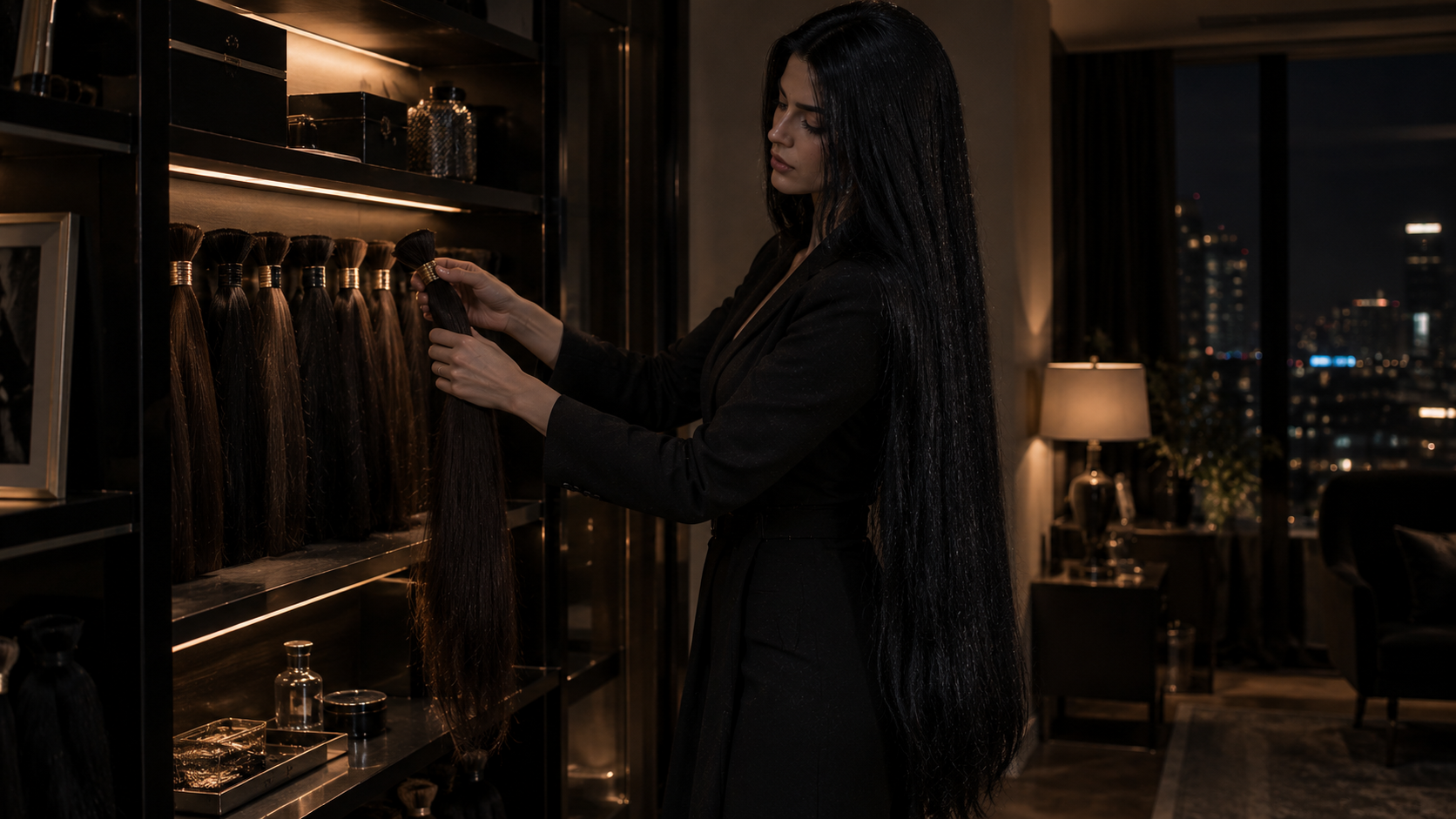
I locked the door after she left and stood in the dim studio with my hand still on the key.
The air had changed.
It held the faint sharp scent of skin and cut hair and the cleaner smell of the products I had used on her hours earlier, when the evening had still been dressed as kindness.
My own hair settled against my back as I turned.
Almost mid-thigh now.
Heavy.
Familiar.
Unmoved.
Hers was in the bin.
That would not do.
I crossed the room and opened it.
The dark brown length was still in large, coherent pieces beneath the smaller sweepings — thick, straight, the same hair I had watched from the elevator and the entrance hall and the window across the street.
I lifted the main mass out with both hands.
It was lighter than it had been on her head, and yet it still had weight.
Still had that quiet density I had noticed the first morning I properly looked at her.
I laid it on a clean towel, folded the towel over it, and set the bundle on the closed till.
Then I washed my hands.
Then I turned off the lights one by one, the way I always did, and left with the towel under my arm.
The walk home was ordinary on the surface.
Streetlight.
Cool air.
The soft drag of my hair against my coat.
Three floors below my apartment her windows were dark when I looked up from the pavement.
I did not linger.
Inside my own door I went first to the locked room.
Not the bedroom.
The other one.
The collection sat in its usual order.
Twenty-one.
Maya’s was still the newest, labelled only in the way I labelled anything that mattered: privately, precisely, without sentiment.
I unwrapped Helen’s hair on the small table under the lamp.
Even off the head it kept a kind of shape.
I smoothed it once, slowly, from the cut ends toward what had been the nape, and felt the last of the evening settle into place.
Twenty-two.
I did not stay long after that.
The hunger that had grown through the months of videos and waiting was quieter now.
Not gone.
Fed.
I locked the room and washed my face and stood for a while in the bathroom mirror with my own hair falling around me in that long black line I had never offered anyone as a pattern.
She had tried to wear a version of me.
That was the insult.
Not the watching, at first.
Watching I understood.
People watched me often enough without knowing why.
It was the imitation that turned the watching into theft.
The braid the day after mine.
The bun the day after that.
The coats that kept approaching the same cut.
The café table chosen for the view and not the coffee.
I had let it continue because I wanted to be sure.
Certainty is cleaner than impulse.
The morning I saw her on the stairs with that prop cup in her hands, I already knew.
The morning she stepped into the elevator wearing a bun that was almost right and not quite owned, I knew more.
By the time she sat across the street with her laptop angled like a shield, the decision was no longer forming.
It had formed.
What remained was only the manner of taking.
I had not planned the shape of the afternoon in detail.
I rarely do.
The empty studio had been convenient.
The voice behind her in the street had been exact.
*I think I have seen you, beautiful.*
She turned the way I expected her to turn — too fast, already preparing to flee, the nervous system ahead of the mind.
The hand on her shoulder was enough.
People like Helen do not require force at the beginning.
They require a reason to stay that sounds almost kind.
Coffee.
A name.
A remark about the outer tables.
An invitation that was not quite an invitation.
She followed me across the street because part of her had been trying to cross that street for weeks.
Inside, I let the hours do the work.
Clients.
Ordinary conversation.
Tea she barely drank.
Maya passing through with her bare head like a quiet fact in the room.
Helen looked at Maya longer than she looked at anything else except my hair.
That, too, I noted.
The treatment was the hinge.
Wash.
Product.
The long, slow combing.
Compliments that were not lies.
Her hair had been beautiful.
That was never the point.
The point was that she sat still and let my hands replace her own idea of control.
By the time I asked to play with it, she had already spent the day practising obedience without naming it.
The blinds.
The lock.
Those were not theatre.
They were the moment the evening stopped pretending to be a friendship.
The middle part was mine.
The ponytail bound with her own strand was mine.
When I asked if she had been copying me, I already had the answer in months of small proofs.
What I wanted was her mouth on it.
She tried to laugh.
Then she tried to leave.
The pull on the ponytail ended both attempts at once.
After that the truth came out of her the way truth usually does when there is nowhere left to stand — thin, wet, and too late to be useful as dignity.
I told her what she was.
Not because I needed her to understand me.
Because I needed her to understand the distance.
She had built a private religion out of my silhouette and then walked into my studio wearing the cheap version of it.
That required correction.
The rest followed from the same logic.
Clothes first.
Then the mirror.
Then the hand between her legs while I made her watch the face she had tried to improve by stealing mine.
The recording was not impulse.
It was a lock on the door she would walk out of later.
When I put the first razor in her hand I was not interested in doing the work for her.
Maya had been different.
Maya had needed the decision taken from her.
Helen needed to participate.
She had spent months making herself into an echo.
The only honest end of that was to let the echo destroy the thing it had been using to sound like me.
She pleaded.
Her hands shook.
The blades dulled and I replaced them.
She said she loved her hair.
That much I believed.
Love was not an argument.
When it was finished I had her take the rest — the last private hair, the brows that gave her face its small familiar shape — because a partial erasure would have left her a way back into the old costume.
Then I made her clean the floor.
People remember differently when they have had to gather what they lost with their own hands.
After she dressed I told her the rule.
No talking.
The video remains.
She nodded the way she had done most things that night: late, small, and without any real choice left in it.
Now, in my apartment, the building was quiet again.
I stood at the window with the lights off and let my hair hang free down my back.
The weight of it was a fact I returned to after every taking.
Hers was in the locked room.
Mine was still on me.
Three floors below, she was learning the first night of a head that no longer matched the woman she had been trying to become.
I felt no confusion about what I had done.
The jealousy had been real.
The insult had been real.
The hunger that the videos had only managed, never satisfied, had found a direction and used it.
In the morning I would open the studio as I always did.
Maya would come in with her bare head and her newer lightness.
The café across the street would fill its outer tables.
And if a bald woman in a dark coat ever sat there again with a laptop and a view of my windows, I would already know the ending.
I turned from the glass.
My hair followed a moment later, long and black and entirely my own.
The collection had grown by one.
The building had grown quieter by the same amount.
That was enough for the night.

Thanks for keeping up with my series and reading such a long story
I was feeling a bit down for a few days hence the delay but i will try to be consistent with my content
And for you guys question’s about ravens hair
I would say she is kinda the main character and her long hair is a constant reminder of stark contrast between her victims and herself
Will she be shaved 🤔
Maybe, maybe not i have thought for a finale of this series just few more stories left and you guys will find out
I know my audience and guys i promise the finale will be something that would make this series worth reading and following
Guys please let me know if stories are getting too boring or monotonous or if it needs any change
Hi, I like your series it’s nice to follow it. I went through all the numbers that you released and was on the edge and keen to read the next one. The images are also helping adding to the overall feeling.
I like the psychological part but what I would love to see is Raven getting tricked/manipulated into getting her treatment. It would be an interesting touch that there is always a bigger fish.
It’s just a suggestion I am looking forward for the next number. I hope you feel better. What are your future plans. Do you want to make another series?
Hey Bald lover thanks for following with the series and thanks for your suggestion
I have already decided about how i want it to end and i feel like you will like it so trust me and keep reading
Because the ending will be only get spicier